The New Frontier of Production: From Automation to Autonomy
Smart Manufacturing represents a fundamental paradigm shift from traditional automated production to a fully integrated, collaborative system that responds in real time to meet changing demands in the factory, in the supply network, and in the needs of the customer. While Industry 4.0 focused on connectivity and data collection, we are now entering the era of Industry 5.0, where the focus shifts toward human centricity, sustainability, and resilient autonomy.
At the heart of this shift is the concept of Shop Floor Transparency. For decades, the factory floor was a "black box" where production status was only known through manual end of shift reports or static whiteboards. Today, the integration of modern Manufacturing Execution Systems (MES) and the Industrial Internet of Things (IIoT) allows for the granular, millisecond by millisecond tracking of every asset, worker, and material movement.
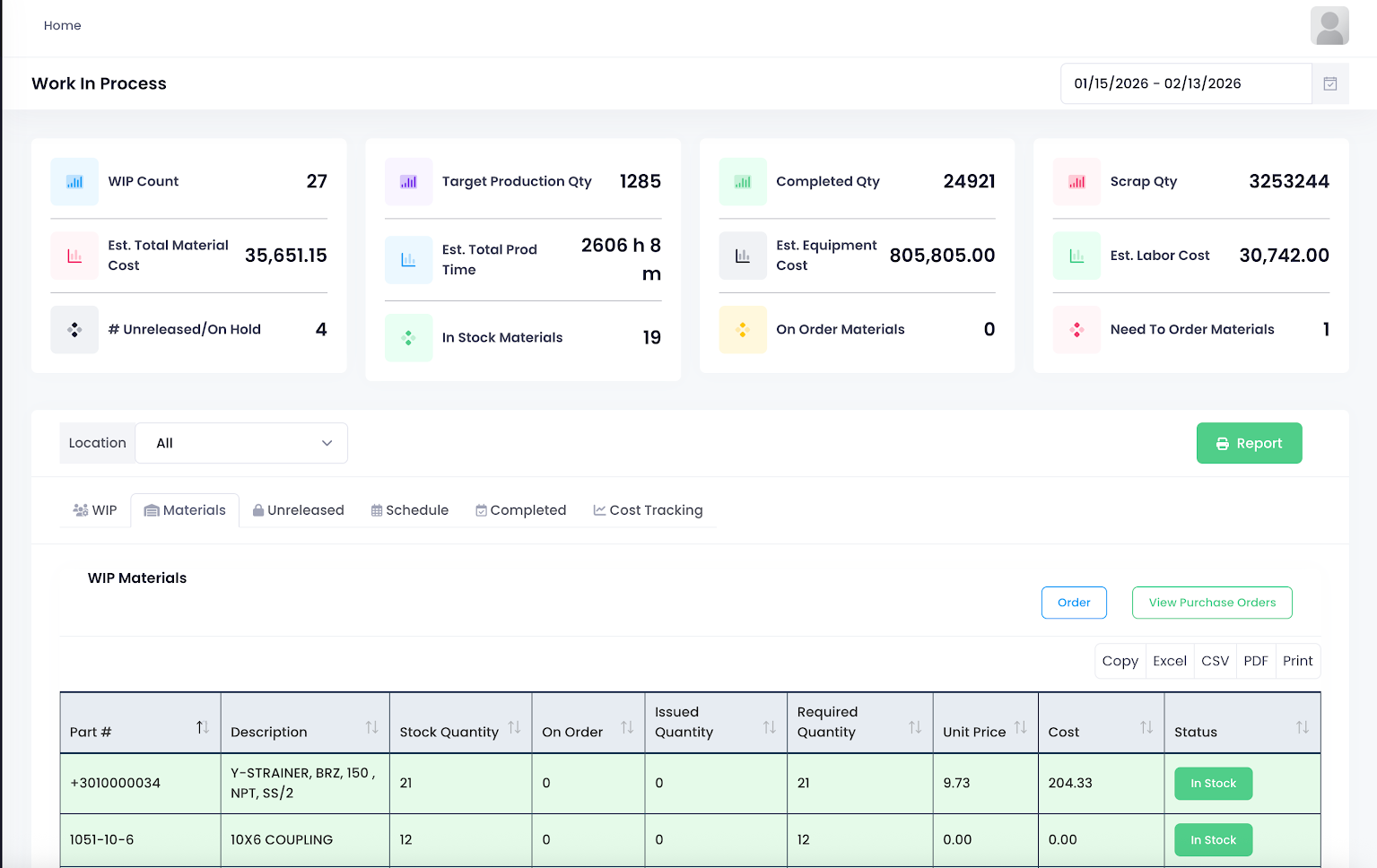
As Artificial Intelligence matures, the "Smart Factory" is evolving into a self healing, self optimizing organism. The data collected from WIP (Work in Progress) systems, as seen in Figure 1, serves as the foundational training set for AI models. By tracking the Estimated Total Production Time (over 2,600 hours in this snapshot) against the Completed Quantity, the system can automatically calculate performance variances and identify bottlenecks before they manifest on the physical line.
The Convergence of IT and OT
A critical challenge in smart manufacturing is the bridge between Information Technology (IT) and Operational Technology (OT). Traditionally, these two worlds were separate: IT managed the business systems (ERP, Email), while OT managed the shop floor (PLCs, Robotics). Smart manufacturing requires the seamless fusion of these layers.
By bringing IT standards, such as high speed networking, cybersecurity protocols, and cloud analytics, to the OT environment, manufacturers can unlock "Edge Intelligence." This allows for complex processing to occur directly on the shop floor, enabling machines to make autonomous decisions (like adjusting cutting speeds or rerouting parts) without waiting for instructions from a centralized server. This convergence is the prerequisite for high speed and high flexibility production required in the modern market.
Core Pillars of Smart Operations
Edge Intelligence & The "Job Level" Digital Thread
Deploying processing power directly to shop floor sensors allows for instantaneous data analysis and millisecond response times. This is the foundation of the "Connected Worker" and the "Connected Machine."
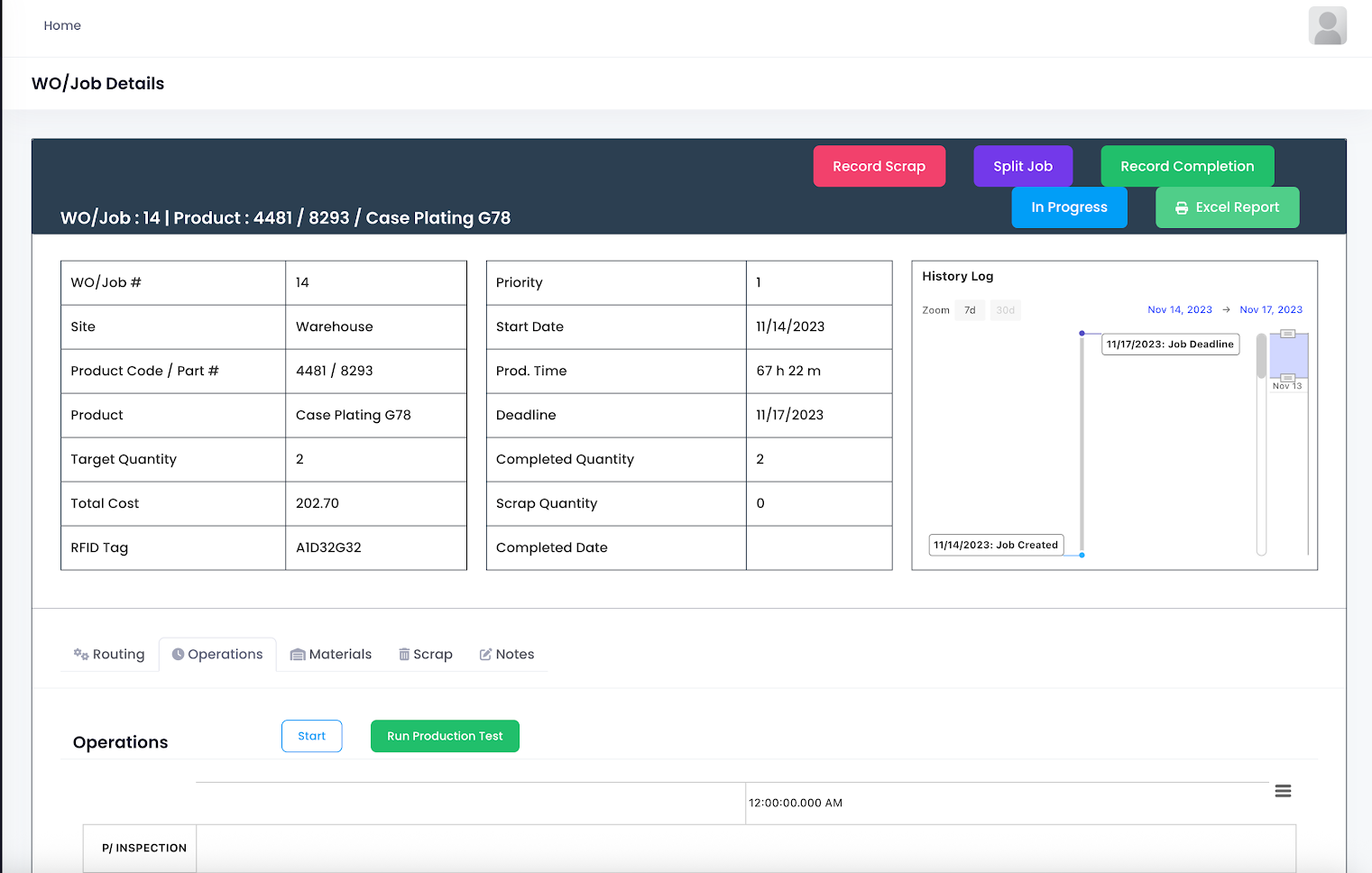
As illustrated in the detailed WO/Job Details (Figure 2), modern MES systems provide a granular "digital passport" for every production order. The interface captures critical metadata, including the specific RFID Tag (A1D32G32) assigned to the material carrier and a high fidelity History Log that tracks the job's progress against its 11/17/2023 deadline. This allows frontline operators to execute complex tasks like "Splitting Jobs" or "Recording Scrap" with a single click, ensuring that the digital record exactly matches the physical reality of the shop floor. This level of synchronization is essential for Mass Customization, where each job may have unique routing requirements and quality gates.
Just In Time Material Replenishment
A smart manufacturing system must do more than track production; it must orchestrate the entire supply ecosystem to ensure that the line never stops due to a missing component.
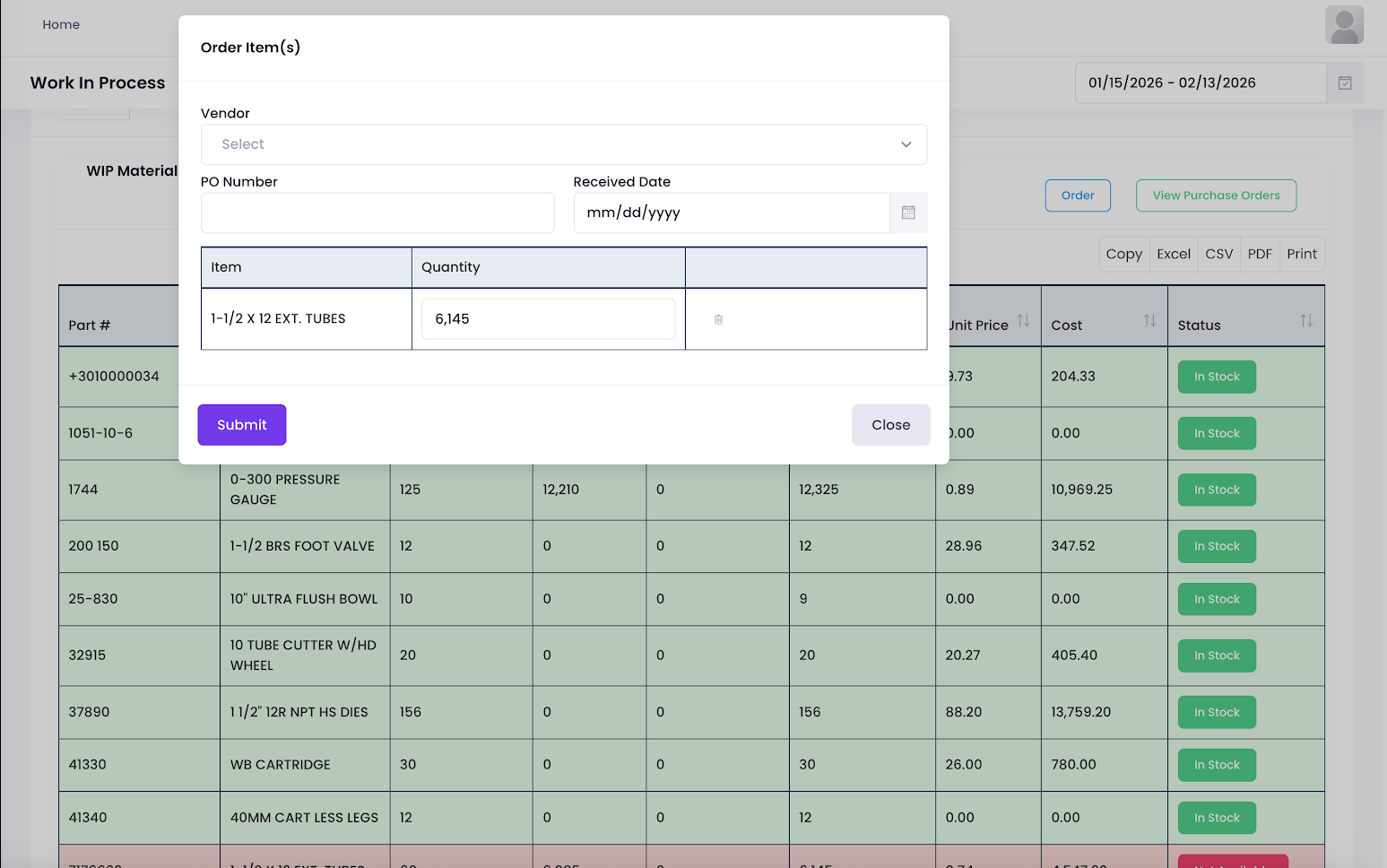
The integration of procurement tools directly into the WIP environment (Figure 3) eliminates the "Information Silo" between the shop floor and the purchasing department. When an operator identifies a shortage of a critical component, such as the "1 1/2 x 12 EXT. TUBES" shown in the order modal, they can trigger a Purchase Order (PO) request immediately. The system automatically links this request to the active Job ID and the preferred Vendor, ensuring that replenishment is synchronized with the actual production schedule. This "Material Ledger Integration" is the key to minimizing safety stock while maintaining 100% production uptime.
Sustainability & The Green Factory
Smart manufacturing is intrinsically linked to sustainability. By reducing waste (scrap), optimizing energy consumption, and extending machine life, digital systems are the primary tool for achieving ESG (Environmental, Social, and Governance) goals.
An intelligent MES can coordinate production schedules to take advantage of off peak energy pricing or prioritize jobs for machines that are currently running at peak energy efficiency. This "Green Orchestration" reduces the carbon footprint of every part produced, a requirement that is increasingly being mandated by global regulators and eco conscious consumers alike.
Measurable Impact
Enterprises adopting these intelligent frameworks report significant improvements across key performance indicators:
- OEE Increase: Average improvement of 15-20% through optimized machine utilization.
- Quality Yield: 30% reduction in scrap and rework via real time vision inspection systems.
- Energy Efficiency: 12% decrease in power consumption through AI driven load balancing.
Advanced Analytics: Turning Data into OEE
Overall Equipment Effectiveness (OEE) is the gold standard for measuring manufacturing productivity. By integrating WIP data with machine telemetry, Smart Manufacturing systems provide a real time OEE score that is broken down into three critical components: Availability, Performance, and Quality.
Availability: Eliminating Unplanned Downtime
Through the WIP dashboard (Figure 1), managers can identify machines that are sitting idle due to material shortages or changeover delays. In a traditional factory, these "micro stops" often go unrecorded, but in a smart environment, they are captured and categorized, allowing for targeted process improvements.
Performance: Optimization of Cycle Times
By comparing real time processing speeds against the theoretical "standard rate" defined in the Product Master (analyzed in our previous paper), the system can detect subtle performance degradation. This allows engineers to fine tune machine parameters or provide additional training to operators who are struggling with specific complex assemblies.
Quality: Zero Defect Manufacturing
Digital WIP systems enable "In Process Quality Checks." Rather than waiting for a batch to be finished before inspection, the system can enforce quality gates at each workstation. If a critical tolerance is not met, the job is automatically quarantined in the system, preventing the waste of downstream labor and materials on a defective part.
The Future Outlook: Autonomous Manufacturing
The convergence of 5G, AI, and robotics is creating a landscape where manufacturing is no longer a linear process but a dynamic service. Success in this era requires a commitment to continuous technological integration and a robust digital core.
We are moving toward "Dark Factories" where routine operations are handled by autonomous mobile robots (AMRs) orchestrated by the very WIP and MES systems we have analyzed today. In this future, human workers shift from "doers" to "orchestrators," spending their time on high value activities like process innovation and custom engineering.