Operational Friction Is the Hidden Cost of Disconnected Systems
As organizations grow, they often add more systems to solve more problems. Sales adopts one tool, finance uses another, operations manages its own workflows, production depends on separate execution data, and management receives reports assembled from multiple sources. Each system may work well inside its own department, but the business still slows down when information does not move across the enterprise.
This hidden drag can be described as Operational Friction. It is the cost created when teams spend time reconciling records, waiting for updates, repeating manual entry, searching for status, and making decisions with incomplete context. Unlike payroll, inventory, or equipment cost, operational friction does not appear as a single line item. It shows up through slower response, duplicated work, missed handoffs, delayed reporting, and decisions made after the business has already moved.
A mid-sized manufacturer operating four facilities may spend more than 30% of weekly planning meetings reconciling differences between production, inventory, and procurement reports before the team can make decisions. The issue is not a lack of data. The issue is that the data does not form a shared operating view.
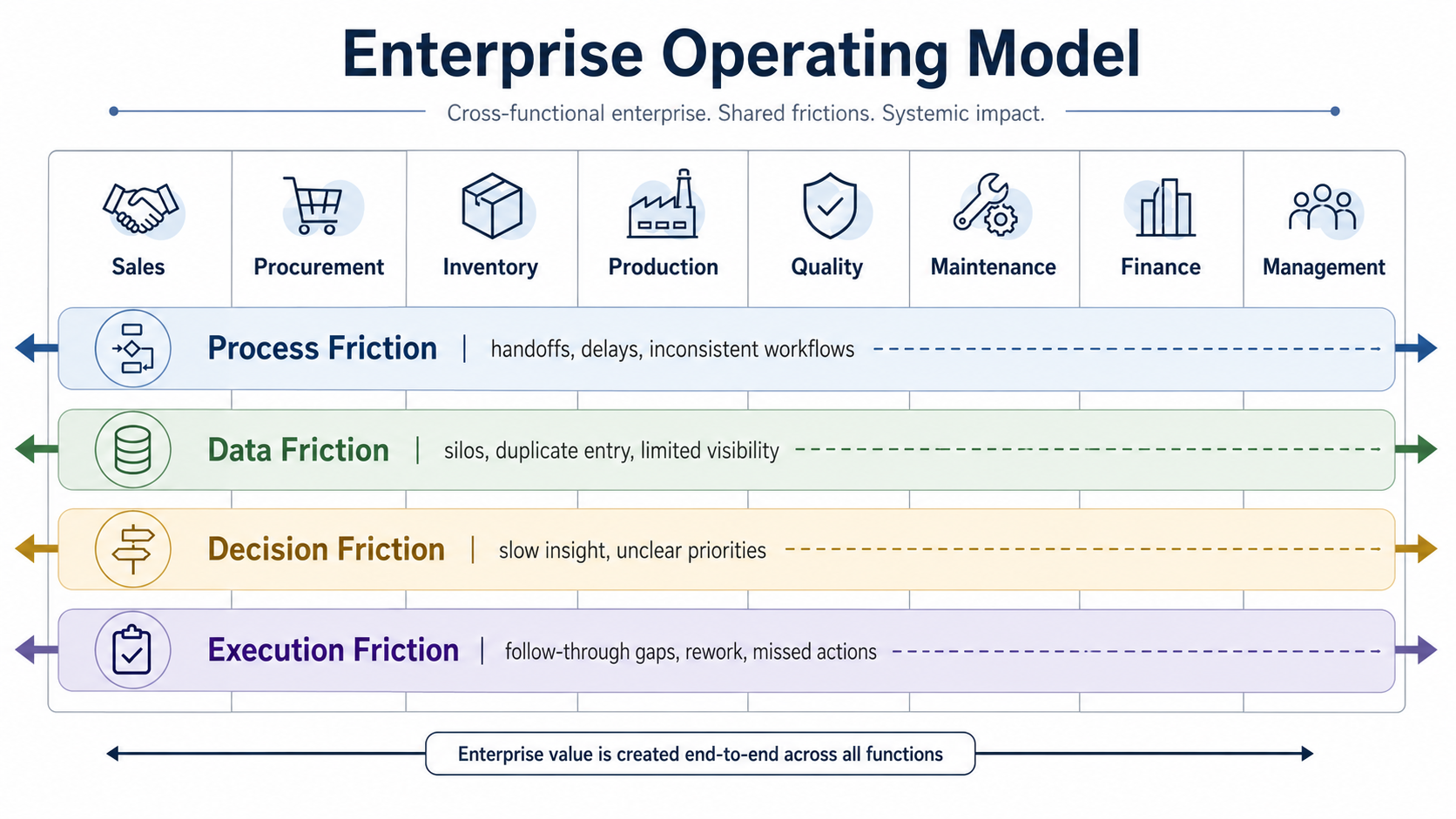
Operational friction usually appears in four forms:
Process friction: workflows stop at departmental boundaries.
Data friction: teams maintain different versions of the same business record.
Decision friction: management sees risks after they have already affected operations.
Execution friction: frontline activity does not update planning, reporting, or management visibility fast enough.
Modern Industry Software Platforms create value by reducing these four types of friction. The goal is not to replace every system immediately. The goal is to create a connected operating layer where processes, data, decisions, and execution can work together. By anchoring separate applications within a unified operational architecture, the platform bridges functional silos, guiding cross-functional teams toward continuous workflow harmony before isolated data gaps turn into costly misalignments. Hard rule: Make it impossible for critical business decisions to depend on information that exists only inside one department. Business benefit: faster coordination, less duplicated work, better decision timing, and stronger enterprise visibility.
Shared Operational Records Create One Business Reality
Many organizations maintain multiple versions of the same business information. Customer records exist in CRM, spreadsheets, and finance systems. Product data may be updated by engineering while procurement continues using older supplier information. Inventory availability may look different to sales, warehouse, and production teams. When each department works from a different version of reality, cross-functional decisions become slower and less reliable.
A modern Industry Software Platform creates a shared operational record around the business objects that drive daily work. This does not mean every department loses its own workflow. It means that key business records remain connected across the enterprise, so each team can act from the same underlying context.
Core operational records typically include:
Customers and accounts
Products and configurations
Suppliers and purchase commitments
Inventory and availability status
Assets and maintenance records
Work orders and production orders
Projects and cost records
Quality holds and exceptions
For example, a customer order should not belong only to sales. The same order should influence inventory allocation, procurement needs, production planning, quality requirements, shipping priorities, and revenue forecasting. Sales, operations, and finance may use different views, but they should not be working from disconnected facts.
This is where platform value becomes practical. A shared operational record reduces the need to reconcile data manually, prevents different teams from maintaining separate versions, and gives management more confidence in the information behind decisions. Hard rule: Make it impossible for departments to maintain conflicting operational versions of the same customer, product, inventory, asset, or order record. Business benefit: improved data consistency, faster cross-functional coordination, reduced administrative effort, and more reliable reporting.
Event-Driven Workflows Turn Signals Into Action
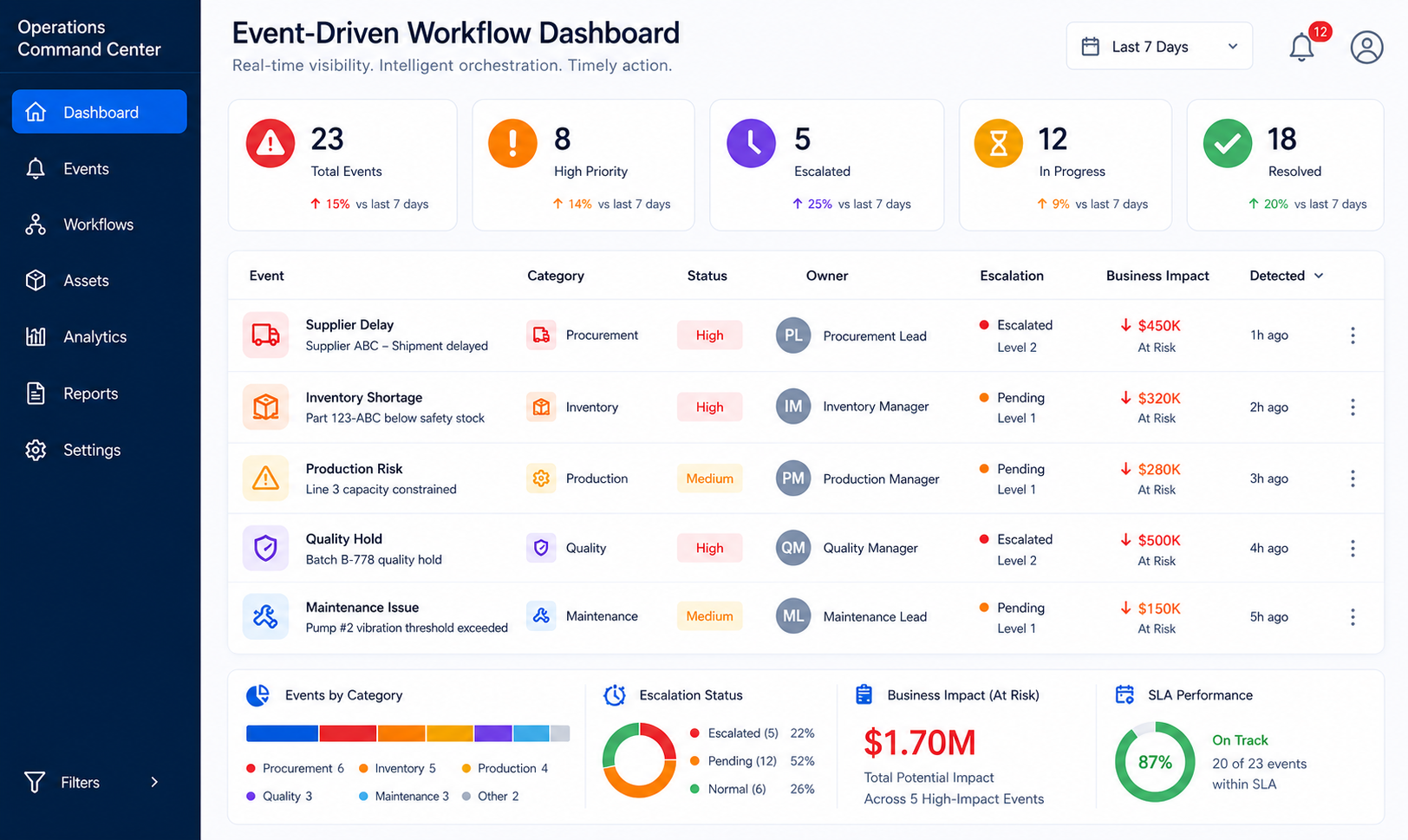
Many systems record events after they happen. A supplier shipment is delayed. A production order falls behind. A quality hold is issued. A maintenance work order remains open. A customer delivery promise becomes at risk. The problem is that these events often remain local until someone notices them, reports them, or escalates them.
A connected platform should convert operational events into workflow action. When a material shortage affects a production order, the system should alert planning and procurement. When a quality hold blocks shipment, sales and customer service should see delivery risk. When maintenance downtime affects production capacity, management should see the operational impact before the next meeting.
Event-driven workflow is especially valuable because it reduces the time between issue creation and response. A distributor connecting inventory, purchasing, warehouse activity, and sales commitments may reduce emergency replenishment requests by nearly 25% when low-stock and late-supplier events automatically trigger review instead of waiting for manual inventory checks.
Event-driven workflows should connect the most business-critical signals:
Inventory below planning threshold
Supplier delivery delay
Production schedule change
Quality hold or inspection failure
Maintenance downtime
Budget or cost threshold breach
Customer order at delivery risk
The goal is not to create more alerts. The goal is to make important signals actionable, assigned, and traceable before they become business results. Hard rule: Make it impossible for critical operational events to remain without owner, status, escalation path, and business impact. Business benefit: faster issue response, fewer missed handoffs, stronger accountability, and earlier risk control.
Business Rules Create Operational Control
Most organizations already know what should happen in their business. Purchase orders above budget should require approval. Products on quality hold should not ship. Production should not start without required materials. Maintenance work should not close without verification. The real challenge is making these rules part of daily execution rather than depending on memory, email, or informal follow-up.
Modern Industry Software Platforms should turn business rules into control gates. A gate prevents a business action from moving forward until required conditions are satisfied. A hold pauses activity when risk is present. A lock protects sensitive or high-impact records from uncontrolled change. These rules make operations more consistent without requiring managers to monitor every transaction manually.
Examples of practical control rules include:
Procurement gate: prevent purchase orders above budget threshold without approval.
Inventory hold: prevent customer promises when required inventory is blocked or unavailable.
Quality lock: prevent shipment when unresolved quality holds remain open.
Production gate: prevent work order release when materials, capacity, or instructions are incomplete.
Maintenance lock: prevent critical work order closure without inspection verification.
These rules are more valuable than dashboards alone. Dashboards show what happened or what is happening. Control gates shape what is allowed to happen next. Hard rule: Make it impossible for high-risk business actions to proceed without required approval, evidence, owner, and workflow status. Business benefit: stronger process discipline, reduced operational risk, better compliance, and fewer preventable errors.
Technical Architecture Should Support Operational Change
Connected operations require more than a polished user interface. They require a platform architecture that can adapt as processes, systems, teams, and business models change. This matters especially for growing organizations that already have ERP, CRM, finance, warehouse, manufacturing, maintenance, or industry-specific systems in place.
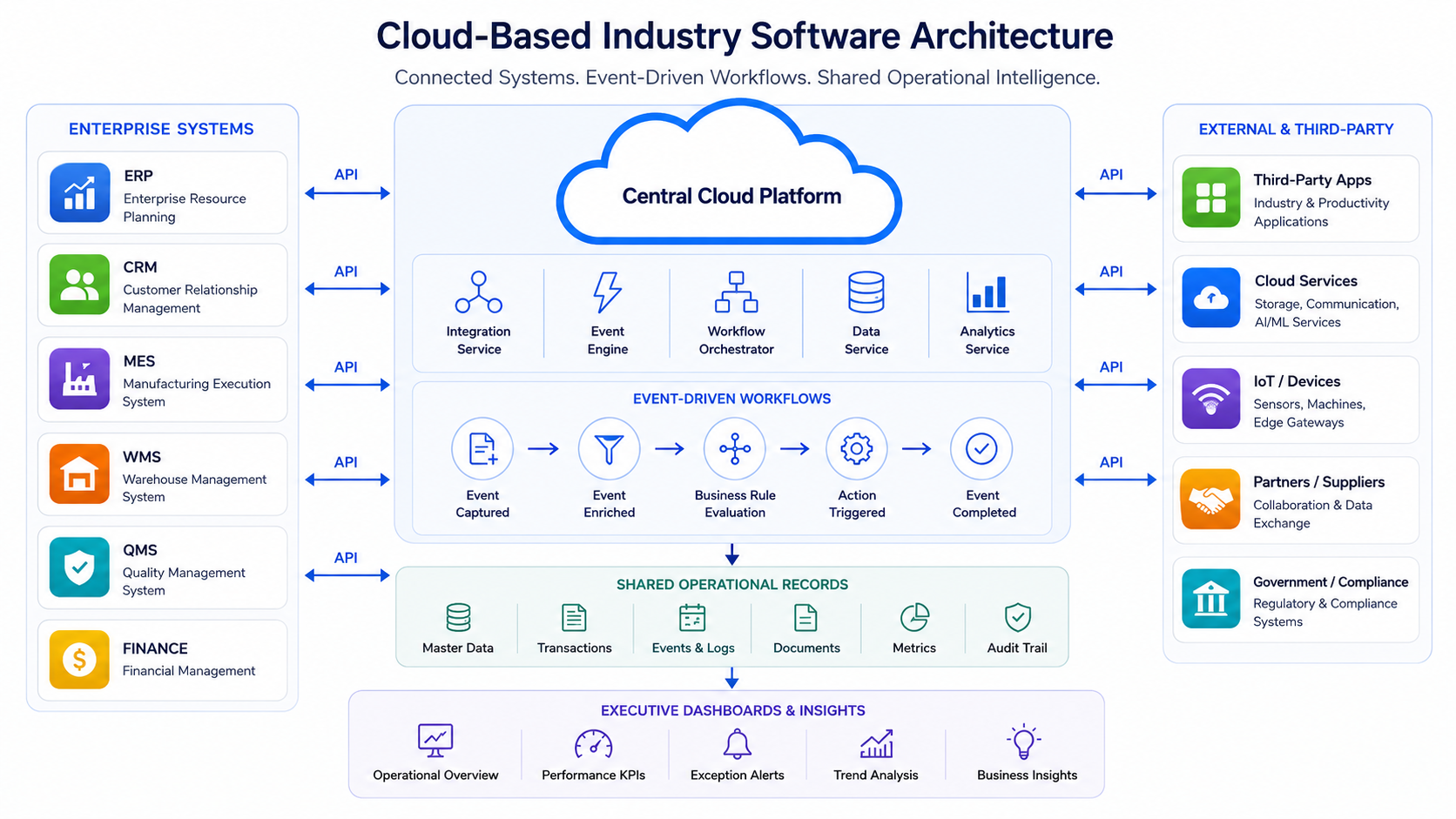
A modern Industry Software Platform should not force every organization into a rigid template. It should support connection, configuration, and phased rollout. API-first integration allows systems to exchange information without rebuilding everything at once. Event-driven workflows allow operational changes to trigger actions automatically. Role-based visibility allows different teams to work from the same business object while seeing the information relevant to their responsibilities.
The strongest platforms usually combine several technical foundations:
API-first integration for connecting ERP, CRM, MES, WMS, QMS, finance, and third-party systems
Configurable workflow engine for approvals, exceptions, reviews, and escalations
Shared operational records for customers, products, assets, suppliers, orders, and inventory
Event-driven automation for turning operational signals into assigned actions
Role-based access control for secure cross-functional collaboration
Cloud-based deployment for faster access across teams, sites, and locations
Real-time dashboards for management visibility into workflow status and performance
These are not technical details for the sake of technical detail. They determine whether the platform can support real operations. A system that cannot integrate, configure, or scale will eventually create another silo. Hard rule: Make it impossible for platform growth to depend on disconnected workarounds, repeated manual exports, or full system replacement for every new workflow. Business benefit: lower technology risk, faster implementation, better scalability, and stronger long-term return on software investment.
Decision Velocity Turns Visibility Into Performance
Management visibility is valuable only when it improves decision timing. Many companies have dashboards, but leaders still act late because dashboards show outcomes rather than decision signals. Revenue has already been delayed, inventory has already accumulated, production has already missed target, or quality issues have already reached customers.
A connected platform should improve Decision Velocity: the speed at which an organization can identify, understand, assign, and act on operational risk. This concept is more useful than simply asking whether reports are available. A report may exist, but if it arrives after the decision window has closed, it does not improve performance.
Decision velocity improves when business events become visible in context. A supplier delay is not only a procurement issue if it affects customer orders. A maintenance failure is not only a maintenance issue if it limits production capacity. A quality hold is not only a quality issue if it delays shipment and revenue recognition.
Management should be able to answer:
Which customer commitments are at risk?
Which operational issues affect revenue or cost today?
Which suppliers, assets, or workflows create the greatest exposure?
Which approvals or holds are blocking execution?
Which owners must act before risk becomes financial impact?
Which process changes would improve performance fastest?
Without this view, leaders manage through delayed reporting. With connected decision visibility, they can intervene while outcomes can still be changed. Business benefit: faster leadership intervention, stronger operational prioritization, better resource allocation, and improved business performance.
Industry Scenarios Show Where Platforms Create Value
Connected operations are easiest to understand through real operating scenarios. The value is not abstract. It appears when organizations reduce delays, avoid rework, improve service levels, and make decisions earlier. A discrete manufacturer connects sales orders, inventory availability, production schedules, quality holds, and shipment status into one operating view. Before the platform, planners discovered delivery risk during daily meetings after collecting updates from several systems. After connecting the workflow, order release delays move from a three-day review cycle to same-day exception review, and emergency schedule changes decrease by 28%. The company does not become more efficient because it has more data. It becomes more efficient because order risk is visible earlier.
A distribution company connects warehouse inventory, procurement commitments, customer orders, and replenishment rules. Before the change, slow-moving inventory was reviewed quarterly while stockout risk was handled through emergency purchasing. After the platform connects demand, inventory, and supplier signals, stockout-related order delays decrease by 19%, while slow-moving inventory review becomes part of monthly planning. The platform helps the company balance availability and working capital instead of reacting to one problem at a time. These scenarios show the practical value of connected operations. The platform reduces operational friction by making important relationships visible: orders to inventory, inventory to procurement, procurement to delivery, quality to fulfillment, and execution to management decisions.
Why Organizations Choose Industry Software
Organizations choose Industry Software when disconnected operations create too much delay, manual work, and management uncertainty. The value is not simply deploying another application. The value is creating a connected operating layer that helps teams manage processes, data, decisions, and performance with stronger control.
Industry Software is designed to support practical transformation. Companies can begin with one priority workflow, such as inventory control, CRM, warehouse operations, manufacturing execution, quality management, asset maintenance, ERP workflows, or project operations. As the business matures, additional modules and workflows can be connected without forcing a full replacement strategy.
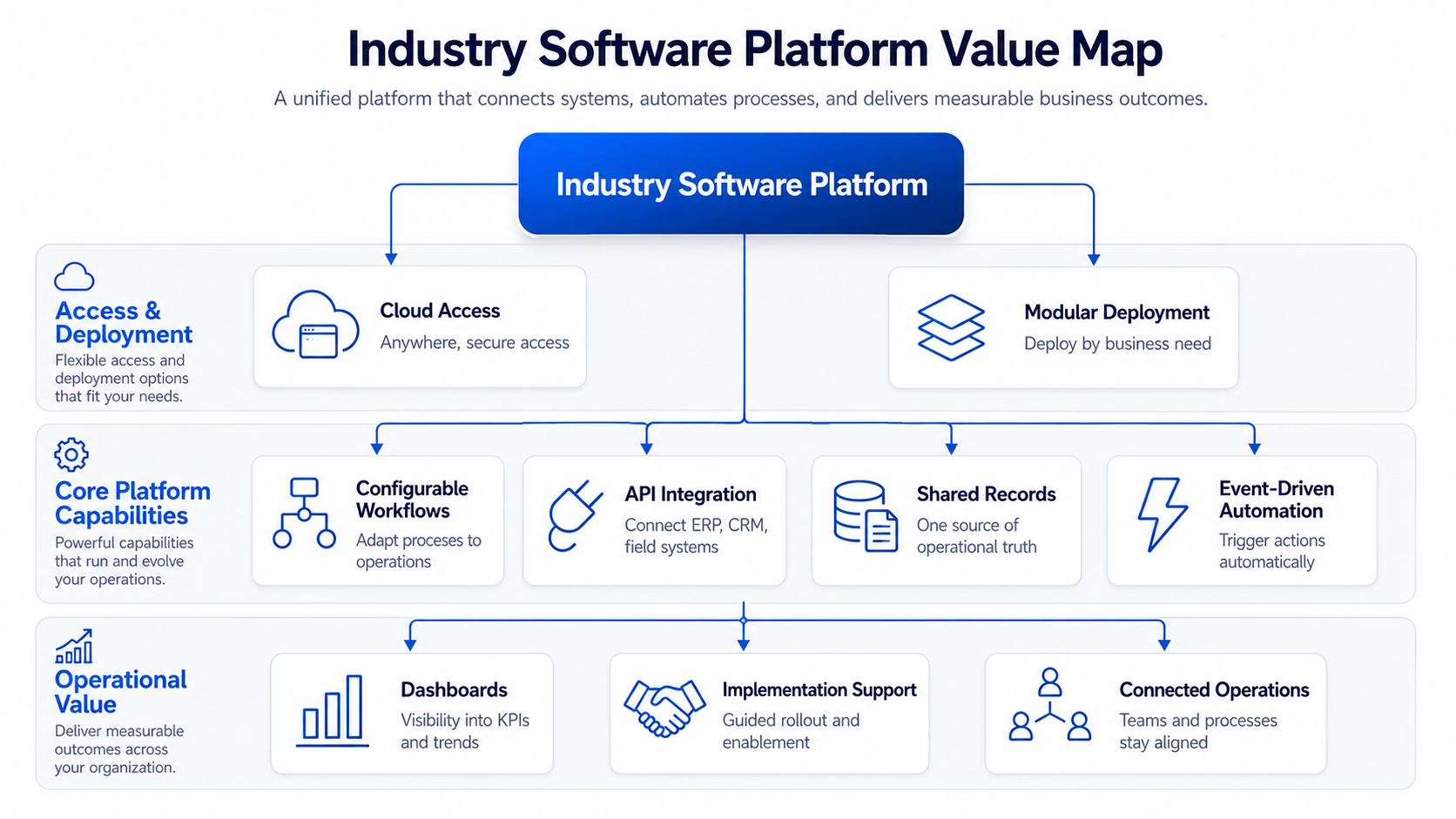
Industry Software supports connected operations through:
Cloud-based access across teams, locations, and devices
Modular deployment so companies can start with priority workflows and expand gradually
Configurable workflows for approvals, gates, holds, locks, exceptions, and escalations
Shared operational records that reduce duplicate entry and inconsistent data
API-first integration with existing business systems and third-party tools
Event-driven workflow automation that turns operational signals into action
Role-based visibility for sales, operations, finance, management, and frontline teams
Real-time dashboards that connect workflow status, owners, exceptions, and business impact
Dedicated implementation support for workflow design, data setup, reporting, training, and optimization
Ongoing configuration support as processes, teams, and business priorities evolve
This combination is important because most organizations do not need a one-time software installation. They need a platform that can grow with the business. Industry Software helps companies move from isolated systems toward connected operational control, one workflow at a time.
Hard rule: Make it impossible for digital transformation to become a collection of disconnected tools without shared records, workflow controls, integration strategy, and ongoing support. Business benefit: faster adoption, lower implementation risk, stronger scalability, better operational control, and clearer value from software investment.
Final Summary
Modern Industry Software Platforms create value by reducing operational friction across the enterprise. They connect processes, data, decisions, and execution so organizations can move faster, control risk earlier, and improve performance with greater confidence. Industry Software helps organizations build this foundation through cloud-based access, modular deployment, configurable workflows, shared operational records, API-first integration, event-driven automation, real-time visibility, and dedicated implementation support. The goal is not only to digitize operations. The goal is to create a connected operating environment where better decisions happen sooner.