Business Risk Starts Before the Report Shows It
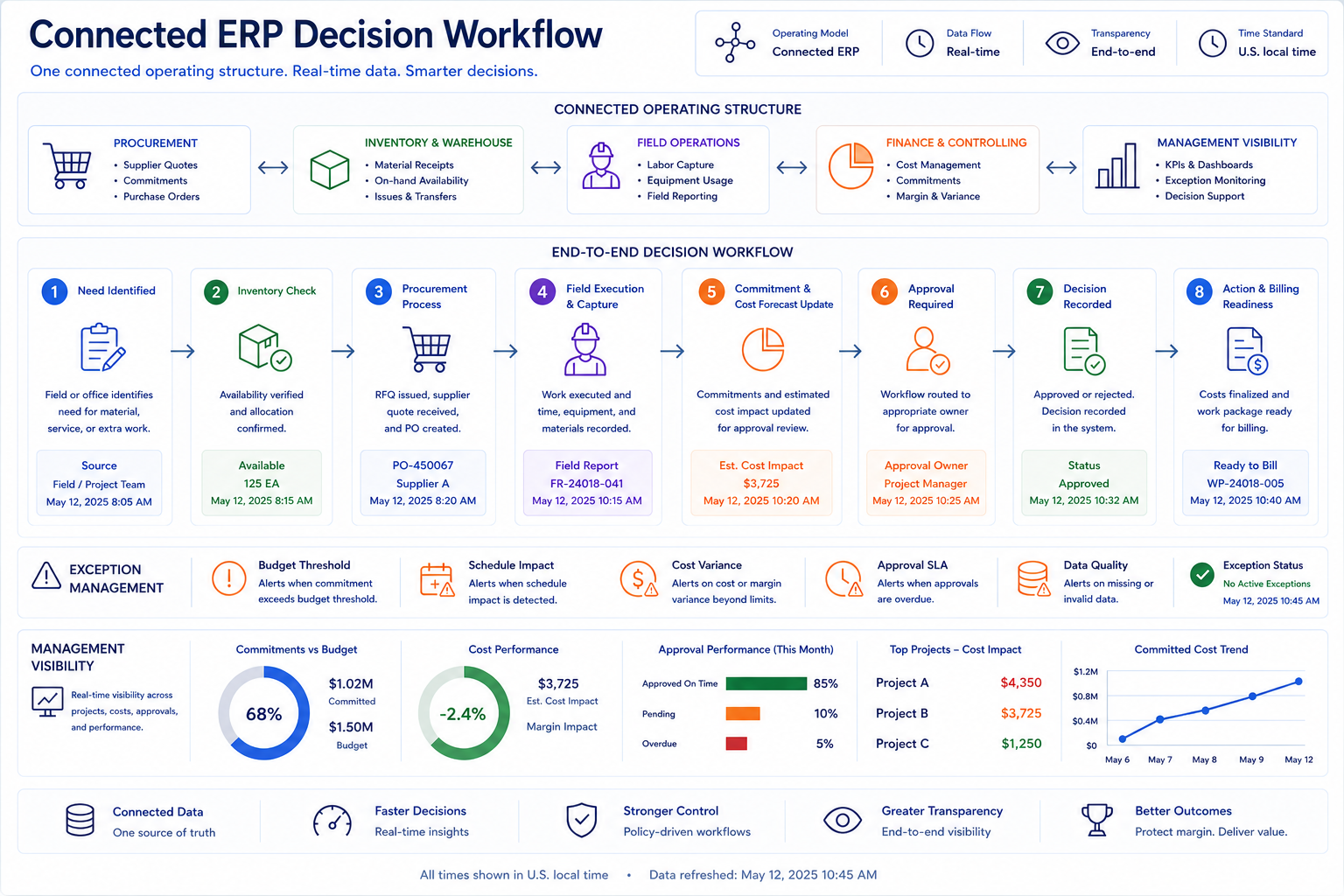
Many companies already use business software, but management still discovers problems too late. Procurement commits spending before finance sees the cost impact. Inventory is reserved or blocked before sales realizes delivery is at risk. Field teams complete extra work before the project forecast changes. Finance then explains the result after the business has already absorbed the impact.
Consider an engineering services company managing field projects, procurement, inventory, and billing across multiple locations. Before improving ERP workflow control, procurement cost overruns were often discovered during month-end review, unbilled field changes accumulated in spreadsheets, and project margin issues appeared after invoices had already been processed. After connecting procurement approvals, inventory promise rules, mobile field updates, and finance readiness checks, purchase-over-budget visibility moved from month-end to PO approval, project margin variance decreased by 18%, month-end preparation time fell by 42%, and unbilled field changes decreased by 31%.
The improvement did not come from more reporting. It came from earlier control. ERP becomes valuable when it prevents disconnected actions from becoming financial surprises. Hard rule: Make it impossible to approve a business action that creates cost, delivery, billing, or reporting risk without owner, status, approval path, and business impact visibility. Business benefit: Earlier risk visibility, fewer management surprises, stronger accountability, and faster correction before problems become financial results.
The Operational Decision Risk Score
ERP should help management understand when operational decisions are creating business risk before the numbers reach financial reporting. A practical way to evaluate that risk is through an Operational Decision Risk Score. Operational Decision Risk Score = (Committed Cost + Delivery Risk + Field Variance) ÷ (Approval Readiness + Evidence Completeness). For example, a project has $240,000 in committed cost above forecast, a delivery risk score of 70, and $18,000 in field labor variance. Approval readiness is 80, and evidence completeness is 75. Operational Decision Risk Score = (240,000 + 70 + 18,000) ÷ (80 + 75) = 1,665.
The exact number is less important than the comparison across projects, departments, or operating periods. A rising score shows that cost, delivery, and field execution risks are accumulating faster than approvals and supporting evidence are being completed. This gives management an earlier signal than waiting for month-end reporting. Business benefit: Better risk prioritization, earlier management intervention, stronger project control, and more reliable financial visibility.
Enterprise Control Gates
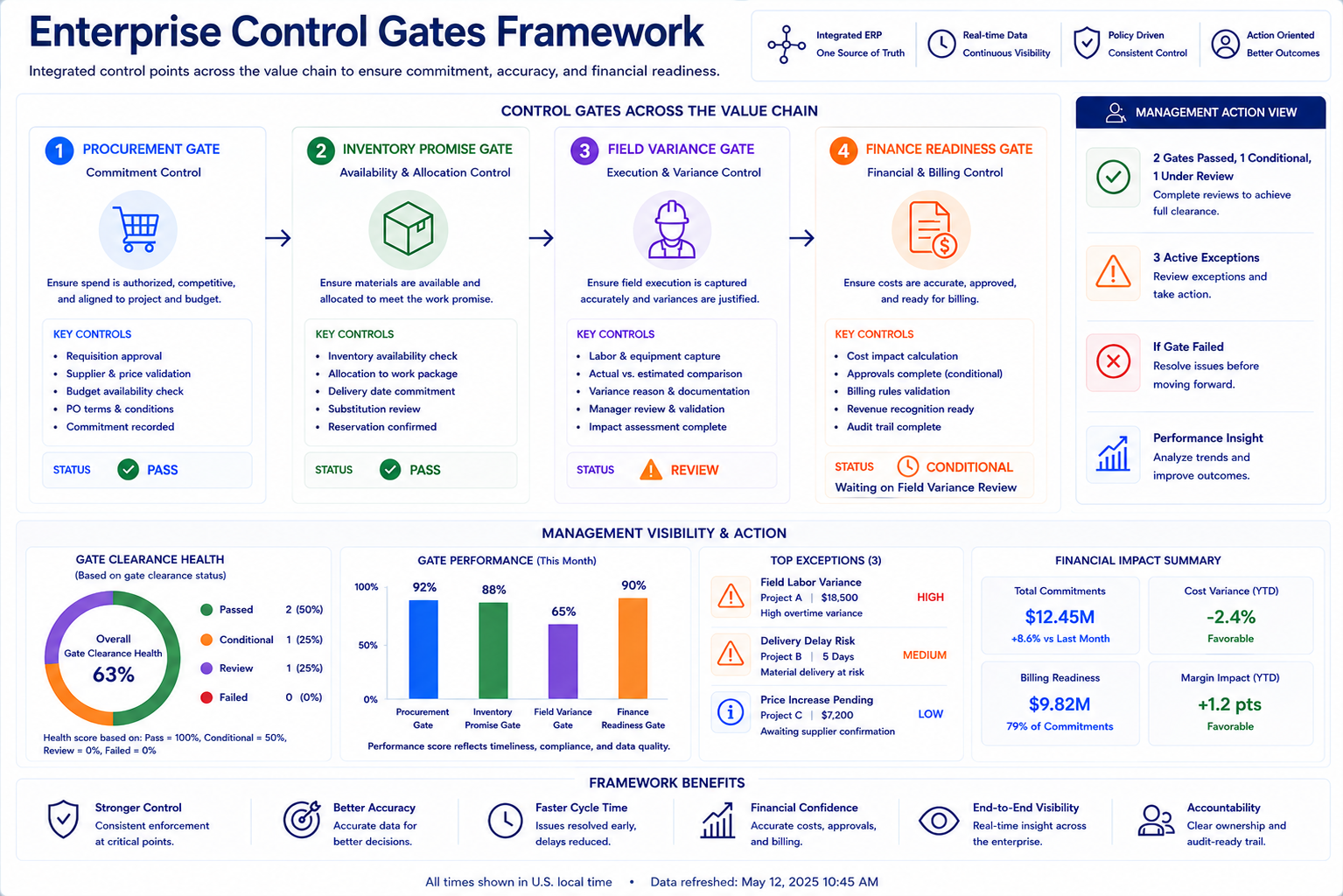
Modern ERP should not only record transactions. It should enforce operating discipline through control gates. An Enterprise Control Gate is a rule-based checkpoint that prevents high-risk actions from moving forward until required conditions are satisfied. By anchoring operational compliance in systemic checks, the platform provides guardrails for cross-functional workflows, guiding teams toward structured evaluation before complex business processes advance to the next stage.
The most useful ERP control gates are usually tied to the business moments where risk first appears:
Procurement Gate: purchase commitments cannot exceed budget thresholds without approval and forecast review.
Inventory Promise Gate: customer delivery cannot be promised when inventory is blocked, reserved, under inspection, or outside the shipment window.
Field Variance Gate: extra labor, material usage, or scope changes must trigger cost and billing review.
Finance Readiness Gate: reporting periods cannot be marked ready while approvals, documents, or exception ownership remain incomplete.
These gates turn ERP from a system of record into a system of operational control. Teams do not need to wait for reports to discover problems. The system prevents risky actions from progressing without visibility, ownership, and review. By embedding policy governance directly into the transactional flow, the platform creates an active layer of accountability, guiding the organization toward structured oversight before minor process deviations accumulate into commercial liabilities.
Procurement Commitments Should Update Cost Risk Before Invoices Arrive
Procurement is often where future cost risk begins. A supplier quote may exceed the original estimate. A subcontractor may exclude freight, testing, installation, or support materials. A long-lead item may need to be ordered earlier than planned. If these details remain inside procurement until invoices arrive, management sees the cost risk too late.
A stronger ERP workflow treats purchase orders as committed cost, not only future invoices. When a quote is approved, the system should compare it with the budget, update committed cost, show exclusions, and route over-budget commitments for approval. This gives project managers and finance a live view of where the forecast is moving.
A practical project cost view should include:
Actual cost
Committed cost
Cost to complete
Pending change exposure
Approved budget and margin target
Hard rule: Make it impossible to release a purchase order above budget threshold without approval, forecast review, and responsibility assignment. Business benefit: Better margin protection, fewer budget surprises, improved cash planning, and more time to renegotiate, substitute, or adjust scope.
Inventory Availability Should Control Customer Promises
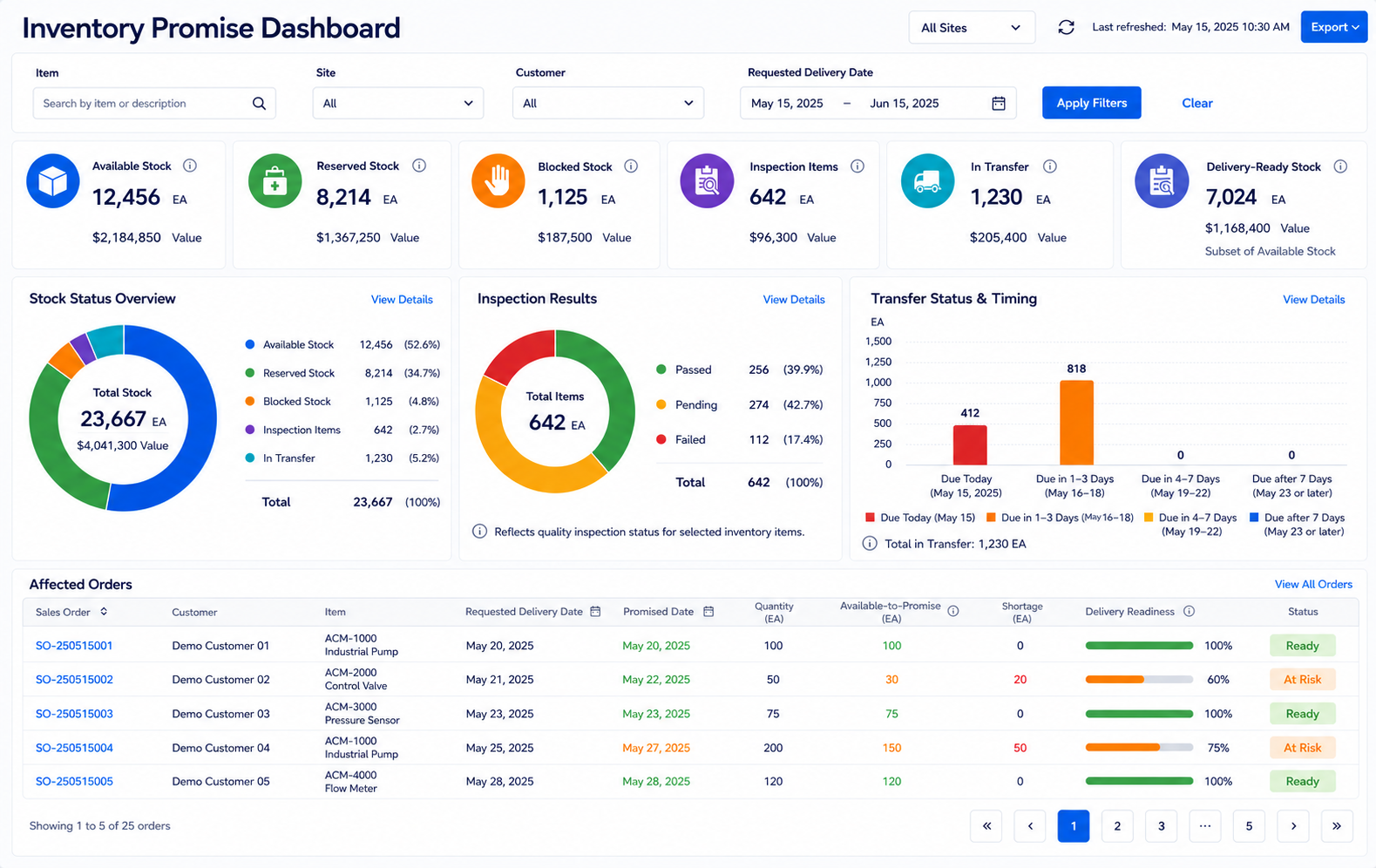
Inventory visibility is not the same as delivery readiness. A company may have stock in the system, but that stock may be reserved, blocked, under inspection, damaged, in transit, or located in the wrong warehouse. If sales only sees quantity, customer promises can become unreliable.
Modern ERP should use available-to-promise logic to control what inventory can support a customer commitment. The system should separate available, reserved, blocked, in-transit, and inspection inventory. It should also consider warehouse location, transfer timing, shipment window, and customer priority before delivery is confirmed.
ERP inventory promise controls should include:
Available-to-promise calculation
Reserved and blocked inventory status
Inspection and quality status
Warehouse location and transfer timing
Affected order visibility when stock changes
Hard rule: Make it impossible to promise a customer delivery date when required inventory is blocked, reserved, under inspection, or unavailable within the shipment window. Business benefit: Fewer wrong delivery promises, lower emergency purchasing, better customer reliability, and stronger inventory discipline.
Field Work Should Update Cost, Billing, and Forecasts
Field teams often see business changes first. A service technician uses extra parts. A project crew spends more labor hours than planned. A site supervisor records an issue that affects schedule, cost, or billing. If these updates stay in messages, paper forms, or separate tools, office teams react too late.
Modern ERP should turn field updates into business signals through mobile field capture and workflow automation. Labor usage should update cost to complete. Extra work should trigger change order or billing review. Material variance should affect cost control. Site issues should appear in project and management views before month-end.
For example, if a field task was planned for 400 labor hours but uses 520 hours at $75 per hour: Labor Variance = (520 − 400) × $75 = $9,000. That variance exists immediately. Waiting until month-end only delays correction. Hard rule: Make it impossible to close a field task, service job, or project phase while extra work, material variance, or unresolved site issues remain without owner, approval status, and billing decision. Business benefit: Reduced revenue leakage, better forecast accuracy, faster issue resolution, and stronger field-office coordination.
Finance Needs Evidence Before Close
Finance teams often discover missing evidence at the worst possible time. A purchase lacks approval. A project cost has no owner. A billing milestone is not ready. An inventory adjustment lacks support. A cost variance has no explanation. The report can still be produced, but confidence behind it is weak.
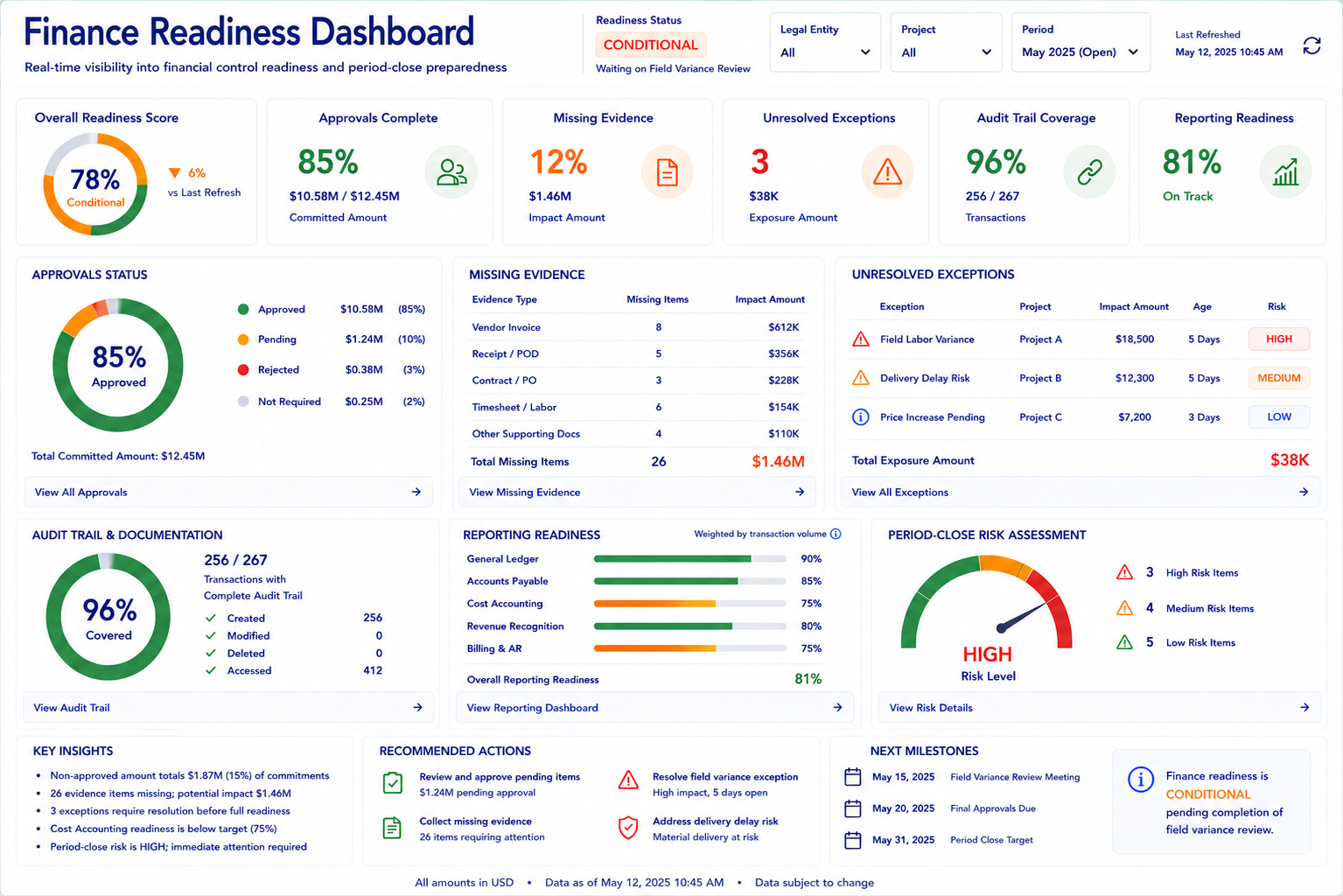
Modern ERP should help finance check reporting readiness before close. The system should show incomplete approvals, missing documents, unresolved exceptions, and unassigned records before they become month-end pressure. Finance should not have to chase every department manually to confirm whether data is ready.
ERP finance readiness controls should include:
Reporting readiness status by workflow
Missing evidence alerts
Approval completion tracking
Exception ownership and aging
Audit trail linkage between transactions and supporting records
Hard rule: Make it impossible to mark a reporting period as ready when revenue, cost, inventory, or project records still have missing evidence, unresolved approvals, or unassigned exceptions. Business benefit: Faster close preparation, fewer manual reconciliations, stronger audit support, and higher confidence in management reporting.
Management Needs an Action View, Not Another Dashboard
Management does not need another dashboard full of totals. Leaders need to know what requires action. A useful ERP action view should show which workflow is blocked, which cost is moving, which delivery promise is at risk, which approval is overdue, and who must respond.
A management action view should answer:
Which procurement commitments exceed budget?
Which orders are at delivery risk because of inventory?
Which projects are moving below target margin?
Which field exceptions affect billing or cost?
Which approvals are delaying progress?
Which records are not ready for reporting?
Which owner must act today?
Without this view, teams explain problems after the fact. Invoices reveal cost overruns, customers reveal delivery gaps, finance finds missing evidence, and management reacts after the result is already visible. With connected ERP workflows, management sees risk while it can still be corrected. Business benefit: Faster decisions, clearer accountability, earlier risk control, and better cross-team alignment.
Why Companies Buy Industry Software
Companies buy Industry Software when they need ERP to solve real operating problems, not just store business records. The value is not a long feature list. The value is a practical operating structure that connects workflow, rule, owner, status, evidence, and business impact.
Industry Software supports connected ERP operations through:
Configurable workflow engine for approvals, exceptions, review paths, and escalation rules
Modular deployment so companies can start with procurement, inventory, field operations, finance readiness, or management action views
Cloud-based access for office, field, warehouse, finance, and management users
Real-time committed cost tracking across procurement, project budgets, and forecasts
Available-to-promise logic for customer delivery control
Field-to-office mobile capture for labor, materials, photos, notes, and site exceptions
Exception management with owner, status, aging, and business impact
Audit trail visibility linking transactions, approvals, evidence, and reporting readiness
Integration layer for connecting ERP data with CRM, inventory, field service, finance, and operational systems
Dedicated implementation support for workflow setup, dashboard refinement, reporting changes, and user adoption
Without this structure, teams discover problems after the fact. With Industry Software, companies can see procurement risk, inventory promise risk, field exceptions, finance readiness gaps, and management action items before they become business results. Companies do not buy Industry Software only to digitize records. They buy it to make better decisions earlier, protect margins, improve delivery reliability, reduce month-end pressure, and give management a clearer way to control the business.
Key Metrics and Calculation Summary
Modern ERP should help teams measure operating risk before it becomes a financial result. These simple metrics give management a practical way to monitor cost, delivery, field execution, and close readiness. By embedding these early indicators directly into the transaction layer, the platform illuminates subtle operational variances, guiding management toward proactive adjustments before hidden vulnerabilities impact the bottom line.
Operational Decision Risk Score = (Committed Cost + Delivery Risk + Field Variance) ÷ (Approval Readiness + Evidence Completeness)
Used to identify where operational risk is accumulating faster than controls are being completed.
Forecast Cost = Actual Cost + Committed Cost + Cost to Complete + Pending Change Exposure
Used to evaluate project or order cost risk before invoices arrive.
Labor Variance = (Actual Labor Hours − Planned Labor Hours) × Labor Rate
Used to identify field cost exposure as soon as work is performed.
Close Readiness Rate = Complete Records ÷ Total Required Records × 100%
Used to determine whether finance has enough evidence, approvals, and exception status to support close.
These metrics do not need to become complex analytics projects. They help organizations move from after-the-fact reporting to earlier operational control. By tying evaluation criteria directly to daily business transactions, the platform gives leadership immediate visibility, guiding teams toward ongoing operational adjustments before small workflow variances turn into larger performance gaps.
Hard Rule Checklist for ERP Control
A connected ERP environment should enforce business discipline without slowing down valid work. The following rules help organizations reduce preventable cost, delivery, billing, and reporting risk. By grounding day-to-day operations in structured cross-checks, the platform provides flexible guardrails for routine execution, guiding teams toward consistent management habits before minor process omissions affect downstream accounting.
Make it impossible to release a purchase order above budget threshold without approval and forecast review.
Make it impossible to promise delivery when inventory is blocked, reserved, under inspection, or unavailable within the shipment window.
Make it impossible to close field work when labor variance, material variance, or extra scope remains unresolved.
Make it impossible to mark a reporting period ready when approvals, evidence, or exception ownership remain incomplete.
Make it impossible for project forecasts to ignore committed cost and pending change exposure.
Make it impossible for management action items to remain without owner, status, and due date.
Make it impossible for finance, procurement, inventory, and field teams to maintain disconnected records for the same business event.
Final Summary
Modern ERP software creates value when procurement, inventory, finance, and field workflows operate through shared rules and connected visibility. The goal is not only to record what happened. The goal is to help companies control what is starting to happen before it becomes cost loss, delivery failure, reporting pressure, or management surprise.
Industry Software helps organizations build this operating structure through configurable workflows, modular deployment, cloud-based access, real-time committed cost tracking, available-to-promise logic, field-to-office mobile capture, exception management, audit trail visibility, and dedicated implementation support.