Quality Management Software: How to Stop Quality Issues Before They Reach Delivery

Summary
×Quality Issues Move Forward When Control Points Are Disconnected
A product can pass through several internal steps before anyone realizes it should not have moved. A batch with an unresolved quality hold may reach packing. A reworked unit may be marked complete before retest evidence is attached. A supplier defect may be recorded during incoming inspection but never connected to the next purchase order, production run, or shipment decision.
This is where delivery risk begins. The issue is not always that the company lacks inspection. The deeper issue is that inspection results, production status, warehouse movement, rework decisions, and delivery release are not controlled by the same workflow. When these control points are disconnected, a known quality risk can continue moving as if it were normal product. A stronger quality process should answer one question before anything moves forward: is this item truly allowed to continue? If the answer depends on a message, spreadsheet note, verbal confirmation, or someone remembering to check a folder, the risk is already too high.
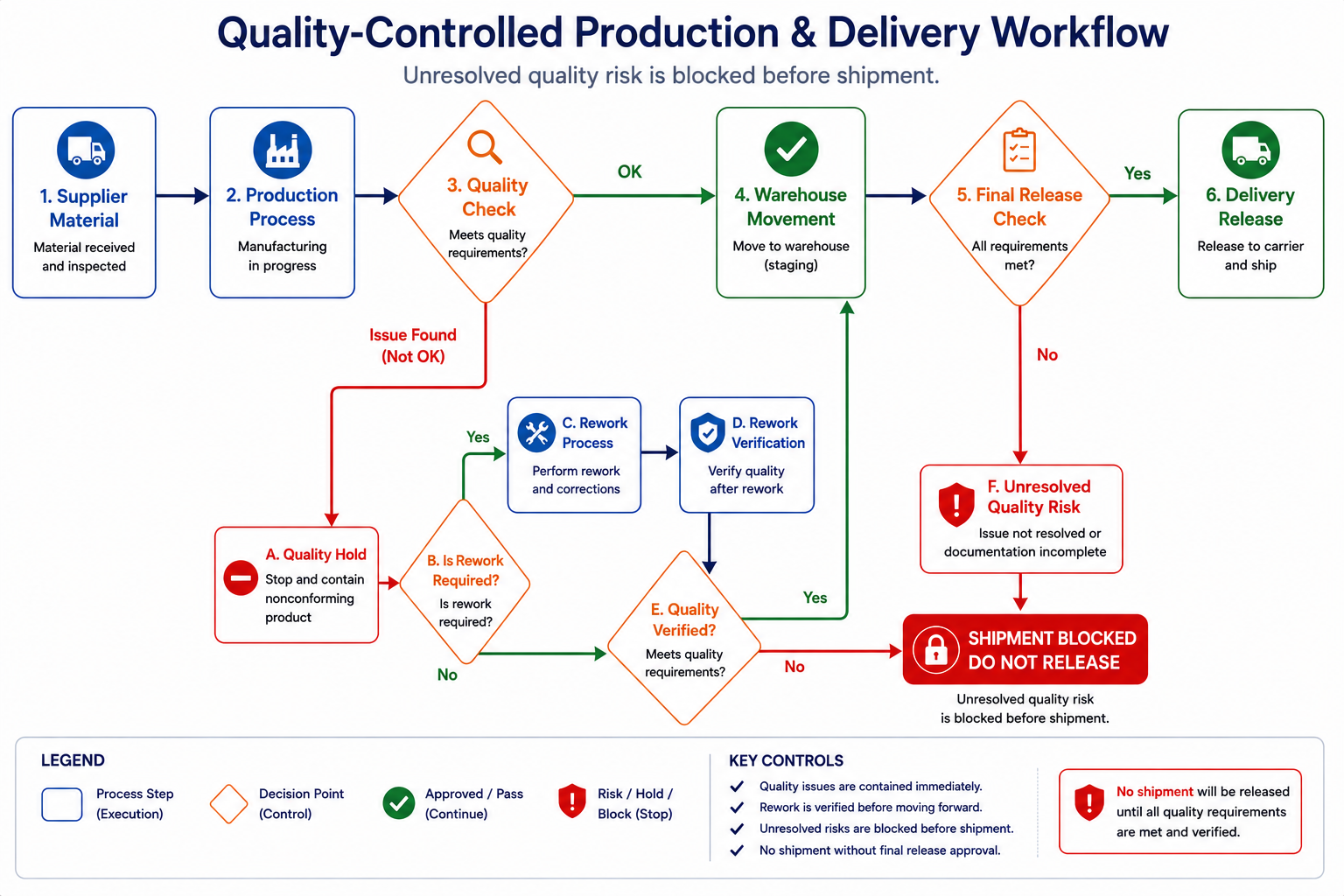
Automotive Components Need Batch Containment
For automotive component suppliers, one defect can represent a wider batch risk. A dimensional issue, material mismatch, coating defect, torque failure, or surface treatment problem may affect parts produced during the same shift, from the same material lot, or under the same machine setting. If the system only records the failed inspection result, related parts may continue moving into warehouse or customer allocation.
The control point is batch containment. When a defect is confirmed, the system should immediately show whether related inventory is still on the line, already in finished goods, reserved for a customer order, or packed for shipment. The team should not need to manually search across production logs, warehouse records, and order lists while the product continues moving.
For this type of operation, better quality software should control the decision path:
Freeze the affected batch before warehouse release
Identify customer orders connected to that batch
Block shipment until disposition is approved
Allow partial release only when the released scope is clearly separated
Keep the approval trail for customer review, internal audit, or future claims
This is not just better documentation. It is the difference between finding one defect and preventing a batch issue from becoming a delivery dispute, customer sorting request, warranty exposure, or repeat production problem. By elevating traceability from a passive record into an active operational layer, the system helps quality teams isolate containment risks early, curbing the momentum that carries localized floor failures toward systemic commercial liabilities.
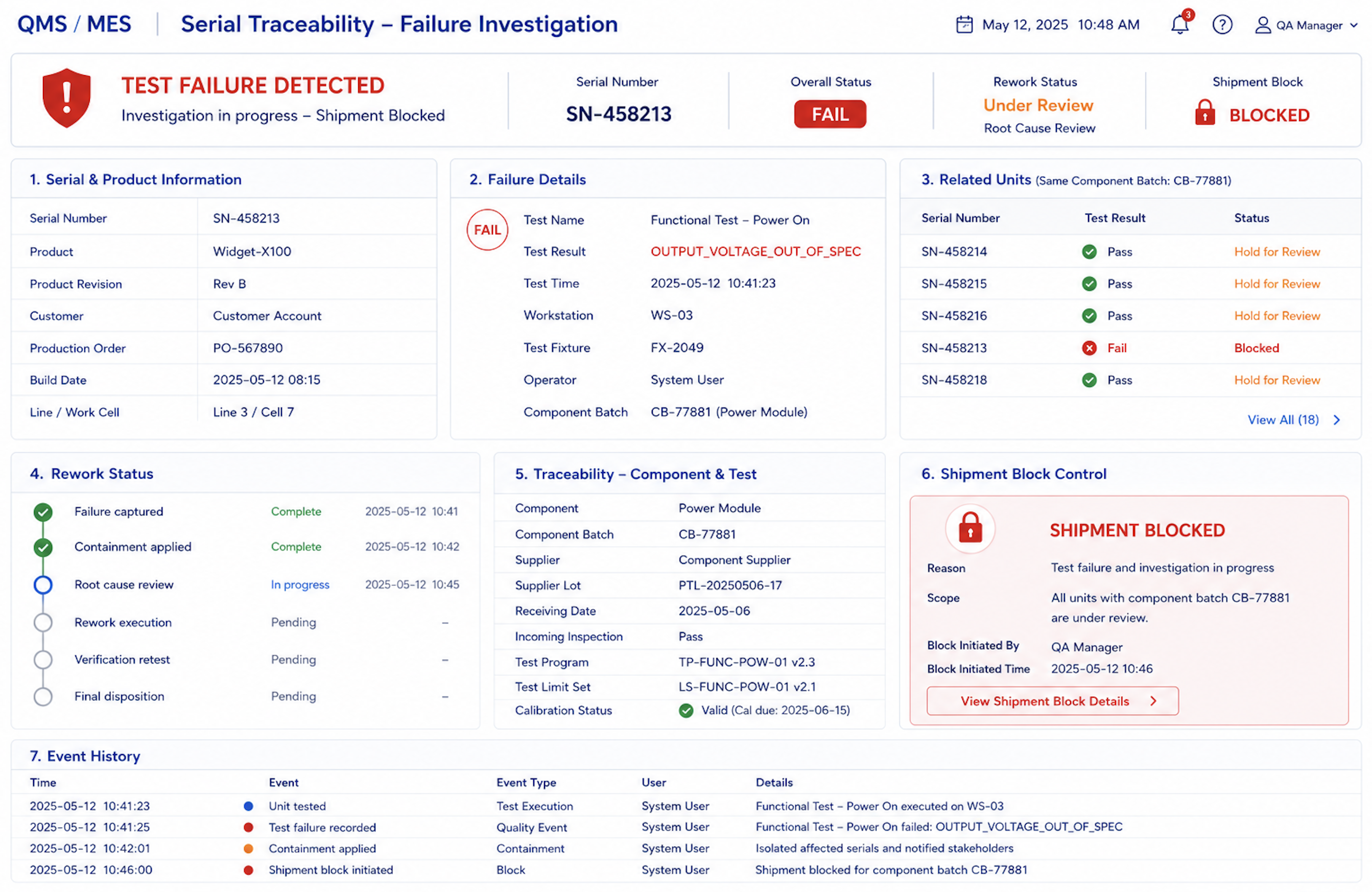
Electronics Assembly Needs Serial-Level Traceability
Electronics assembly has a different risk pattern. A failed test may appear on one unit, but the cause may connect to a component reel, soldering process, firmware version, operator station, or test fixture. If the software cannot trace from defect to serial number and process condition, the team may hold too much product or release units that share the same hidden risk.
The control point is traceability at the right level. A failed serial number should not only create a defect record. It should show which units were built under the same condition, which test step failed, whether the same failure repeated on the same fixture, and whether any related units are already packed or staged for delivery.
For electronics manufacturers, the system should support decisions such as:
Hold one serial number, a serial range, or the full production run
Compare the failed unit with other units from the same component batch or station
Require retest evidence before reworked units are released
Block shipment when related serial numbers still require review
Escalate repeated test failures to engineering or process review
The value is precision. The company should not freeze everything because impact is unclear, and it should not release questionable units because investigation is too slow. Quality control becomes stronger when traceability directly supports containment decisions. By grounding material hold actions in verifiable batch records, the platform provides engineering teams with the data resolution needed to narrow down containment scopes, shifting the operation away from guesswork toward evidence-driven risk management.
Packaged Goods Need Label and Packaging Release Control
For packaged goods, the product may be correct while the delivery is still wrong. A wrong label, incorrect date code, mismatched batch number, missing customer marking, or wrong packaging version can create a serious shipment issue even when the product itself passes inspection. These problems often happen because packaging checks are treated as records, not as release conditions.
The control point is shipment release. If the required label verification is not complete, the order should not be released. If the packaging version does not match the customer requirement, the system should stop the shipment before it reaches the dock. If a date code or lot code is missing, delivery readiness should stay blocked until the evidence is corrected.
For packaged goods companies, the system should connect product batch, packaging material, customer order, label version, lot code, date code, inspection result, and final release approval. The solution is not telling operators to be more careful. The solution is making it impossible for the wrong packaging evidence to support a release decision. This is where quality software moves from inspection support to delivery control.
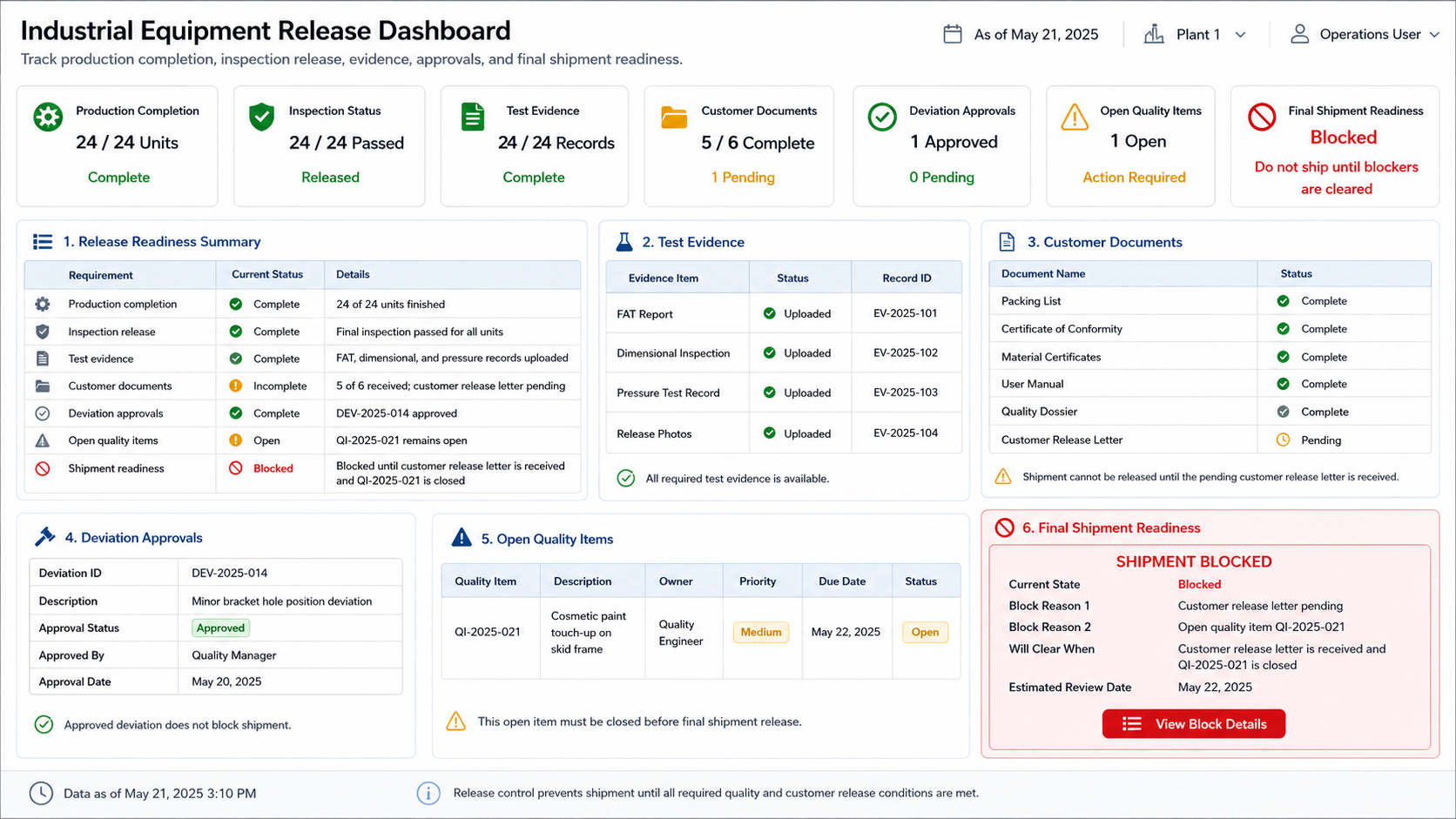
Industrial equipment needs final acceptance evidence
Industrial equipment and machinery companies often deal with custom specifications, long production cycles, factory acceptance tests, inspection reports, photos, certificates, deviation approvals, and customer-specific release requirements. The product may be physically complete, but still not ready to ship. The risk is not always a defect; sometimes the risk is incomplete acceptance evidence.
The control point is release readiness. A machine should not be treated as ready for delivery only because production has finished. If test documents are missing, customer-specific inspection records are incomplete, deviations are not approved, or certificate packages are not ready, shipment should remain blocked.
For industrial equipment manufacturers, the system should make the distinction clear:
Physically complete means production work is finished
Quality complete means inspections, tests, deviations, and documents are closed
Ready to ship means customer and internal release requirements are fully satisfied
This distinction matters because many delivery delays happen after production completion. A management team may think the equipment is ready, while quality, documentation, or customer approval is still open. Better quality software makes that gap visible before the shipment date becomes a crisis.
Better Quality Software Controls What Happens Next
Basic quality tools often focus on recording what happened. That is useful, but not enough when the goal is to stop quality issues before delivery. A more effective quality management system must connect quality status to movement, release, ownership, and evidence. The most important difference is control. If a batch is on hold, warehouse should not be able to ship it. If rework is incomplete, the item should not move to final release. If a supplier issue affects active production, procurement and planning should see it before the next order depends on the same material. If customer documentation is missing, the system should not show the shipment as ready.
The strongest quality workflow should control a few critical decisions:
What cannot continue moving?
What cannot ship?
What needs verification?
What evidence is missing?
Who has authority to approve release?
Which repeated issue requires corrective action?
Management Needs a Delivery Risk View
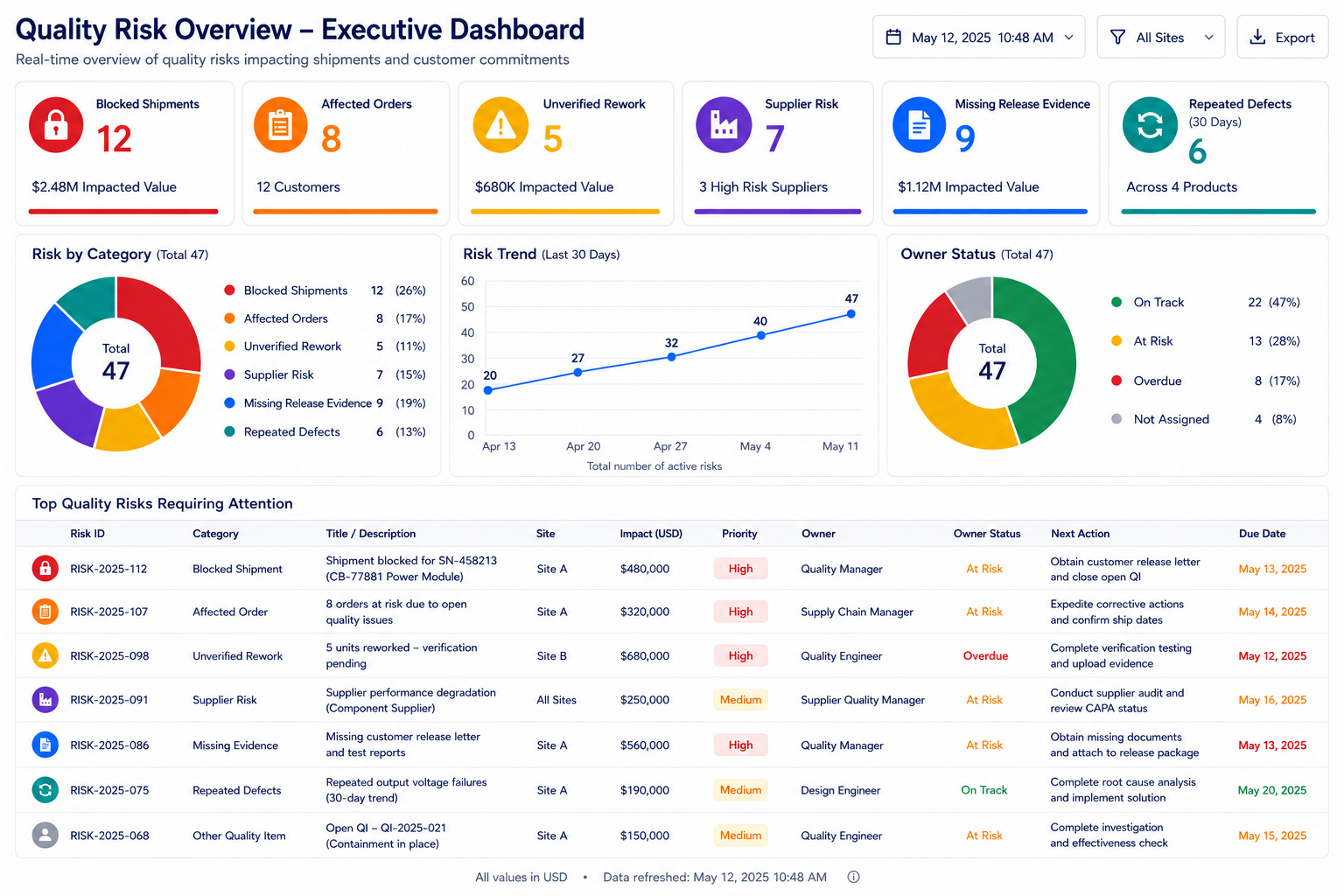
Management does not need another dashboard that only shows defect counts after the fact. Leaders need to know which orders cannot ship, why they cannot ship, who owns the next action, and whether the same problem is repeating. That is the difference between quality reporting and quality control.
A useful management view should show blocked shipments first. It should separate supplier-related risk, batch hold risk, unverified rework, missing release evidence, repeated defects, and customer-specific approval gaps. This allows managers to focus on delivery risk instead of reviewing every minor quality activity.
The dashboard should answer direct questions:
Which customer orders are blocked by quality today?
Which batches, lots, or serial numbers are affected?
Which rework items are complete but not verified?
Which suppliers are creating active delivery risk?
Which final release packages are missing documents or approval?
Which repeated issues should become corrective action?
How Industry Software Supports Quality Control Before Delivery
Industry Software helps companies connect inspection, traceability, rework, supplier quality, and release control into one practical quality workflow. The platform supports configurable quality rules, shipment blocking, batch and serial tracking, release evidence, and management dashboards, so teams can see what cannot move forward and why.
Industry Software also offers key advantages for growing enterprises:
Modular customization to start with the most urgent quality workflow
Cloud-based access for teams across production, warehouse, quality, and management
Dedicated service team for implementation and workflow optimization
Ongoing after-sales support as business needs evolve
Cost-effective value with flexible deployment and practical functionality
Industry Software has helped multiple enterprises optimize quality processes, strengthen delivery control, and improve operational visibility. By turning quality management from passive recordkeeping into active process control, Industry Software supports companies in building more reliable operations and a stronger foundation for long-term growth.