Reliability Should Be Managed Before Failure Becomes Downtime
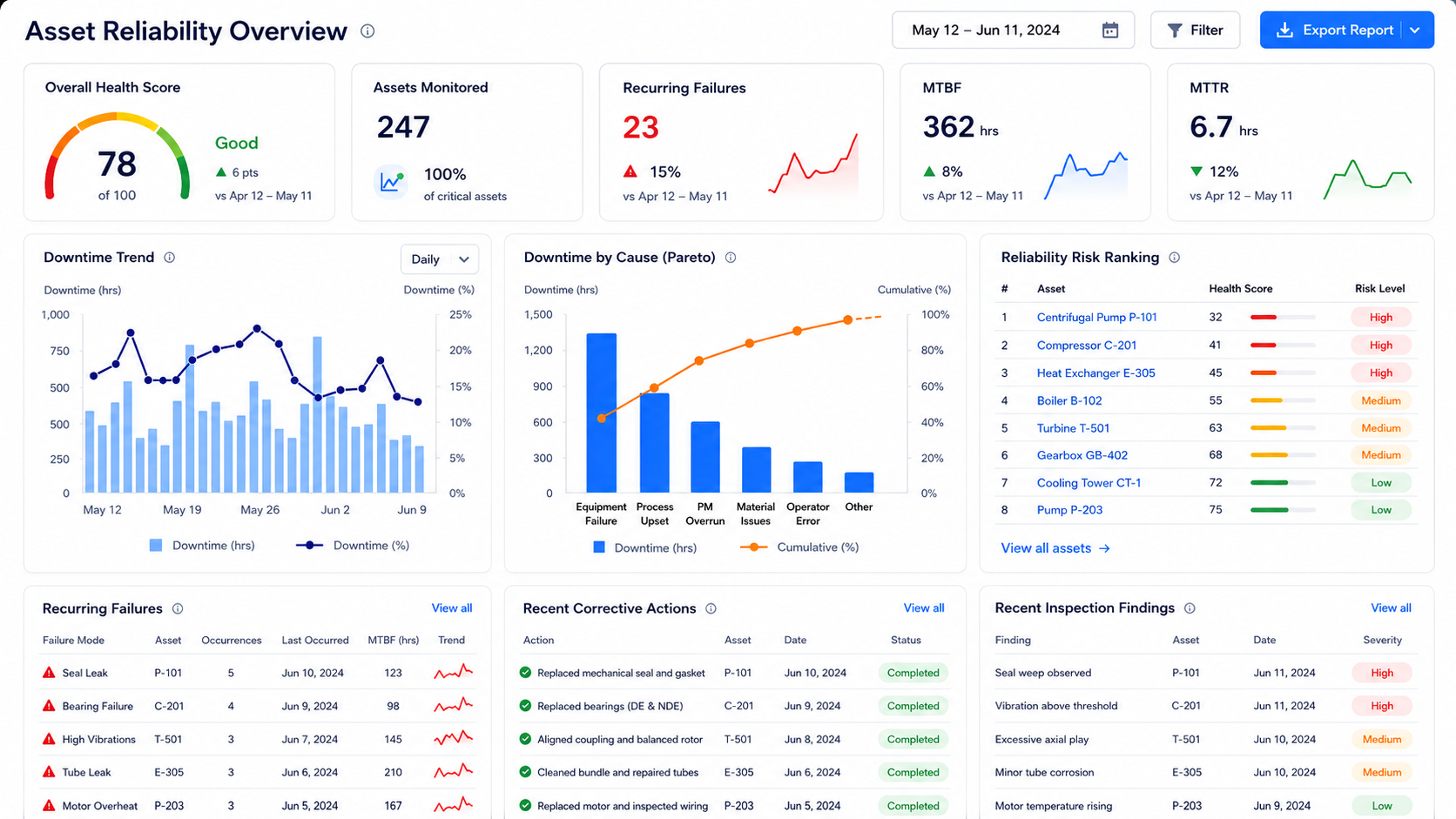
Most equipment failures do not occur without warning. Inspection findings, recurring work orders, growing downtime trends, and unresolved corrective actions often appear long before a critical breakdown affects production. The challenge is not collecting these signals. The challenge is connecting them early enough to support action.
A useful way to prioritize reliability risk is through a Reliability Risk Score: Reliability Risk Score = (Failure Frequency × Downtime Impact) ÷ (Inspection Coverage + Corrective Action Completion). Consider two production compressors. Compressor A experiences eight failures annually and carries a downtime impact score of 15. Inspection coverage is 60% and corrective action completion is 40%. Reliability Risk Score = (8 × 15) ÷ (60 + 40) = 1.20. A second compressor with fewer failures and stronger inspection discipline produces a significantly lower score. This does not create an engineering standard, but it gives maintenance leaders a practical way to prioritize limited resources.
A mid-sized chemical manufacturer used a similar approach to identify three pumps responsible for a disproportionate share of production interruptions. After connecting inspection records, maintenance history, and corrective action tracking into a single workflow, recurring failures decreased from 12 per month to 4 per month within nine months, reducing unplanned downtime by 41%.
Hard rule: Make it impossible for recurring asset failures to continue without root cause review, maintenance ownership, and corrective action planning. Business benefit: reduced downtime, improved asset reliability, lower maintenance cost, and stronger operational continuity.
Work Orders Should Control Maintenance Execution
Many organizations create work orders, but too often those work orders become administrative records rather than operational controls. Technicians receive assignments through phone calls, emails, spreadsheets, or informal discussions while system updates happen later. As a result, supervisors lose visibility into work status, maintenance priorities, and resource utilization.
An Asset Management Platform should place the work order at the center of maintenance execution. Every task should connect to the affected asset, assigned personnel, required parts, inspection requirements, and completion verification. This creates a shared operational record that maintenance, operations, and management can trust.
Effective work order control typically includes:
Work request and approval status
Maintenance priority
Labor assignment
Spare parts availability
Completion verification
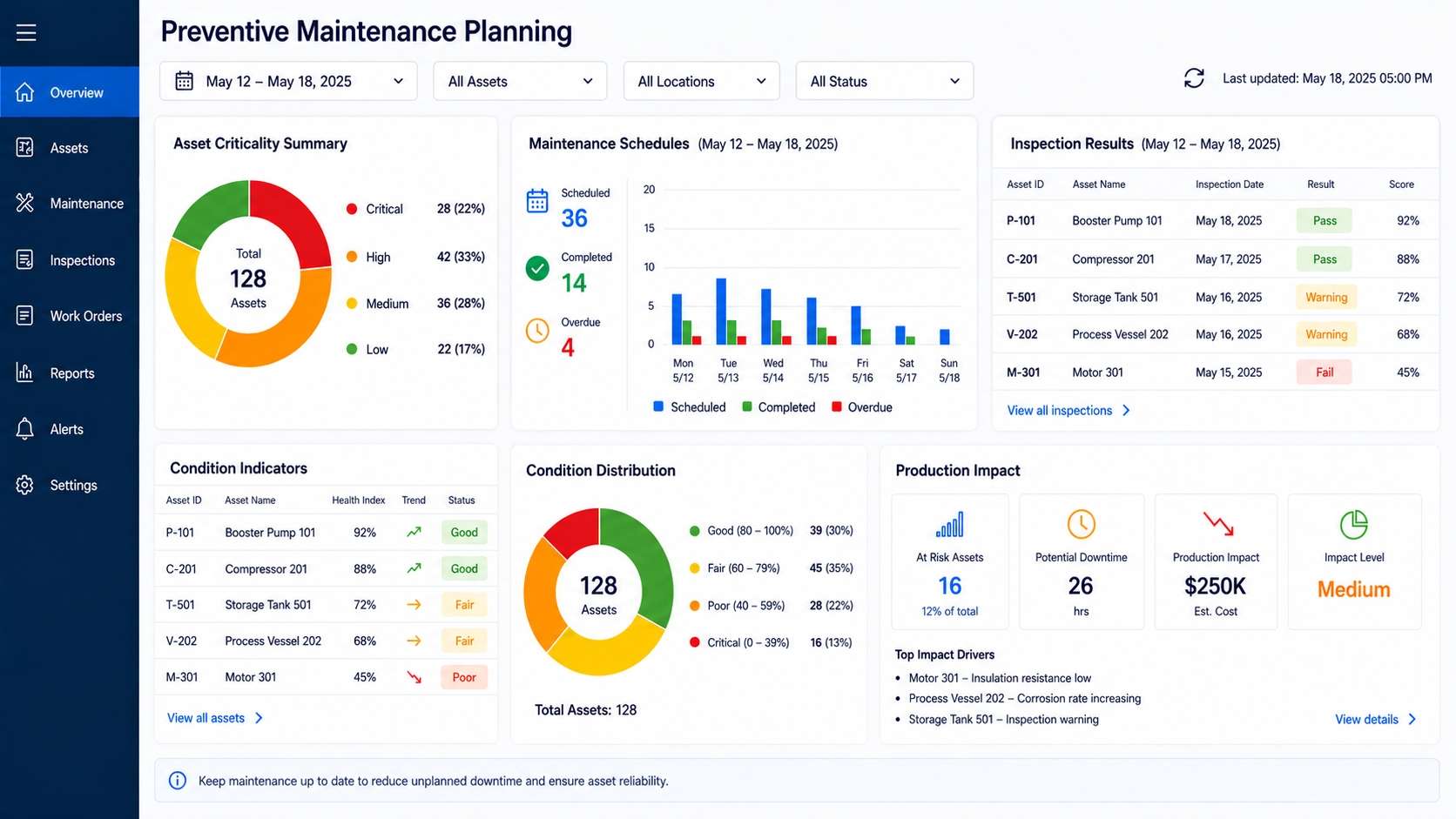
Hard rule: Make it impossible for maintenance work to proceed without visible ownership, priority, status, and asset linkage. Business benefit: stronger maintenance discipline, improved planning accuracy, and greater operational visibility. By locking asset availability and technician scheduling behind these digital validation gates, the system eliminates blind execution, converting reactive equipment maintenance into a structured, highly predictable asset performance engine.
Preventive Maintenance Should Protect Production Capacity
Preventive maintenance only creates value when it reduces operational risk. Many organizations still rely heavily on calendar-based schedules that generate maintenance activities regardless of asset condition, production impact, or failure history. By decoupling maintenance from rigid timelines and linking it directly to asset usage telemetry and historical degradation patterns, the system replaces blind routine with high-impact intervention, ensuring that maintenance efforts preserve operational uptime rather than compounding maintenance waste.
A stronger approach aligns maintenance activity with asset criticality. Equipment that directly affects production, safety, environmental compliance, or customer commitments should receive a different maintenance strategy than lower-risk assets. Maintenance planning should be based on operational consequence rather than frequency alone.
Preventive maintenance planning should consider:
Asset criticality
Failure history
Inspection results
Operating conditions
Production impact
Hard rule: Make it impossible to schedule preventive maintenance solely by calendar frequency when asset condition, risk, and operating context indicate different priorities. Business benefit: improved equipment availability, better maintenance efficiency, and stronger reliability performance.
Asset History Should Become Decision Evidence
Most organizations collect asset data. The challenge is turning that information into decisions. Maintenance records, inspections, repair history, downtime events, vendor information, and spare parts usage often exist across separate systems. When equipment repeatedly fails, teams spend valuable time reconstructing history before deciding how to respond.
An Asset Management Platform should create a complete asset record that follows equipment throughout its lifecycle. Maintenance teams should be able to understand what work was performed, which parts were replaced, how frequently failures occur, what inspections revealed, and whether previous corrective actions delivered results.
A trusted asset record should include:
Asset hierarchy and location
Maintenance history
Inspection records
Downtime events
Spare parts usage
Vendor and warranty information
Hard rule: Make it impossible to evaluate asset performance without access to maintenance history, inspection findings, downtime records, and previous corrective actions. Business benefit: faster troubleshooting, improved maintenance decisions, and stronger asset lifecycle management.
Spare Parts Should Support Reliability, Not Create Delays
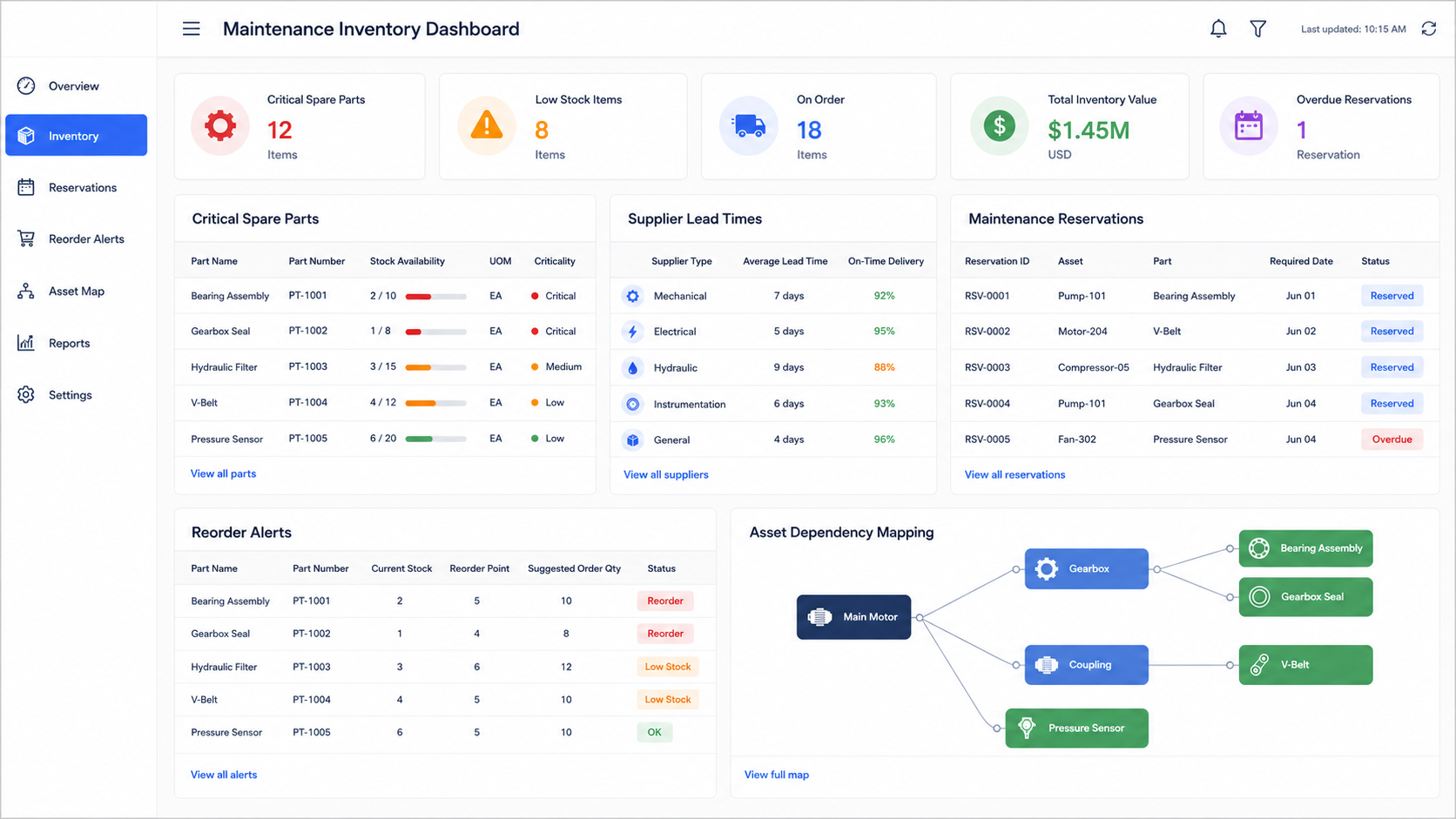
Even the best maintenance plans fail when critical spare parts are unavailable. Many organizations discover that extended downtime is caused not only by equipment failure, but by delays in locating, ordering, or replenishing required components. By embedding a dynamic parts-availability check directly into the maintenance workflow, the platform transforms spare parts provisioning from an isolated supply chain activity into a responsive defense mechanism, eliminating the stock-out friction that so often drags down asset recovery.
Asset Management Platforms help connect maintenance planning with inventory visibility. Maintenance teams should know whether parts are available, reserved, on order, or at risk before work begins. This reduces emergency purchases, avoids scheduling disruptions, and improves maintenance readiness.
Critical spare part controls often include:
Stock availability
Reserved inventory
Reorder status
Supplier lead times
Critical spare identification
Hard rule: Make it impossible to release critical maintenance work without visibility into required spare parts availability and replenishment status. Business benefit: faster repairs, reduced downtime, and improved inventory utilization. By gating work order release behind a digital component-check, the system prevents technicians from tearing down machinery only to wait on delayed components, converting blind wrench-time into a synchronized, parts-ready execution workflow.
The Asset Health Quadrant
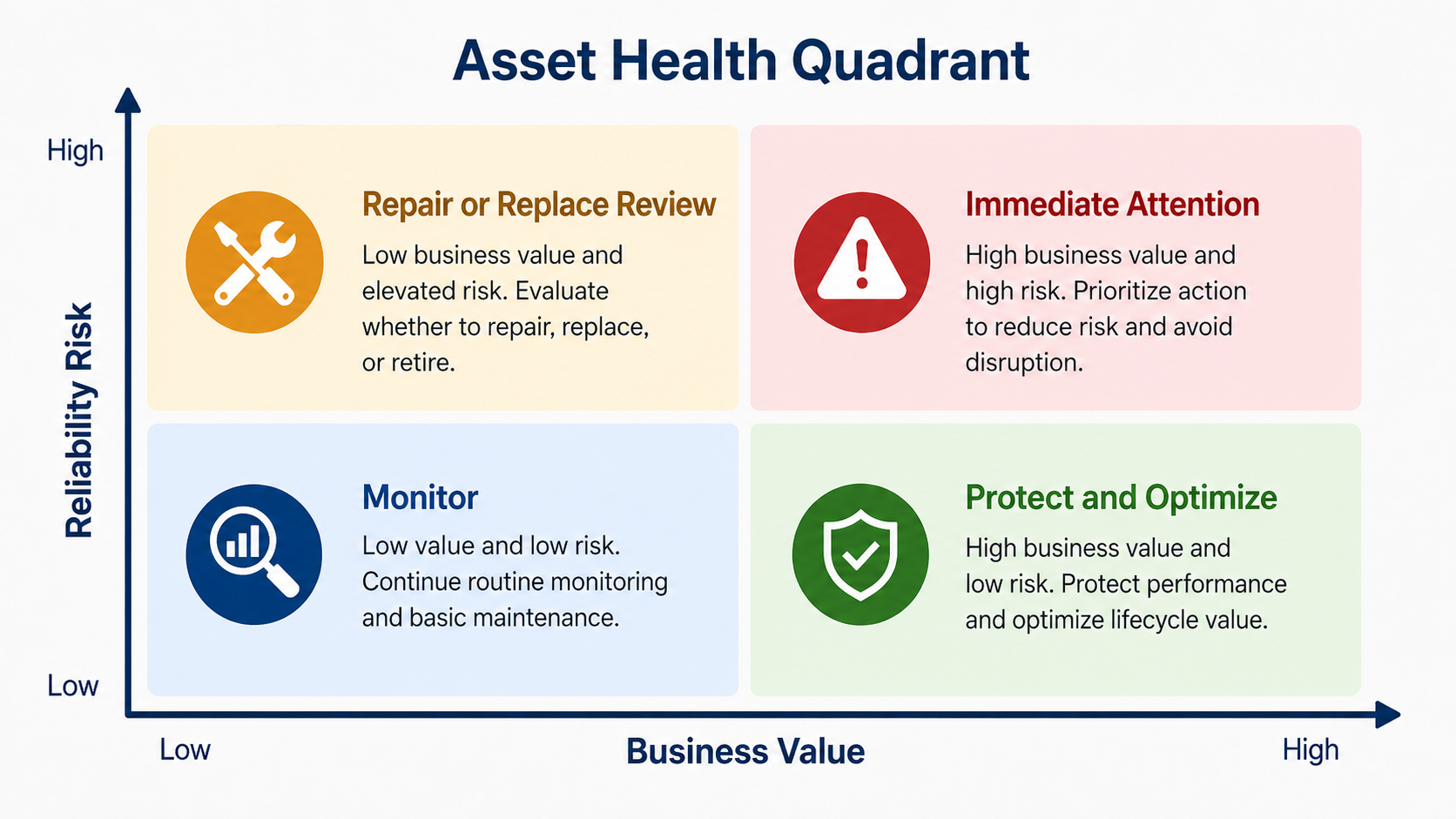
Not every asset deserves the same maintenance strategy. One useful framework evaluates equipment using two dimensions: Business Value and Reliability Risk. By mapping machinery across these critical vectors, the platform moves organizations away from blanket maintenance policies, enabling teams to target high-consequence, high-risk assets with predictive monitoring while applying run-to-failure or basic preventive methods where the impact is low.
This creates four categories:
High Value + High Risk
Immediate attention. Reliability improvement plans, corrective action programs, and management visibility are required.
High Value + Low Risk
Protect and optimize. Focus on preventive maintenance and continuous performance improvement.
Low Value + High Risk
Evaluate repair-versus-replace options and determine whether maintenance investment remains justified.
Low Value + Low Risk
Monitor and maintain through standard maintenance procedures.
This framework helps organizations prioritize maintenance resources, capital planning, and reliability initiatives more effectively than treating every asset equally. Business benefit: stronger investment decisions, improved maintenance prioritization, and better asset utilization.
Why Companies Invest in Industry Software
Organizations invest in Industry Software when asset complexity, maintenance workload, and operational risk exceed what spreadsheets and disconnected systems can manage effectively. The value is not simply digitizing maintenance records. The value is creating a connected asset management environment that links reliability, maintenance execution, inspections, inventory, downtime, and operational performance.
Industry Software supports this through:
Cloud-based access across maintenance and operations teams
Modular deployment based on business priorities
Configurable workflows for maintenance execution and approvals
Asset lifecycle visibility
Reliability improvement workflows
Spare parts and inventory integration
Role-based dashboards and reporting
Dedicated implementation and optimization support
This allows organizations to improve reliability while building a scalable asset management foundation that can evolve as operational needs change. By treating asset strategy as a dynamic operational blueprint rather than a static compliance exercise, the platform helps engineering teams continuously calibrate their defense mechanisms against shifting production realities.
Final Summary
Asset Management Platforms create value when asset records, maintenance activities, inspections, reliability data, spare parts, and operational performance become part of one connected workflow. The objective is not simply to maintain equipment. The objective is to improve reliability, strengthen maintenance execution, reduce downtime, and maximize asset performance. Industry Software helps organizations build this foundation through cloud-based access, modular deployment, configurable workflows, asset lifecycle visibility, reliability intelligence, and dedicated implementation support.