Manufacturing Quality Traceability: How to Find Production Problems Before They Become Rework

Summary
×Final Inspection Is Often Too Late
A manufacturer completes a batch of products and sends them to final inspection. The defect rate is higher than expected, and the team begins asking familiar questions. Was the issue caused by a material lot, a machine setting, an operator change, a supplier variation, or a process step that drifted during production? The answer should be in the production data, but the data is scattered across paper forms, spreadsheets, machine logs, and inspection records.
By the time the problem reaches final inspection, the cost has already started to grow. Materials have been consumed, labor has been spent, machine capacity has been used, and delivery time may be at risk. If the team cannot trace the problem quickly, more units may need to be held, reworked, scrapped, or reinspected.
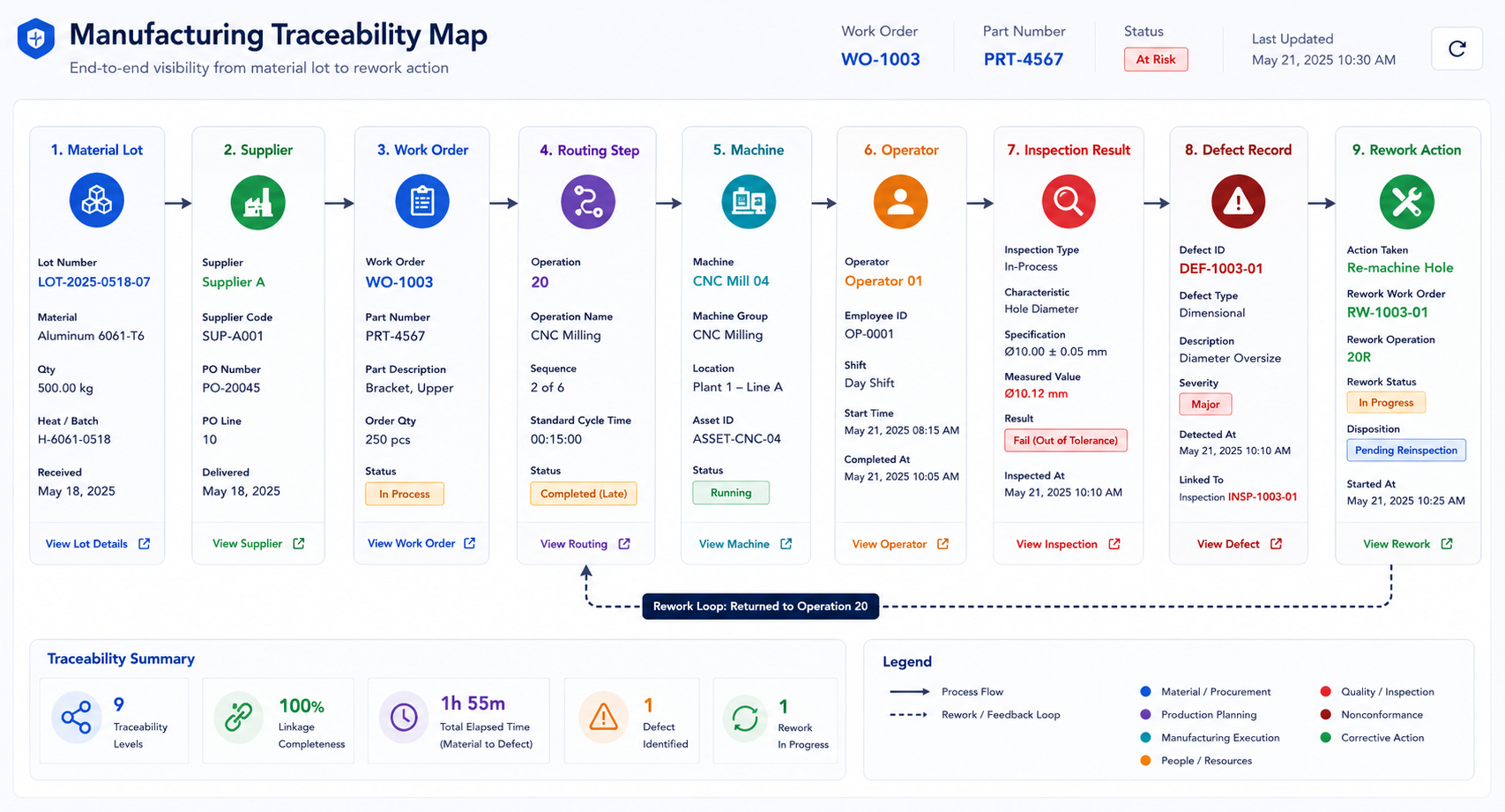
Quality traceability is not only about finding who made a product. It is about connecting the full production context: raw material batches, supplier records, production orders, routing steps, equipment, operators, inspection results, defect records, and rework actions. When this context is connected, manufacturers can identify quality risk earlier and reduce the chance that small process issues become large rework problems.
Material Traceability Starts Before Production Begins
Many quality problems start with material variation. A supplier batch may be different from previous lots, a material may be close to expiration, a substitute may be used without enough review, or a component may be released before all inspection results are available. If these details are not tied to the production work order, later investigation becomes slow and uncertain.
Material traceability should begin before production starts. Each material lot, batch, or serial number should be connected to the production order that consumes it. The system should show supplier, receiving date, inspection status, certificate information, expiration date, quality hold status, and where the material was used.
Industry Software can support lot tracking, serial number tracking, material approval status, and quality hold rules. If a material is blocked, expired, or missing required inspection, the system can prevent it from being used in production or flag the work order for review. This gives quality teams more control before defects reach the shop floor.
Process Checkpoints Catch Issues Earlier
Final inspection is important, but it should not be the first serious quality check. Manufacturing quality is created through the process, not only verified at the end. First-piece inspection, in-process inspection, machine setup verification, measurement checks, and operator confirmations all help detect problems before they spread.
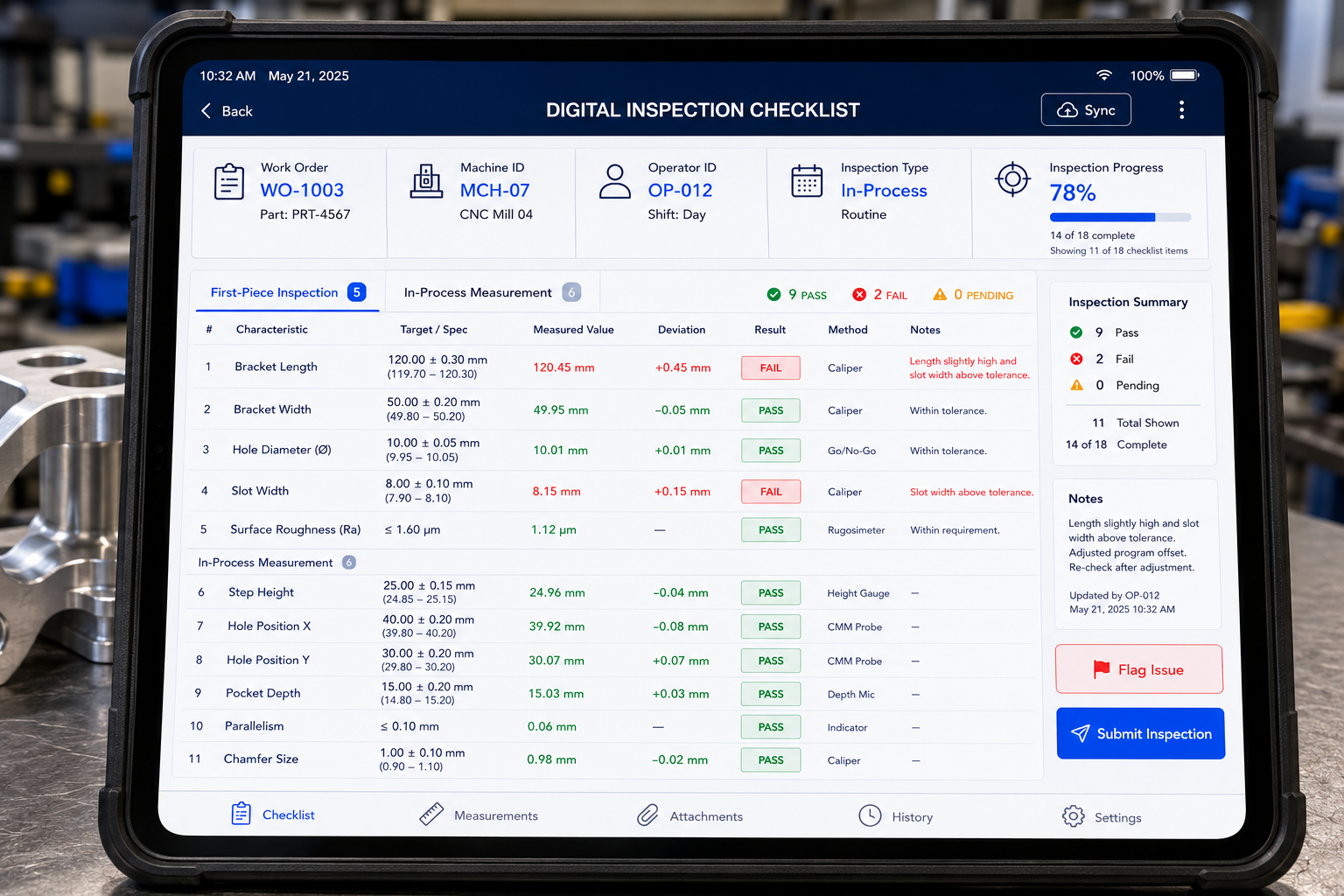
A process checkpoint should be linked to the work order and routing step. If a dimension is out of tolerance, a torque value is missing, or an inspection checklist fails, the issue should be visible immediately. The team should know whether production can continue, whether the batch should be held, or whether a supervisor or quality engineer needs to review the process.
Industry Software can embed digital quality checklists and inspection forms into production workflows. Quality results can be captured at the operation level instead of being recorded separately after production. This makes traceability more useful because the defect is connected to the exact step where it appeared.
Quality Data Needs Production Context
A defect record without context is difficult to use. If the system only shows that a product failed inspection, the team still needs to investigate which material lot was used, which machine processed it, which operator was on shift, what routing step was involved, and whether similar defects appeared on nearby batches.
Production context turns quality records into useful evidence. It helps teams distinguish between isolated defects and repeatable patterns. If defects appear only on one machine, the root cause may be equipment related. If they appear only with one material lot, the supplier or incoming quality process may need review. If they appear during one shift or after a setup change, the issue may be operational.
A strong traceability record should connect:
Production work order
Material lot or serial number
Supplier and receiving information
Machine or work center
Operator or shift
Routing step
Inspection result
Defect type and severity
Rework or scrap decision
Customer or batch impact
Industry Software can connect these data points in one quality traceability view. Instead of searching through separate files, quality teams can trace from a defect back to the material, process, equipment, operator, and inspection history. This shortens investigation time and helps managers make better hold, rework, or release decisions.
Quality Holds Should Stop Problems From Spreading
When a potential defect is found, manufacturers need a way to stop affected materials, work-in-progress, or finished goods from moving forward. If the hold process depends on email or manual labels, some inventory may continue moving before the quality team completes review.
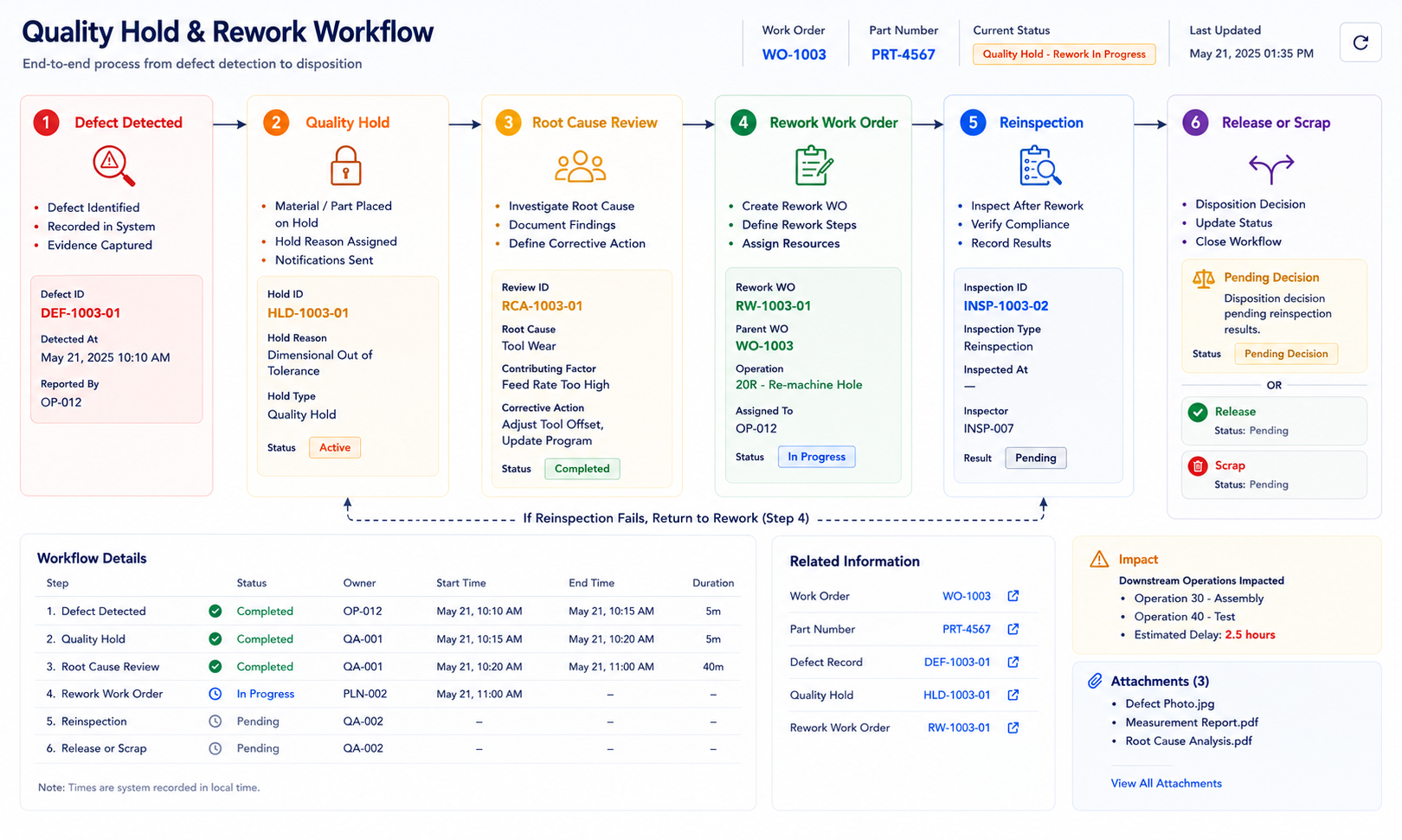
A quality hold should clearly identify what is blocked, why it is blocked, who owns the review, and what must happen next. It may apply to a material lot, a production batch, a work order, a finished goods location, or a specific serial number range. The hold should also prevent accidental use, shipment, or completion until the issue is resolved.
Industry Software can support quality hold workflows tied to materials, work orders, batches, and inventory locations. When a hold is created, affected items can be flagged in the system, and related teams can see the status. This helps prevent small issues from spreading into larger quality escapes.
Rework Should Be Managed as a Controlled Workflow
Rework is not simply “fixing the product.” It is a controlled process that should define what needs to be corrected, which steps are required, who approves the rework, which materials are consumed, and how the product is reinspected. If rework is handled outside the system, manufacturers may lose visibility into cost, root cause, and repeat quality issues.
A controlled rework process should create a rework work order or rework instruction tied to the original production record. It should include the defect reason, corrective steps, labor time, material usage, inspection requirements, and final disposition. This allows managers to see not only how much rework happened, but why it happened.
Industry Software can support rework work orders, defect codes, corrective actions, inspection steps, and final approval workflows. Rework data can then feed into quality dashboards and historical analysis. This helps companies understand whether rework is driven by materials, equipment, process design, training, or supplier performance.
Metrics Show Whether Quality Is Improving
Quality traceability should lead to measurable improvement. If the system only stores inspection results but does not help teams understand trends, the company may keep reacting to defects without reducing them. Managers need visibility into quality performance by product, line, supplier, material lot, machine, shift, and defect type.
A simple starting metric is first pass yield: First Pass Yield = (Units Passed Without Rework / Total Units Produced) × 100%. If first pass yield drops on one production line, the team can review related equipment, operators, materials, and inspection data. If rework rate increases after a supplier change, purchasing and quality can investigate incoming materials. If scrap rate rises during one shift, supervisors can review training, setup, or process adherence.
Useful quality KPIs can include:
First pass yield
Defect rate
Rework rate
Scrap rate
Quality hold duration
Supplier defect rate
Repeat defect rate
Inspection failure by process step
Cost of poor quality
Industry Software can help managers monitor these KPIs through quality dashboards and alerts. When defect rate, scrap rate, or rework rate exceeds a defined threshold, the system can flag the issue before it becomes a larger production or delivery problem. By shifting from retrospective reporting to real-time threshold containment, the platform prevents localized variances from cascading into supply chain disruptions, allowing teams to defend product integrity at the exact moment of deviation.
Traceability Supports Faster Root Cause Analysis
Root cause analysis becomes difficult when data is scattered. A quality engineer may need to check receiving records, production logs, machine data, operator notes, inspection sheets, and rework forms. If those records are not connected, investigation can take days, and production may remain blocked while the team searches for evidence.
Traceability improves root cause analysis by connecting the relationships among materials, process steps, equipment, operators, defects, and outcomes. Instead of asking “Where should we look first?” teams can narrow the investigation based on patterns. They can compare affected and unaffected batches, review common material lots, identify shared machines, and check whether similar defects appeared before.
Industry Software can support quality analysis by linking defect records with work orders, material lots, equipment, inspection results, and rework outcomes. This gives quality teams a faster path from defect detection to root cause review and corrective action. By unifying these isolated variables into an unbroken digital genealogy, the system replaces time-consuming manual tracebacks with immediate traceability, turning raw data into a precise diagnostic engine for continuous quality improvement.
Quick Self-Check: Can You Trace Quality Problems Before They Become Rework?
A quality traceability process should help teams act before defects become widespread. If quality data is only available after final inspection, the company may be controlling defects too late. By embedding real-time inspection gates directly into the production sequence, the platform shifts quality management from a post-mortem autopsy to an active, inline defense, ensuring deviations are choked off long before they can contaminate the broader supply chain.
A strong quality traceability process should be able to answer:
Can you trace each finished product or batch back to material lots and suppliers?
Are inspection results linked to work orders, routing steps, machines, and operators?
Can quality holds prevent affected materials or products from moving forward?
Are defects categorized by type, severity, process step, and root cause?
Can rework be managed through controlled rework work orders?
Can managers see first pass yield, defect rate, rework rate, and scrap rate by line or product?
Can the team compare affected and unaffected batches during root cause analysis?
Are quality trends visible before problems reach final inspection?
If several answers are unclear, the issue may not be inspection effort. It may be traceability. Better quality management starts when production, material, inspection, and rework data are connected. By anchoring these siloed data streams into a single thread of operational truth, the platform eliminates guesswork on the floor, transforming quality control from a reactive guessing game into an active, data-driven system of prevention and containment.
How Industry Software Supports Manufacturing Quality Traceability
Industry Software helps manufacturers connect material lots, suppliers, production work orders, routing steps, equipment, operators, inspection results, defect records, quality holds, and rework workflows in one configurable system. The platform can be tailored around each company’s production model, quality checkpoints, approval rules, inspection requirements, and reporting structure.
Manufacturers can start with lot tracking, inspection checklists, quality hold workflows, defect records, or rework work orders, then expand into dashboards, supplier quality analysis, and root cause reporting. This modular approach helps companies improve traceability without replacing every manufacturing process at once.
Cloud-based usage and unified data views help quality, production, inventory, and management teams work from the same operational record. Industry Software helps companies find production problems earlier, control rework more effectively, and turn quality data into continuous improvement.