Inventory Problems Usually Come from Decision Gaps
Many companies carry large inventory balances and still experience shortages. This happens because inventory volume does not guarantee inventory usefulness. The right material may be unavailable, while slow-moving stock consumes warehouse space and working capital.
Consider a manufacturer carrying $22 million in inventory. Despite this investment, 11% of production orders experience material shortages each month, while more than $4 million of inventory has not moved in over twelve months. The problem is not inventory quantity. The problem is that inventory decisions are not aligned with demand, supplier reliability, lead-time risk, and operational priorities.
A stronger inventory system should help teams understand where inventory creates value and where it creates exposure. Purchasing, replenishment, safety stock, and excess inventory review should all connect to the same operating logic. This turns inventory from a warehouse balance into a business decision system.
Hard rule: Make it impossible to approve inventory purchases without visibility into demand forecasts, current stock, open supply commitments, and existing excess inventory. Business benefit: lower carrying costs, fewer shortages, better cash utilization, and stronger operational planning.
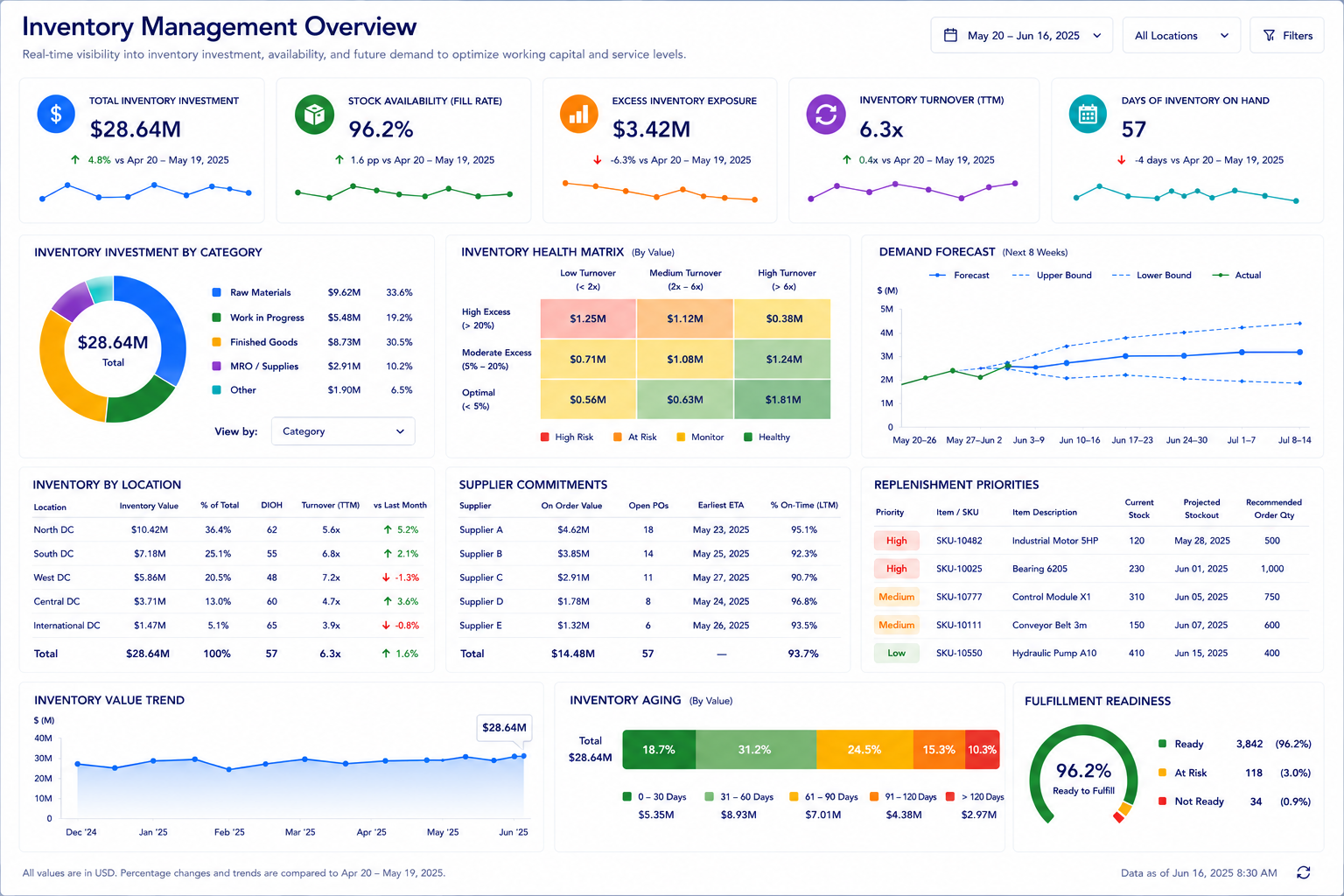
Inventory Should Be Managed Through an Availability-Capital Balance
A smarter inventory strategy needs to balance two goals that often compete with each other. Operations wants availability, while finance wants lower working capital. If the organization focuses only on availability, inventory grows too quickly. If it focuses only on reduction, production and customer service may suffer.
One practical framework is the Availability-Capital Balance. It asks whether each inventory decision protects revenue, supports production, reduces risk, or simply increases stock value without improving performance. This framework helps teams move away from broad inventory targets and toward more precise inventory decisions.
A useful inventory decision model can be expressed as: Inventory Decision Score = Demand Criticality × Lead-Time Risk × Service Impact ÷ Inventory Exposure. For example, a critical component with high demand impact, long supplier lead time, and direct production consequence may justify stronger safety stock even if carrying cost is higher. A slow-moving part with low service impact and high inventory exposure should trigger review before additional purchasing.
Key decision factors should include:
Demand criticality
Lead-time risk
Supplier reliability
Service or production impact
Current inventory exposure
Hard rule: Make it impossible to apply the same replenishment policy to materials with significantly different demand risk, lead-time exposure, and business impact. Business benefit: better availability, lower excess stock, stronger inventory discipline, and more effective working capital allocation.
Replenishment Should Anticipate Shortages Before They Interrupt Operations
Replenishment should not begin only when stock falls below a minimum quantity. By that point, the business may already be exposed to supplier delays, production disruption, or customer service risk. Effective replenishment looks forward, connecting expected demand with current inventory, open purchase orders, supplier lead times, and consumption patterns.
A distributor may have enough stock for today’s orders but not enough to support next month’s confirmed demand. If replenishment is based only on current balance, the shortage will appear too late. If the system connects demand, supplier lead time, and open commitments, replenishment can begin before service levels are affected.
Inventory Management Systems should help teams prioritize replenishment by urgency and business impact. The goal is not to create more purchase recommendations. The goal is to show which replenishment decisions protect revenue, production, and customer commitments.
Replenishment controls should focus on:
Demand coverage by planning period
Open purchase order status
Supplier lead-time changes
Critical item shortage exposure
Replenishment priority by business impact
Hard rule: Make it impossible to rely on manual inventory review as the primary method for identifying replenishment risk. Business benefit: fewer emergency purchases, better supplier planning, reduced operational disruption, and improved inventory reliability. By institutionalizing automated, algorithmic replenishment triggers, the platform transitions the supply chain from a reactive posture to a predictive powerhouse, ensuring that material availability remains uncompromised by human oversight or administrative delay.
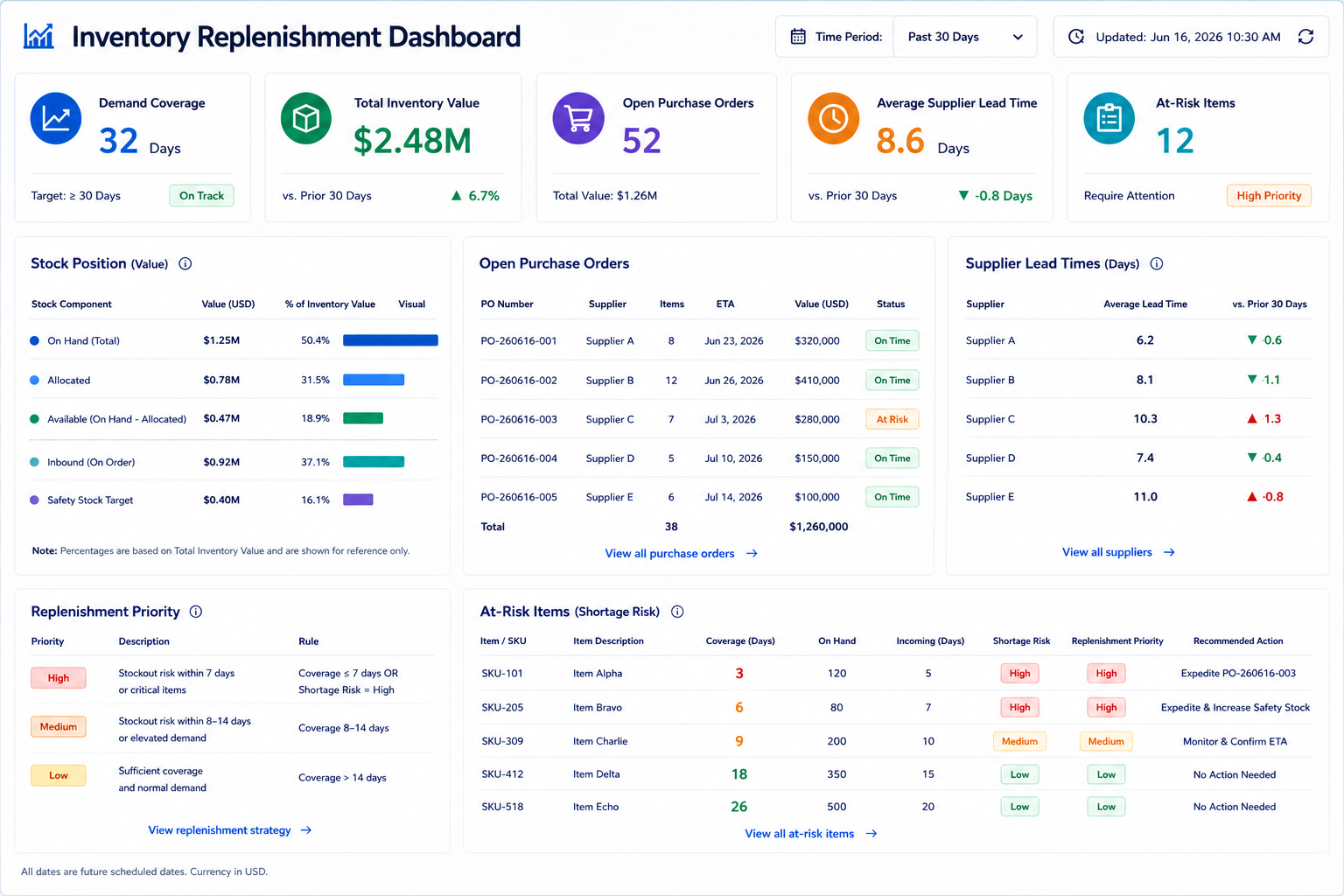
Supplier Commitments Should Change Inventory Decisions
Inventory availability is only as reliable as the supply commitments behind it. A purchase order does not guarantee future stock if the supplier lead time changes, delivery slips, or material availability becomes constrained. When supplier updates stay inside procurement, inventory teams may continue planning with outdated assumptions.
A connected inventory workflow should treat supplier performance as an inventory signal. Late deliveries, lead-time changes, partial shipments, and supplier constraints should update inventory risk automatically. This allows teams to adjust replenishment timing, reserve critical stock, qualify alternatives, or revise customer and production commitments earlier.
For example, a manufacturer relying on one supplier for a long-lead component may appear covered for the next six weeks. If the supplier moves delivery out by three weeks and the system does not update inventory coverage, production risk remains hidden until the shortage is unavoidable.
Supplier-related inventory controls should include:
Supplier delivery performance
Lead-time trend changes
Open purchase commitment status
Alternative sourcing visibility
Critical material exposure
Hard rule: Make it impossible to assume future inventory availability without validating current supplier commitments, lead-time performance, and supply risk. Business benefit: reduced supply risk, stronger planning confidence, better supplier coordination, and fewer unexpected shortages.
Excess Inventory Should Be Identified Before It Becomes a Write-Off
Shortages usually get immediate attention, but excess inventory often grows quietly. Forecasts change, products are revised, customer demand shifts, supplier minimums increase, and purchasing decisions continue based on old assumptions. By the time finance identifies the problem, inventory may already be obsolete, slow-moving, or difficult to recover.
A stronger inventory process should evaluate excess exposure continuously. Inventory should be reviewed against future demand, movement history, product lifecycle status, and existing purchase commitments. This prevents teams from continuing to buy items that already exceed realistic consumption.
One practical measure is: Excess Inventory Exposure = Inventory Value Above Forecast Need × Aging Factor. If a company holds $600,000 of material above twelve-month forecast need and the aging factor is 1.4 because the material has limited movement, the exposure becomes:$600,000 × 1.4 = $840,000. The number is not an accounting write-off. It is a management signal that inventory risk is growing and should be reviewed before it becomes a financial loss.
Hard rule: Make it impossible to continue purchasing inventory that already exceeds forecast demand without documented review and approval. Business benefit: lower write-off risk, reduced carrying costs, improved working capital performance, and stronger inventory discipline.
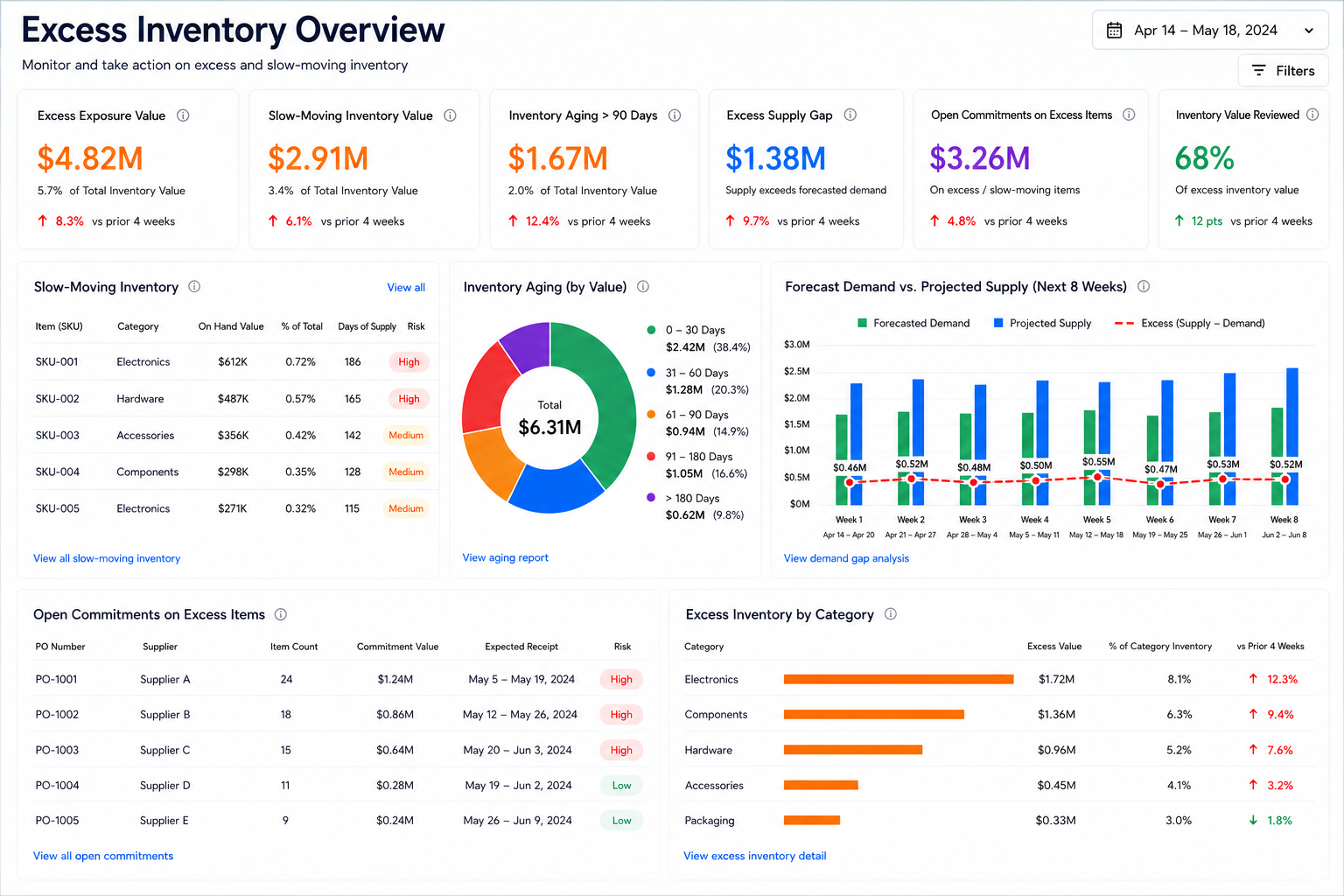
Inventory Performance Should Be Measured Beyond Stock Levels
Inventory reports often show quantity, value, and location. These are useful, but they do not explain whether inventory is supporting the business. Management needs to know whether inventory improves service levels, protects production, supports revenue, or simply ties up cash.
A stronger performance view should connect inventory with business outcomes. A stock-out rate shows availability risk. Inventory turnover shows capital efficiency. Excess exposure shows future write-off risk. Supplier reliability shows replenishment confidence. Service level performance shows whether inventory strategy supports customers.
Management should be able to answer:
Which items threaten production or customer service?
Which inventory categories consume excessive working capital?
Which suppliers create the greatest inventory risk?
Which locations experience recurring shortages?
Which products generate excess stock exposure?
Which inventory decisions need intervention this month?
Without this view, organizations manage inventory reactively. With connected inventory intelligence, leaders can balance availability and capital before performance is affected. Business benefit: stronger decision-making, improved inventory performance, better working capital control, and earlier operational visibility.
Inventory Should Support the Entire Business
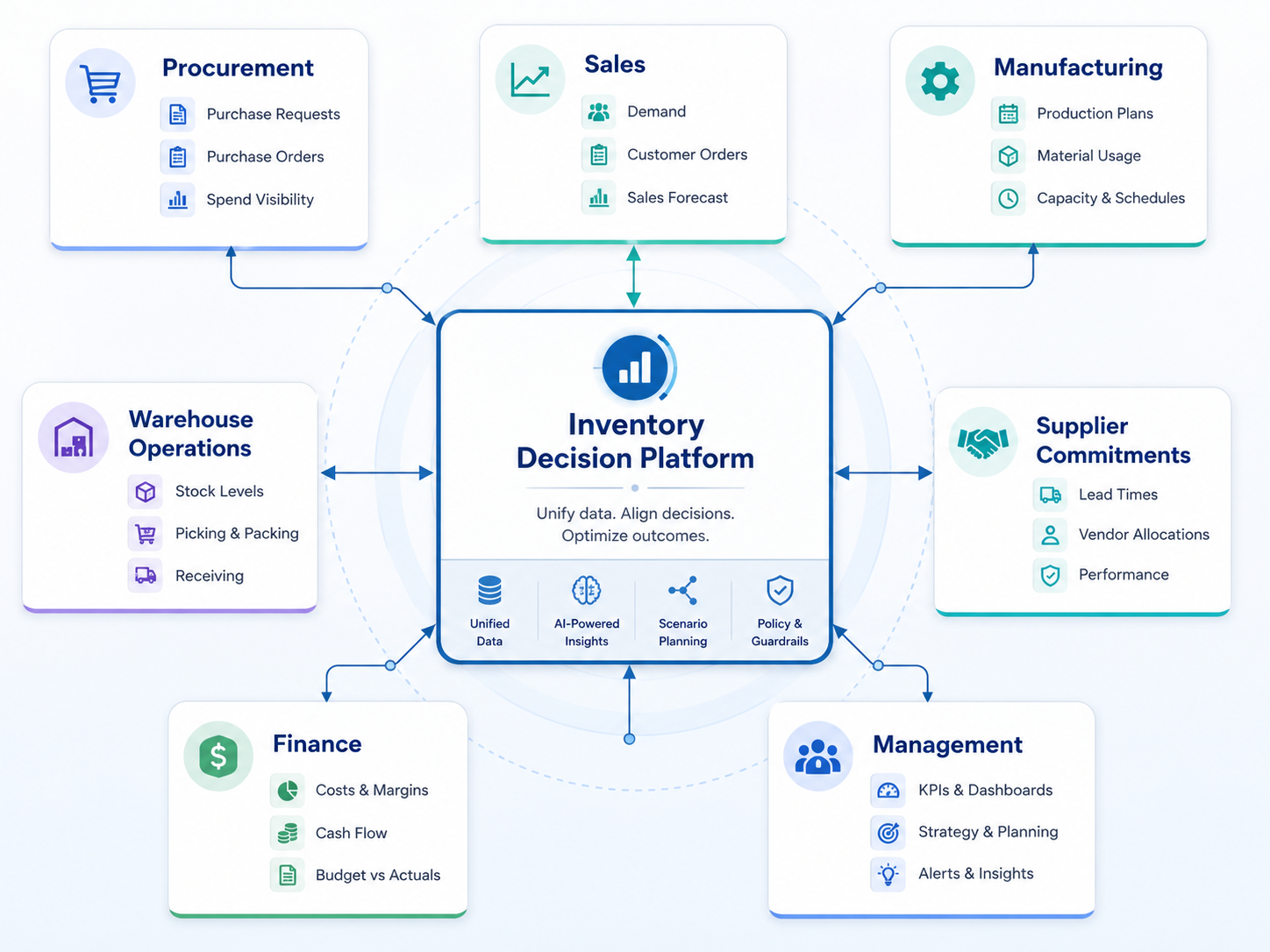
Inventory is not only a warehouse concern. Procurement depends on it for purchasing decisions. Manufacturing depends on it for production continuity. Sales depends on it for customer promises. Finance depends on it for working capital performance. When these teams use disconnected inventory information, the business makes conflicting decisions.
A shared inventory workflow gives each department a consistent view of stock, demand, commitments, and risk. Procurement can avoid buying what is already overstocked. Sales can avoid promising inventory that is reserved or unavailable. Manufacturing can see shortage risk before production is released. Finance can understand whether inventory investment supports business performance. This is where Inventory Management Systems become more than stock tracking tools. They create the operating link between availability, service, cost, and cash.
Hard rule: Make it impossible for procurement, operations, sales, and finance to make inventory decisions using disconnected inventory information. Business benefit: stronger organizational alignment, fewer conflicting decisions, improved inventory utilization, and better business performance.
Why Companies Invest in Industry Software
Organizations invest in Industry Software when inventory complexity grows beyond what spreadsheets, manual reviews, and disconnected systems can reliably manage. The value is not only inventory visibility. The value is creating a connected inventory decision workflow that balances demand, replenishment, supplier commitments, excess exposure, and working capital performance.
Industry Software supports smarter inventory decisions through:
Cloud-based access across procurement, warehouse, operations, sales, and finance teams
Modular deployment so organizations can start with inventory visibility, replenishment, supplier commitments, or excess inventory control
Configurable workflows for replenishment review, purchase approval, inventory holds, and exception management
Demand-driven replenishment connected to stock position, forecast, and open supply commitments
Supplier commitment tracking to improve planning confidence and shortage visibility
Inventory performance dashboards for availability, turnover, excess exposure, and working capital impact
Dedicated implementation support for data setup, workflow design, reporting, user training, and ongoing optimization
Final Summary
Inventory Management Systems create value when demand signals, stock levels, replenishment decisions, supplier commitments, excess inventory exposure, and business performance become part of one connected operating workflow. The goal is not simply to track inventory. The goal is to balance availability, working capital, and operational performance with better decision timing. Industry Software helps organizations build this foundation through cloud-based access, modular deployment, configurable workflows, demand-driven replenishment, supplier visibility, inventory intelligence, and dedicated implementation support.