Warehouse Problems Usually Start Before Picking Begins
Many fulfillment delays appear during picking or shipping, but the cause often starts earlier. Inventory is received with incomplete verification. Products are placed in inefficient locations. Pick faces are not replenished in time. Warehouse teams release orders based on system stock that has not been physically confirmed. By the time pickers discover the issue, the order is already at risk.
Consider a distributor managing 120,000 SKUs across multiple warehouse zones. Inventory accuracy averages 94%, which may look acceptable. However, the remaining 6% can create thousands of location, quantity, or availability exceptions each month. Customer orders are delayed, supervisors reassign labor, and warehouse teams spend time searching for inventory that the system says should exist.
A high-performance WMS should prevent these issues from moving downstream. Receiving, putaway, inventory movement, cycle counts, replenishment, picking, and shipping should update the same warehouse record. The goal is not only to show where inventory is stored. The goal is to make sure inventory is accurate enough to support order release and fulfillment decisions.
Hard rule: Make it impossible to allocate customer orders against inventory that has not been verified through controlled warehouse transactions. Business benefit: higher inventory accuracy, fewer fulfillment delays, reduced search time, and stronger customer service performance.
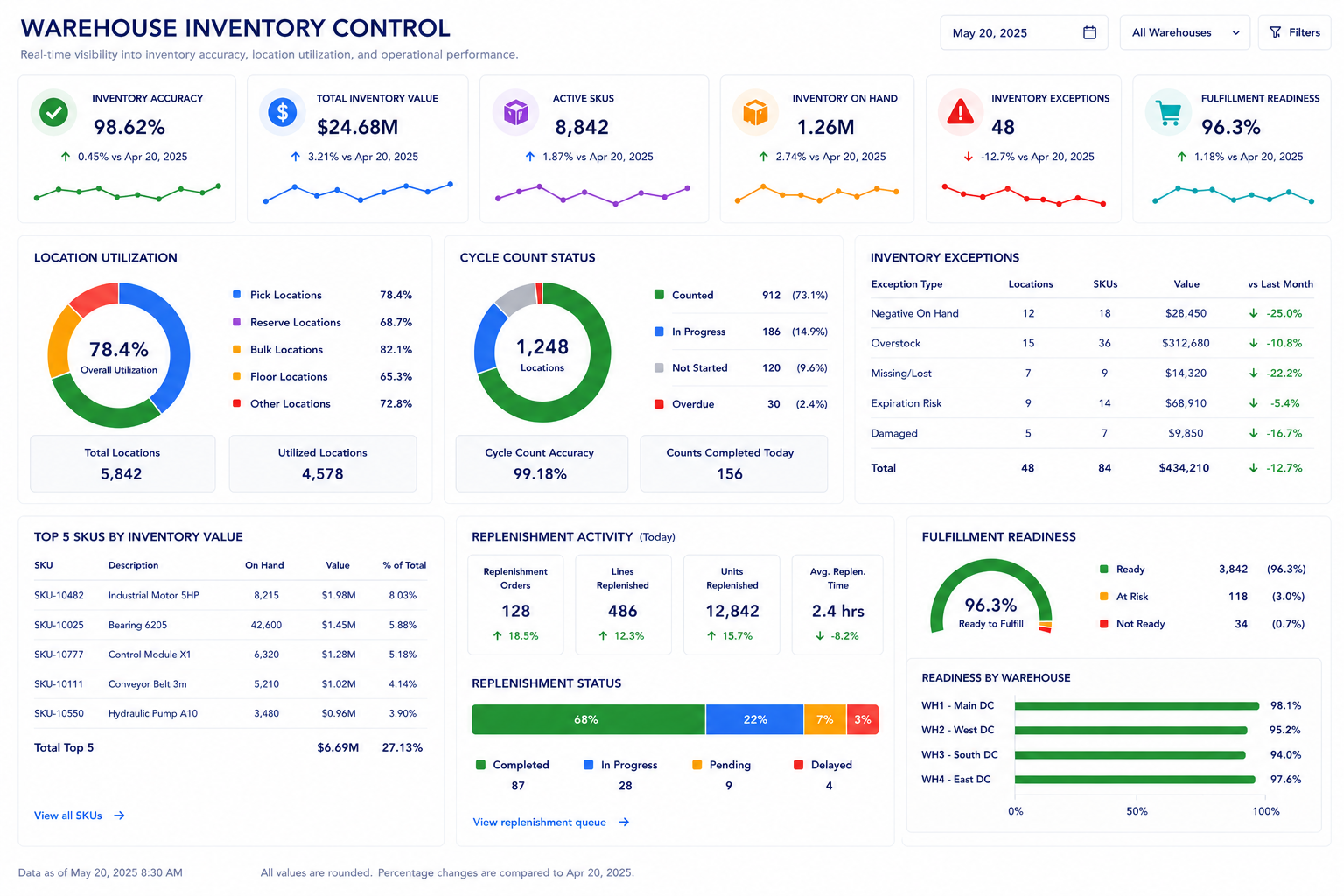
Receiving Should Establish Inventory Confidence Immediately
Receiving is the first warehouse control point. If inbound inventory enters the warehouse with quantity errors, damage, missing lot information, incorrect labels, or incomplete product details, the problem continues through putaway, picking, shipping, and customer delivery. A receiving error is rarely isolated; it becomes a warehouse execution risk.
A stronger WMS creates visibility when inventory arrives. The receiving team should know what was expected, what was actually received, which differences require review, and whether the product is ready for putaway. Quantity, condition, lot or serial information, expiration date, handling requirements, and inspection status should become part of the inventory record before the item moves deeper into the warehouse.
Receiving controls should focus on:
Expected versus received quantities
Lot, serial, or expiration validation
Damage and exception tracking
Inspection or hold status
Putaway readiness
Hard rule: Make it impossible to release received inventory into active stock until quantity, condition, and required product information have been verified. Business benefit: fewer receiving errors, stronger inventory integrity, reduced downstream corrections, and faster warehouse execution.
Putaway Should Improve Future Fulfillment Speed
Putaway is not just storage. It is a fulfillment decision. Where inventory is placed affects travel distance, picking speed, replenishment frequency, labor productivity, and order cycle time. Poor putaway decisions create cost long after receiving is complete. By optimizing storage placement at the point of entry, the system transforms inbound handling into a strategic foundation for outbound velocity, ensuring that early efficiency gains are never erased by downstream warehouse friction.
A modern WMS should help teams place inventory based on product velocity, storage requirements, available capacity, pick frequency, and warehouse layout. Fast-moving products should be positioned closer to efficient pick paths. Slow-moving inventory should not consume high-value picking space. Products with special handling requirements should be placed where the warehouse can execute safely and consistently.
One useful measure is: Putaway Efficiency Impact = Pick Frequency × Travel Distance Reduction × Labor Cost Factor. If a fast-moving SKU is picked 900 times per month and relocation reduces average travel by 40 feet per pick, the warehouse eliminates 36,000 feet of unnecessary travel for that item alone. Across many high-velocity SKUs, better slotting can meaningfully reduce labor hours and improve order flow.
Putaway controls should focus on:
Product velocity
Storage requirements
Zone capacity
Pick path efficiency
Replenishment impact
Hard rule: Make it impossible to assign inventory locations without considering product velocity, storage requirements, and warehouse capacity constraints. Business benefit: faster picking, lower labor cost, reduced travel time, and improved warehouse throughput. By embedding these constraints into an unpassable logic gate, the system automates spatial intelligence, transforming warehouse geometry from a logistical bottleneck into a high-velocity execution engine.
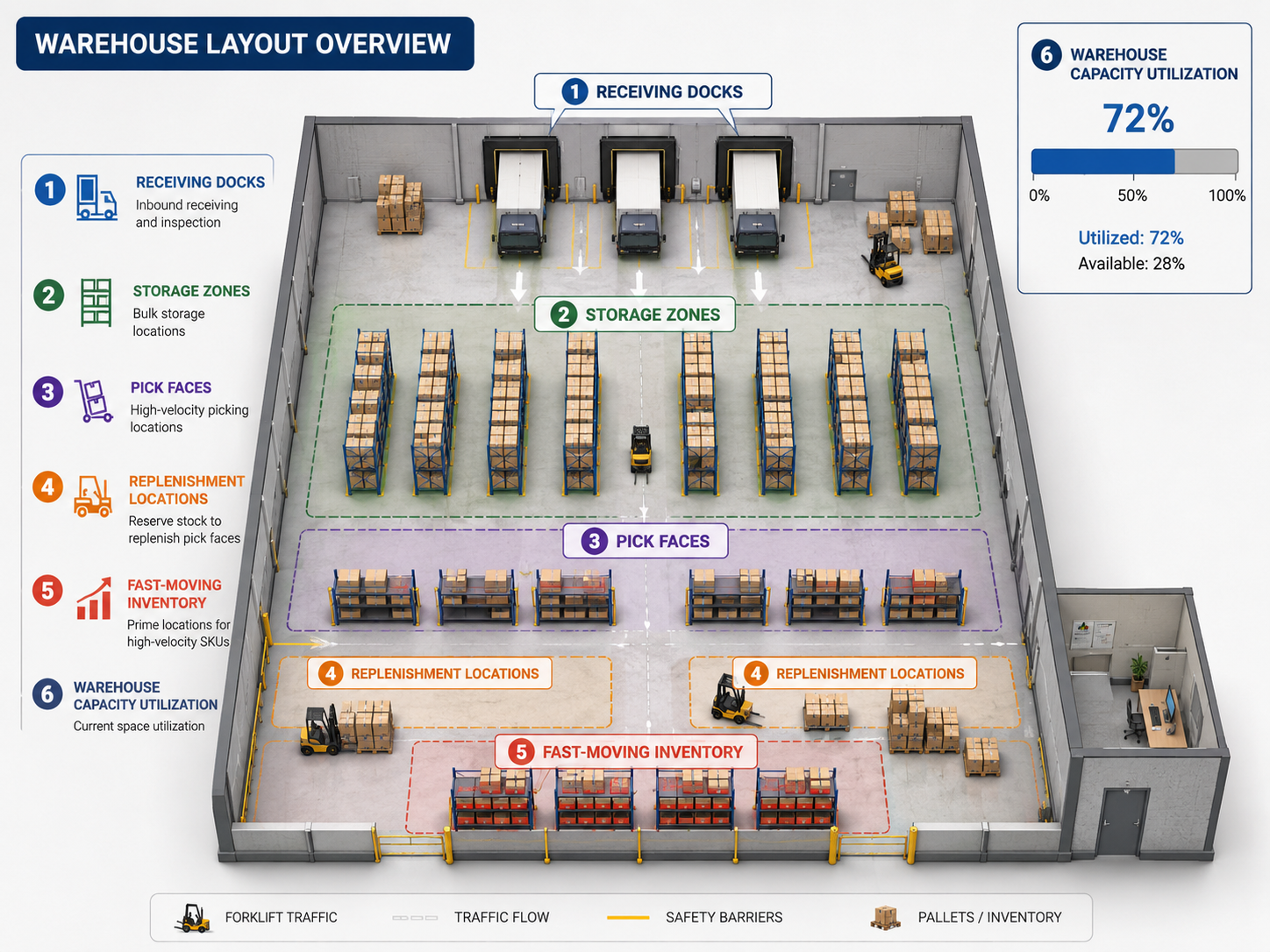
Picking Accuracy Should Protect Fulfillment Performance
Many warehouses try to improve picking speed before controlling picking accuracy. This can create a false performance gain. Orders move faster, but errors increase. Customer service teams handle complaints, warehouse teams process returns, and inventory records become less reliable.
A high-performance WMS should build accuracy into the picking workflow. Pickers should confirm the correct location, product, quantity, unit of measure, and order requirement before the pick is completed. Exceptions should be visible immediately, not discovered during packing or customer delivery.
For example, if a warehouse ships 50,000 orders per month and has a 1.5% picking error rate, 750 orders require correction, return handling, reshipment, or customer communication. If each exception costs $22 in labor, freight, and handling, monthly correction cost reaches $16,500 before considering customer satisfaction impact.
Picking controls should focus on:
Location verification
Product validation
Quantity confirmation
Exception handling
Order completion status
Hard rule: Make it impossible to confirm order picks when product, location, quantity, or order requirements do not match warehouse records. Business benefit: higher order accuracy, fewer returns, lower correction cost, and improved customer satisfaction. By making validation an absolute prerequisite for physical movement, the system locks out human error at the source, ensuring that operational velocity never comes at the expense of inventory integrity.
Replenishment Should Prevent Pick-Face Shortages
Warehouse replenishment should not wait until pick locations run empty. When pick faces stock out, orders pause, labor is redirected, and supervisors must solve problems that should have been visible earlier. Reactive replenishment creates interruptions across the entire fulfillment flow.
A stronger WMS treats replenishment as a preventive workflow. The system should monitor inventory consumption, order demand, pick-face capacity, reserve stock, and replenishment priority before shortages affect active picking. During seasonal peaks or high-volume order waves, this becomes especially important because small pick-face shortages can quickly become widespread order delays.
Replenishment controls should focus on:
Pick-face inventory thresholds
Reserve stock availability
Demand by order wave
Replenishment task ownership
Critical SKU priority
Hard rule: Make it impossible for critical picking locations to reach stock-out status without replenishment alerts, ownership, and action status. Business benefit: fewer fulfillment interruptions, better labor efficiency, smoother order flow, and higher warehouse productivity. By transforming inventory depletion from a passive crisis into an actively managed workflow, the system guarantees that pick faces remain perpetually charged, preventing empty bins from derailing outbound momentum.
Shipping Should Confirm Execution Before Inventory Leaves
Shipping is the final warehouse control point before inventory leaves the facility. Once an incorrect shipment leaves the dock, correction becomes more expensive. Wrong products, missing items, incorrect quantities, incomplete documentation, or carrier errors can create customer claims, replacement shipments, and operational rework.
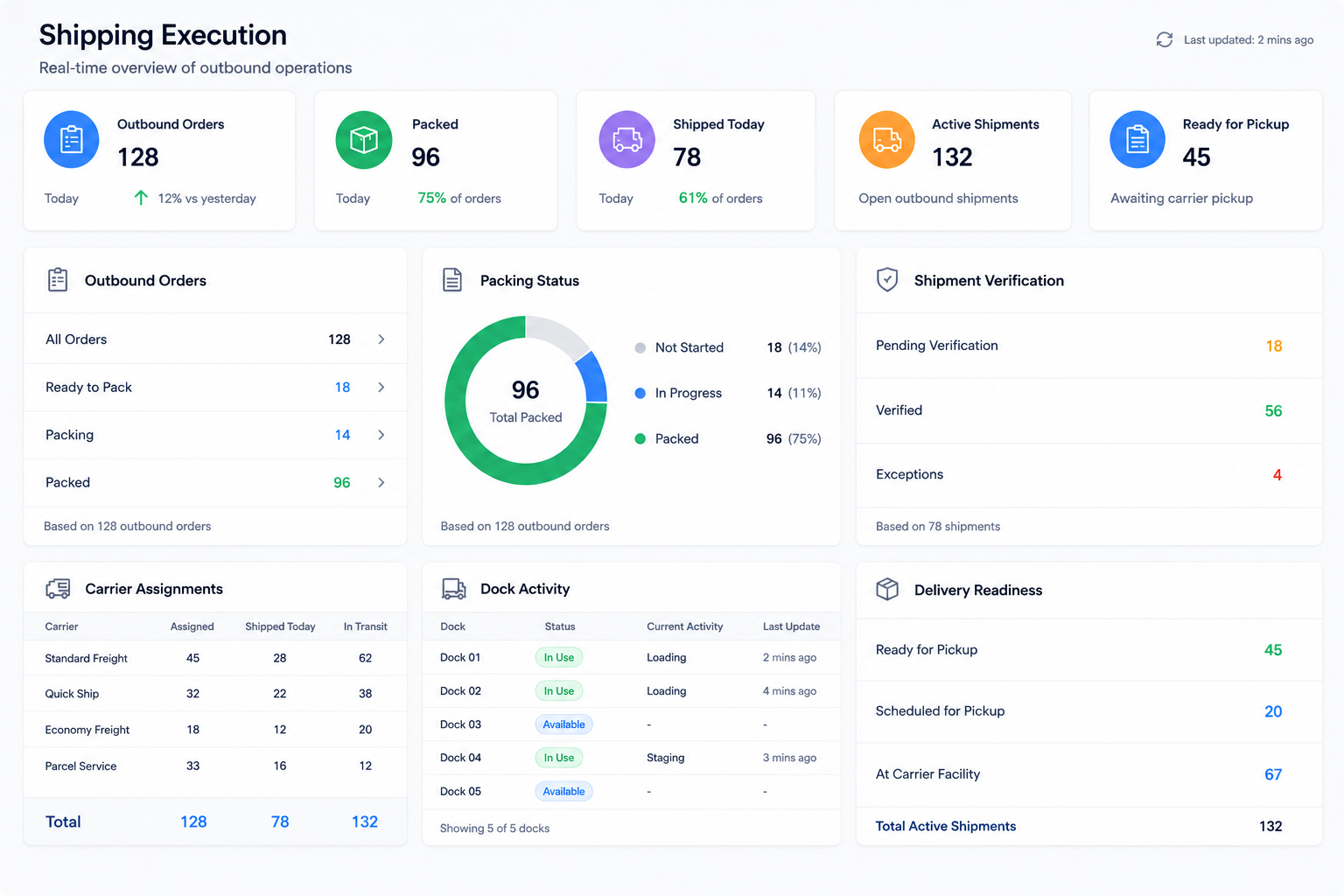
A WMS should verify that the order has completed the required warehouse process before release. Pick status, packing confirmation, shipment documentation, carrier assignment, routing requirements, and order completeness should be visible at the dock. Shipping should be treated as a release gate, not simply a loading activity.
Shipping controls should focus on:
Shipment verification
Packing confirmation
Order completeness validation
Carrier and routing confirmation
Shipment status visibility
Hard rule: Make it impossible to release shipments when order validation, packing verification, or shipping documentation remains incomplete. Business benefit: higher shipping accuracy, fewer customer claims, lower transportation rework, and stronger delivery performance.
The Fulfillment Readiness Score
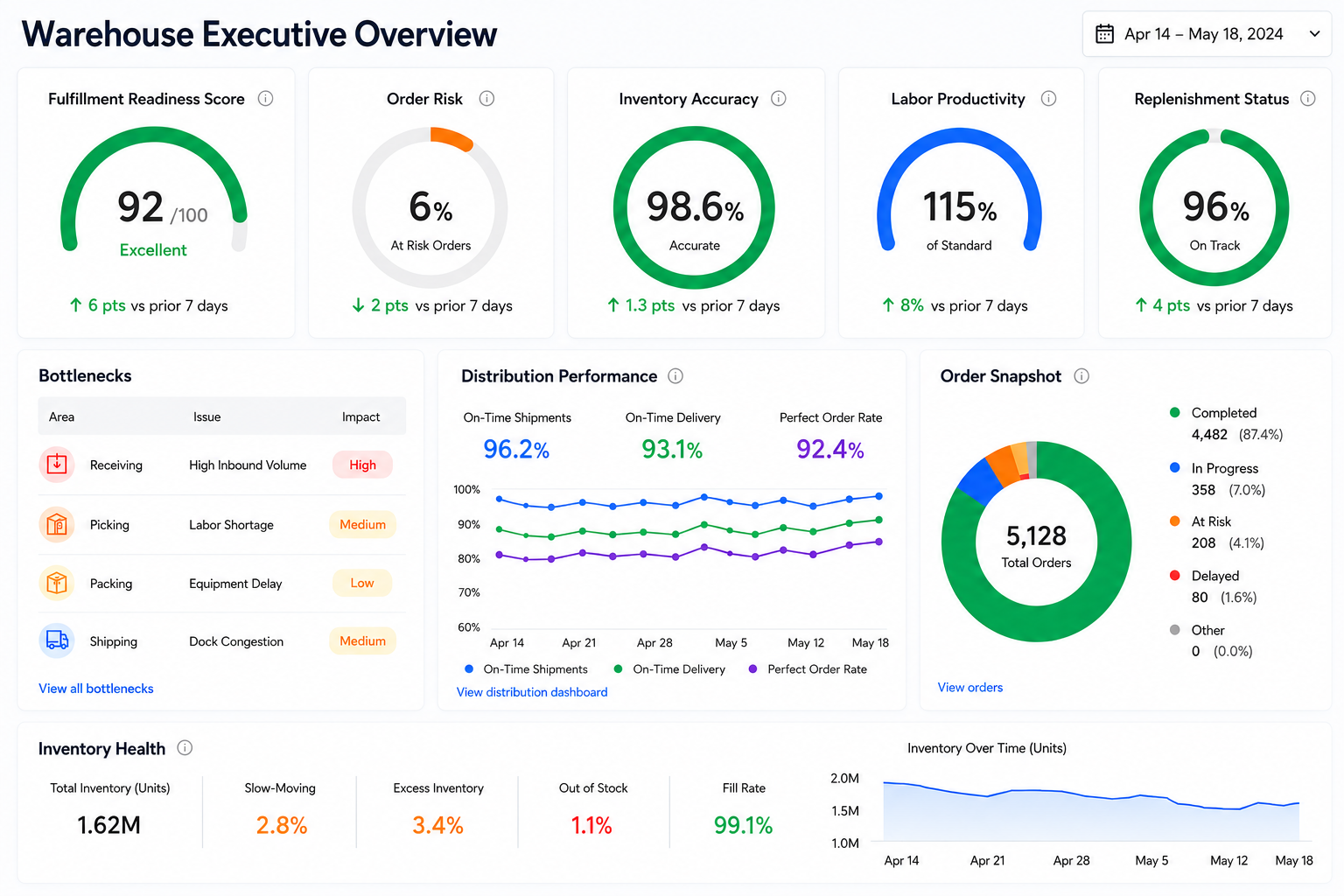
Warehouse leaders need a simple way to understand whether orders are truly ready to move. A practical framework is the Fulfillment Readiness Score, which evaluates whether inventory, labor, replenishment, picking, and shipping conditions support customer commitments.
A simplified formula can be expressed as: Fulfillment Readiness Score = Verified Inventory × Pick-Face Availability × Labor Readiness × Shipping Readiness. Each factor can be scored from 0 to 1. If verified inventory is 0.96, pick-face availability is 0.90, labor readiness is 0.85, and shipping readiness is 0.95, then: Fulfillment Readiness Score = 0.96 × 0.90 × 0.85 × 0.95 = 0.70. A score of 0.70 tells management that the warehouse may look active, but fulfillment risk is present. The purpose is not mathematical perfection. It is a practical operating view that helps leaders identify whether orders are likely to move accurately and on time.
Management should be able to answer:
Which orders are at risk of delay?
Which zones are creating bottlenecks?
Which SKUs have pick-face shortages?
Which inventory categories show accuracy issues?
Which labor activities create the greatest cost?
Which shipments need intervention today?
Why Companies Invest in Industry Software
Organizations invest in Industry Software when warehouse growth, inventory complexity, customer expectations, and fulfillment requirements exceed what spreadsheets, disconnected systems, and manual processes can reliably support. The value is not simply warehouse automation. The value is creating a connected execution workflow that links inventory, receiving, putaway, replenishment, picking, shipping, labor activity, and management visibility.
Industry Software supports warehouse performance through:
Cloud-based access across warehouse, operations, sales, and management teams
Modular deployment for receiving, inventory control, picking, replenishment, shipping, or dashboards
Configurable workflows for order release, inventory holds, replenishment tasks, exceptions, and shipping validation
Inventory accuracy controls that connect receiving, movement, cycle counting, and allocation
Fulfillment execution visibility across picking, packing, shipping, and customer order status
Warehouse performance dashboards for accuracy, throughput, labor, bottlenecks, and readiness
Dedicated implementation support for workflow setup, reporting, training, and ongoing optimization
Without this structure, warehouse teams spend time correcting errors after they occur. With Industry Software, organizations can identify warehouse risk earlier, improve fulfillment execution, reduce operating cost, and build a stronger distribution operation. By replacing reactive firefighting with preventative procedural guardrails, the platform locks in operational discipline, converting standard fulfillment chaos into a predictable, high-velocity distribution powerhouse.