Quality Control Should Start Before Defects Reach Inspection
Many companies still manage quality as a final checkpoint. Products are produced, inspected, rejected, corrected, and sometimes reworked before shipment. This approach may catch defects, but it does not prevent the same problems from recurring. The organization spends time fixing quality outcomes instead of controlling the conditions that create them.
Consider a manufacturer that produces 80,000 units per month. If 3% require rework and each rework case costs $18 in labor, material handling, and delay, monthly rework cost reaches $43,200 before considering schedule disruption or customer impact. The issue is not only the defect rate. The issue is that quality signals are not reaching the process early enough.
A preventive QMS should help teams identify defect patterns before they become repeated failures. Inspection results, process deviations, supplier issues, operator notes, and corrective actions should connect into one quality workflow. Quality should not be a department that reacts at the end. It should be a control system that influences production, supplier decisions, and process improvement while work is still moving.
Hard rule: Make it impossible for repeated defects to continue without root cause review, corrective action owner, and prevention plan. Business benefit: lower rework cost, faster defect containment, stronger process stability, and improved customer quality performance. Enforcing this strict quality loop ensures that recurring failures are blocked from becoming acceptable baseline operations, directly converting these mandatory investigative steps into verifiable cost reductions and stable manufacturing quality.
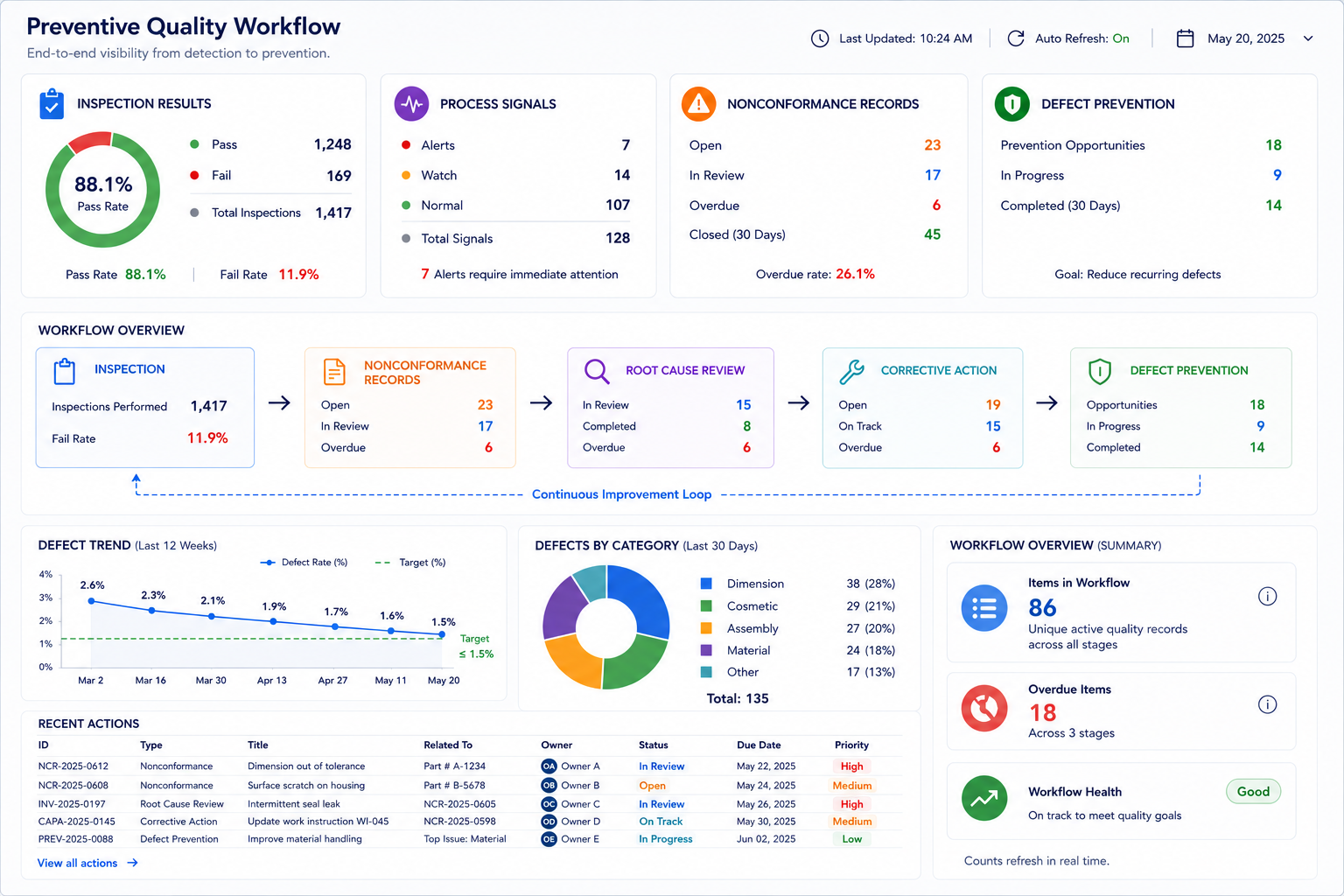
Inspection Data Should Become a Process Signal
Inspection data is often recorded, reviewed, and filed. That is not enough. If inspection results do not influence process decisions, quality teams may know what failed but not prevent the next failure. A modern QMS should turn inspection records into process signals. If dimensions drift toward tolerance limits, defect rates increase on a specific line, or one product family shows recurring failures, the system should highlight the trend before the batch is completed or before the next production run repeats the issue.
Inspection controls should focus on:
In-process inspection trends
Defect frequency by product, line, supplier, or shift
Tolerance drift and process deviation
Inspection hold and release status
Linkage between inspection results and corrective action
Hard rule: Make it impossible to release product when inspection results exceed defined quality thresholds without disposition, approval, and corrective action status. Business benefit: faster containment, fewer escaped defects, lower scrap and rework, and better production confidence.
Nonconformance Should Lead to Prevention, Not Just Documentation
Nonconformance records are valuable only when they drive action. If NCRs are used mainly to describe what went wrong, teams may create documentation without improving the process. The same defect can return under a different batch, operator, supplier, or production order.
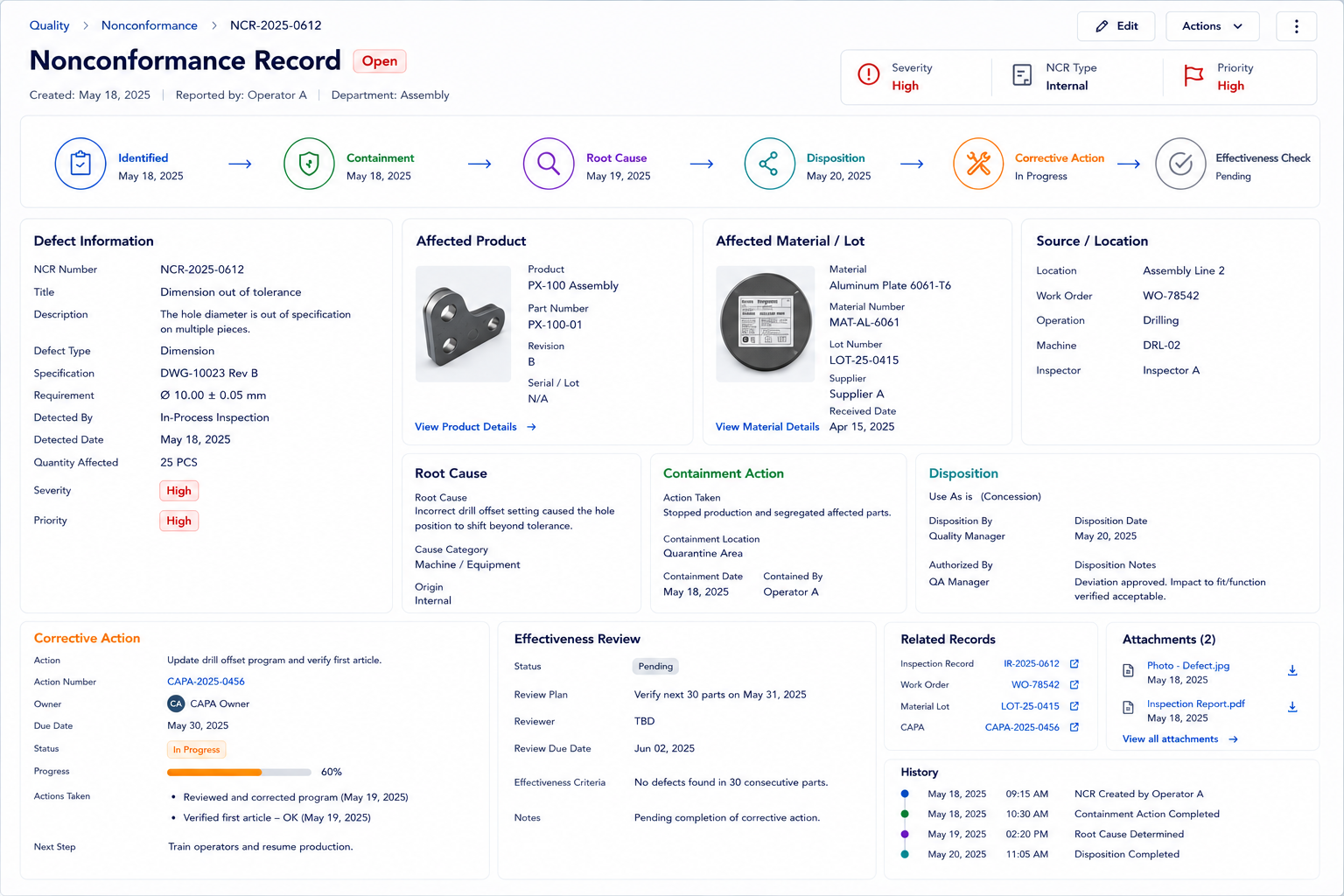
A stronger QMS should connect each nonconformance to root cause, containment, disposition, corrective action, and effectiveness review. The goal is not to create more records. The goal is to make sure quality problems move toward prevention instead of repeated correction. For example, a recurring surface defect may be recorded as separate incidents across multiple weeks. If those records are not connected, the problem looks like isolated quality noise. If the QMS links them by product, line, material lot, supplier, and process step, the pattern becomes visible and actionable.
Hard rule: Make it impossible to close a nonconformance without cause, disposition, corrective action decision, and verification of effectiveness. Business benefit: fewer repeat defects, stronger accountability, better audit readiness, and more reliable process improvement. Enforcing this absolute compliance gate ensures that quality issues are never prematurely dismissed, directly locking in these operational safeguards to turn everyday corrections into verifiable, long-term process integrity.
Corrective Actions Should Be Connected to Root Cause
Corrective action often fails when teams fix symptoms instead of causes. A defective part is reworked, an operator is reminded, or a supplier is notified, but the underlying process issue remains. The result is quality activity without quality improvement. By mistaking these superficial patches for permanent corrections, organizations trap themselves in a loop of repetitive errors, burning operational resources on firefighting instead of stabilizing the process to prevent the failure from returning.
A preventive QMS should require corrective actions to connect back to verified root cause. If the root cause is unclear, the action should not be treated as complete. If the action does not reduce recurrence, the review should reopen the issue or escalate it. This keeps CAPA from becoming an administrative checklist. Corrective action should answer three questions: what caused the issue, what changed in the process, and how the organization knows the change worked. Without that discipline, corrective actions can close in the system while defects continue in production.
Hard rule: Make it impossible to close corrective action without verified root cause, implemented process change, responsible owner, and effectiveness evidence. Business benefit: stronger defect prevention, fewer recurring issues, improved compliance discipline, and better use of quality resources.
Supplier Quality Should Be Part of the Same Control System
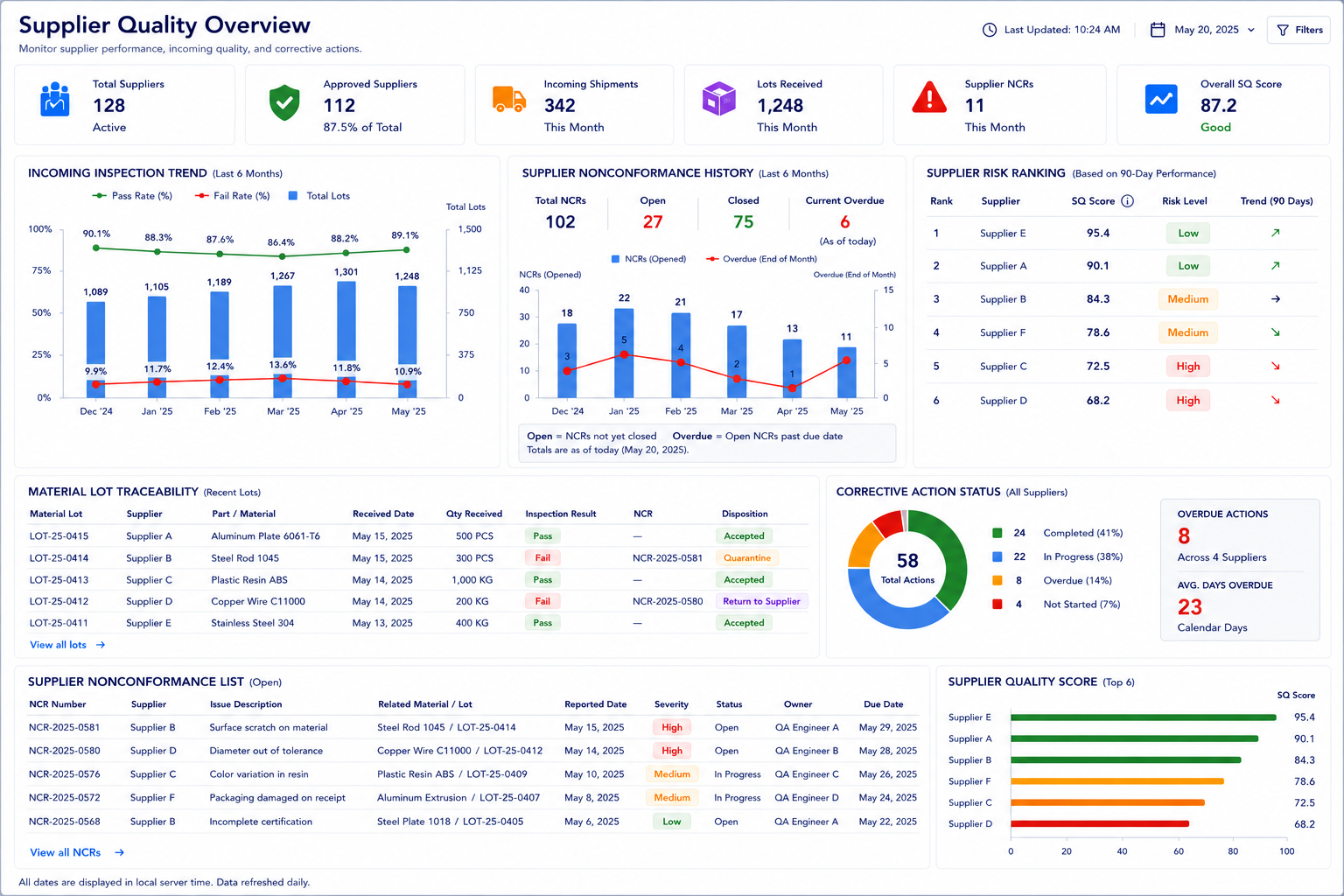
Many quality problems originate outside the factory. A supplier changes a material, ships inconsistent lots, misses documentation, or delivers parts that pass basic receipt checks but fail later in production. If supplier quality is managed separately from internal quality, teams may not see how supplier performance affects defects, rework, and customer delivery.
A QMS should connect supplier quality with inspection, nonconformance, corrective action, and production impact. Supplier issues should not remain isolated in procurement emails or receiving notes. They should become part of the quality record so teams can understand which suppliers create recurring risk and which materials require tighter control.
Supplier quality controls should include:
Incoming inspection results
Supplier nonconformance records
Material lot traceability
Supplier corrective action status
Supplier quality trend visibility
Hard rule: Make it impossible to approve continued supplier use for critical materials when unresolved quality issues, missing documentation, or repeated nonconformances remain open. Business benefit: fewer supplier-driven defects, stronger material control, better supplier accountability, and reduced production disruption.
Quality Holds Should Protect Customers and Production Flow
A quality hold is not simply a stop sign. It is a control point that protects customers, production flow, and the company’s reputation. Poorly managed holds create confusion. Materials may sit in limbo, production may continue with uncertain status, or teams may release products without clear disposition.
A strong QMS should make quality hold status visible and actionable. Teams should know what is on hold, why it is on hold, who owns the disposition, what evidence is required, and whether the affected material can be reworked, scrapped, returned, or released. The goal is to prevent both uncontrolled release and unnecessary delay. Quality hold management becomes especially important when defects affect multiple lots, suppliers, production orders, or customer shipments. The system should help teams understand the full scope of affected product before release decisions are made.
Hard rule: Make it impossible to release held material or product without disposition, approval, affected-scope review, and supporting evidence. Business benefit: fewer escaped defects, clearer production flow, faster disposition decisions, and stronger customer protection.
Management Needs Quality Risk Visibility
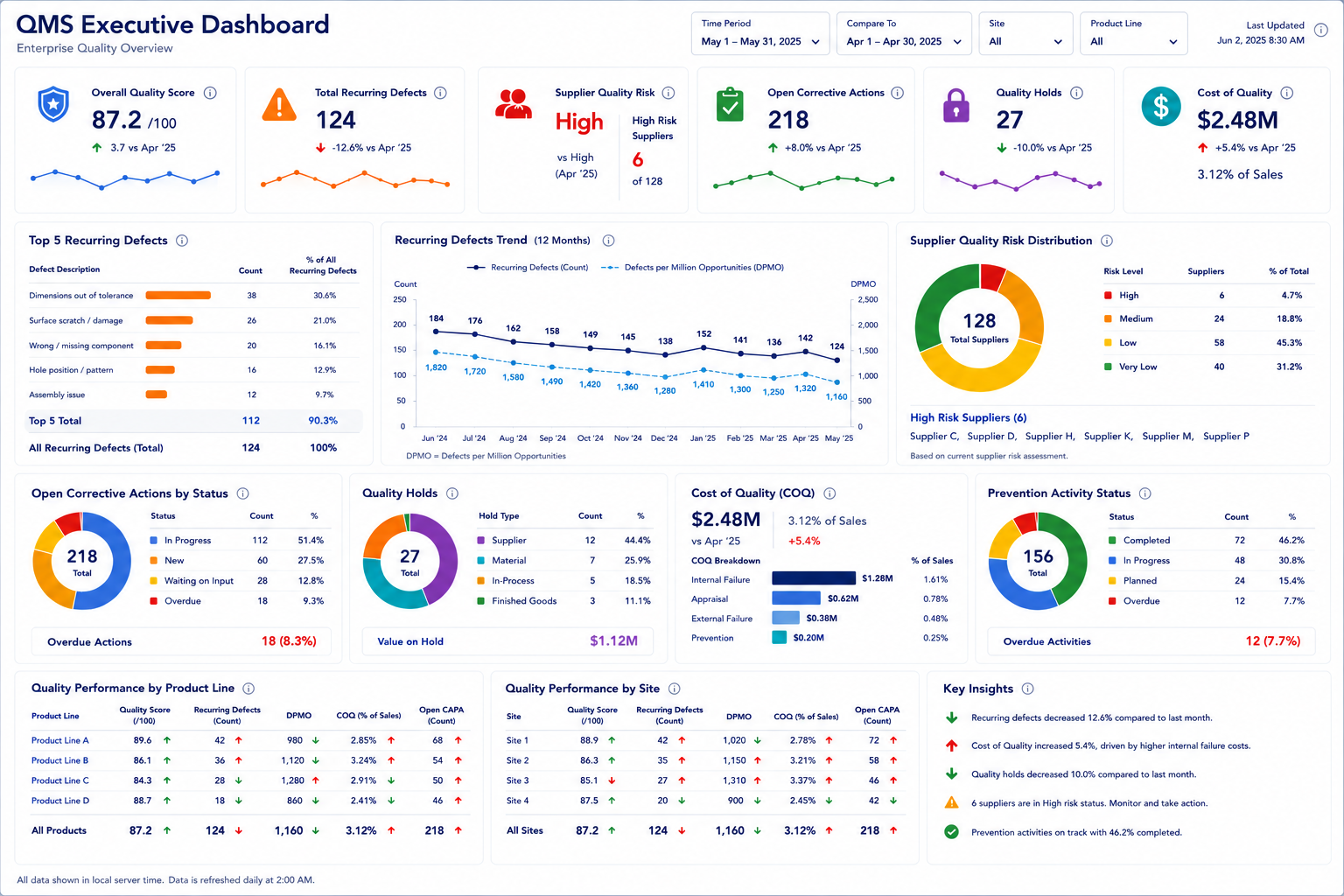
Management does not need only defect counts. Leaders need to understand where quality risk is forming, which problems are repeating, which suppliers are creating exposure, which corrective actions are overdue, and which products or processes need intervention. Shifting the focus from passive metrics to these actionable risk indicators allows executives to stop measuring failures after the fact and start directing targeted resources to stop quality drift before it compromises the business.
A useful QMS management view should answer:
Which defects are recurring?
Which products or lines show rising quality risk?
Which suppliers create the most quality exposure?
Which corrective actions are overdue or ineffective?
Which holds are affecting production or shipments?
Which quality issues require leadership escalation?
Without this view, management sees quality outcomes after cost has already been created. With preventive quality visibility, leaders can intervene earlier and allocate resources toward the root causes that matter most. Business benefit: faster management intervention, lower cost of quality, stronger compliance confidence, and better customer satisfaction.
Why Companies Invest in Industry Software
Companies invest in Industry Software when quality management has become too reactive, too manual, or too disconnected to prevent repeated problems. The value is not only recording inspections or storing quality documents. The value is creating a preventive quality workflow that connects defects, causes, actions, suppliers, holds, and management visibility.
Industry Software helps organizations start with the quality problem that creates the most business pressure. Some companies need stronger nonconformance control. Others need better supplier quality tracking, CAPA discipline, inspection visibility, or management reporting. Industry Software supports a practical path: solve the highest-risk quality workflow first, then expand into broader quality control, analytics, compliance, and continuous improvement.
Industry Software supports QMS through:
Inspection and nonconformance visibility
Corrective action and effectiveness tracking
Supplier quality management
Quality hold and disposition control
Executive quality risk dashboards
Cloud-based access across quality, production, procurement, and management teams
Dedicated implementation support for workflows, dashboards, reporting, and adoption
Without this structure, teams document quality issues after they happen. With Industry Software, organizations can identify patterns earlier, control quality risk before release, reduce repeated defects, and move from inspection and correction toward prevention. Breaking this cycle of hindsight allows quality teams to intercept failures at the source, transforming the entire department from a costly clean-up crew into an active driver of process reliability.
Final Summary
Quality Management Systems create value when inspection results, nonconformance records, corrective actions, supplier quality, quality holds, and management visibility become part of one preventive quality workflow. The goal is not only to find defects. The goal is to prevent defects from repeating and reaching customers.
Industry Software helps organizations build this QMS foundation through inspection visibility, nonconformance control, corrective action management, supplier quality workflows, quality hold control, executive dashboards, cloud-based access, and dedicated implementation support.