Why Product Complexity Needs Stronger Control
Product complexity is increasing faster than most organizations can manage. Engineering changes, supplier updates, compliance requirements, manufacturing improvements, and customer expectations all influence how products evolve over time. The challenge is no longer storing product information. The challenge is controlling how product decisions affect inventory, suppliers, manufacturing, quality, compliance, and business performance.
Product Lifecycle Management helps organizations create a controlled product environment where product data, engineering changes, documentation, supplier information, and release decisions remain connected throughout the product lifecycle. The objective is not simply to manage files. The objective is to improve product decisions before they create operational cost, quality issues, compliance risk, or production disruption.
Product Data Should Create a Trusted Product Record
Many organizations believe they have product data under control because drawings, specifications, bills of material, supplier records, and test reports exist somewhere inside the business. The challenge is not whether information exists. The challenge is whether everyone is working from the same information at the same time.
Engineering may reference one revision while manufacturing uses another. Procurement may source materials from an outdated supplier record. Quality teams may inspect against a superseded specification. These situations rarely result from poor intentions. They occur because product information becomes fragmented across departments, systems, and document repositories.
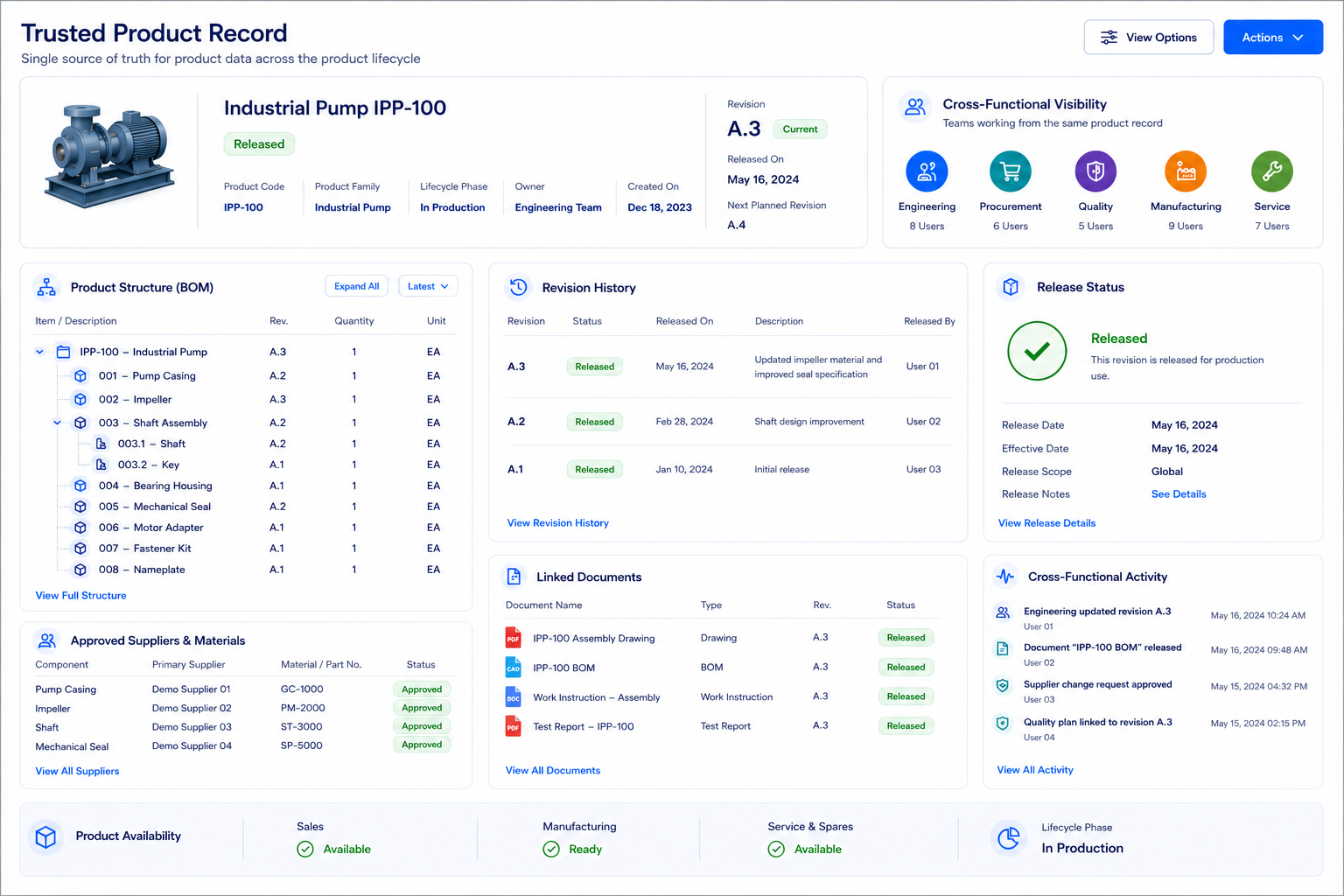
A strong PLM environment creates a trusted product record that connects product structures, revisions, approved materials, supplier information, documentation, and release status. Every department works from the same product definition, reducing the risk of conflicting decisions and improving confidence throughout the organization.
Product records should provide visibility into:
Product structure and revision status
Approved supplier and material records
Current manufacturing and quality requirements
Document approval and release history
Product availability for sales, production, and service
Hard rule: Make it impossible for engineering, procurement, quality, manufacturing, and service teams to work from different versions of product information. Business benefit: Better data consistency, fewer product errors, improved collaboration, and stronger product governance.
Engineering Changes Should Be Treated as Business Decisions
Engineering changes are often viewed as technical activities, but their consequences extend far beyond engineering. A component substitution may affect inventory value. A material change may require supplier requalification. A drawing revision may trigger manufacturing updates, compliance reviews, and customer communication.
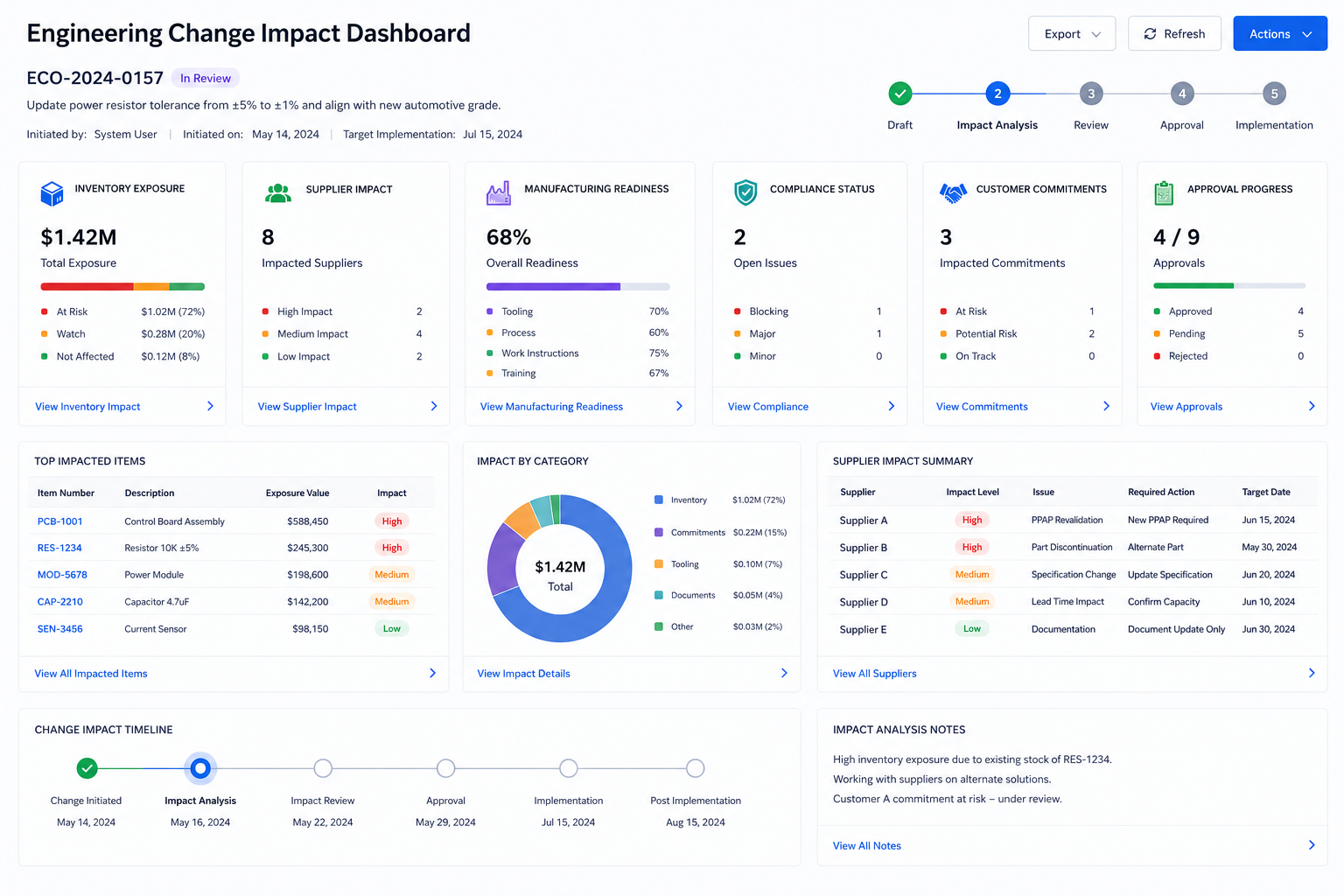
For this reason, engineering changes should be evaluated according to business impact rather than technical effort alone. A design improvement may look attractive from an engineering or margin perspective, but the broader business implications may include existing inventory exposure, supplier qualification requirements, documentation updates, manufacturing process adjustments, and customer delivery commitments.
Consider a design team that identifies a component capable of reducing material cost by $8 per unit. The opportunity appears attractive from a margin perspective. Further review reveals $120,000 of existing inventory exposure, supplier qualification requirements, documentation updates, and manufacturing process adjustments. The technical improvement remains valuable, but the broader business implications become equally important.
Leading organizations increasingly use structured impact reviews to evaluate change risk before approval. One useful approach is the Change Impact Index: Change Impact Index = (Affected Products × Inventory Exposure) ÷ (Change Readiness Score + Cross-Functional Completion Rate)
For example, a change affecting 12 active products with $180,000 of inventory exposure, a readiness score of 80, and a cross-functional completion rate of 90 generates a significantly higher impact score than a smaller change affecting four products and $40,000 of inventory exposure. The purpose of the metric is not mathematical precision. The purpose is visibility. It helps organizations identify which changes deserve deeper review before they create downstream cost.
Change reviews should consider:
Affected product structures and revisions
Inventory exposure and obsolete material risk
Supplier qualification requirements
Manufacturing instruction updates
Compliance and certification impact
Customer delivery commitments
Hard rule: Make it impossible to release an engineering change without visibility into inventory exposure, supplier impact, manufacturing readiness, quality requirements, compliance records, and customer commitments. Business benefit: Lower change costs, fewer obsolete materials, improved release decisions, and stronger cross-functional coordination.
Documentation Should Support Decisions, Not Just Storage
Many organizations already store drawings, specifications, certificates, test reports, work instructions, and compliance records. The challenge is determining whether those documents are current, approved, and relevant to the decision being made. A drawing may be correct for one revision but not another. A supplier certificate may apply to one material but not a replacement component. A manufacturing instruction may be valid in one facility but outdated in another. When employees must manually determine which documents are relevant, the organization becomes dependent on individual knowledge rather than controlled processes.
PLM should connect documentation directly to product context. Users should immediately understand document status, revision level, approval ownership, effective dates, and release readiness. This turns documentation from a passive storage layer into an active control point for engineering, quality, manufacturing, compliance, and service decisions.
Documentation controls should focus on:
Revision and effective-date traceability
Product and configuration linkage
Approval ownership
Release readiness
Retirement and replacement control
Hard rule: Make it impossible to release products, changes, or production packages when required documentation is missing, outdated, or unapproved. Business benefit: Faster audits, improved consistency, stronger compliance control, and reduced document-related errors.
Supplier Changes Should Not Break Product Control
Supplier changes are often treated as procurement decisions. In reality, many supplier changes are product changes. A supplier may discontinue a component, propose an alternative material, modify a manufacturing process, or update certification requirements. While these changes may improve availability or cost, they can also affect product performance, quality requirements, manufacturing methods, and regulatory compliance.
Organizations that manage supplier changes separately from product governance often discover problems later in production. Procurement may approve a substitute component to maintain supply continuity, while engineering, quality, and manufacturing remain unaware of the broader impact.
PLM helps connect supplier changes to product structures, approved materials, quality requirements, and compliance records. This ensures that supply decisions remain aligned with product requirements and release controls. It also gives procurement, engineering, quality, and manufacturing teams a shared view of supplier-driven product risk before release decisions are made.
Supplier-related reviews should focus on:
Approved supplier and material status
Alternative part approval workflows
Quality and compliance impact
Product release readiness
Manufacturing implications
Hard rule: Make it impossible to approve supplier-driven product changes without engineering review, quality assessment, compliance validation, and product impact visibility. Business benefit: Better supplier control, fewer quality issues, reduced compliance risk, and stronger product governance.
Manufacturing Readiness Should Be Confirmed Before Product Release
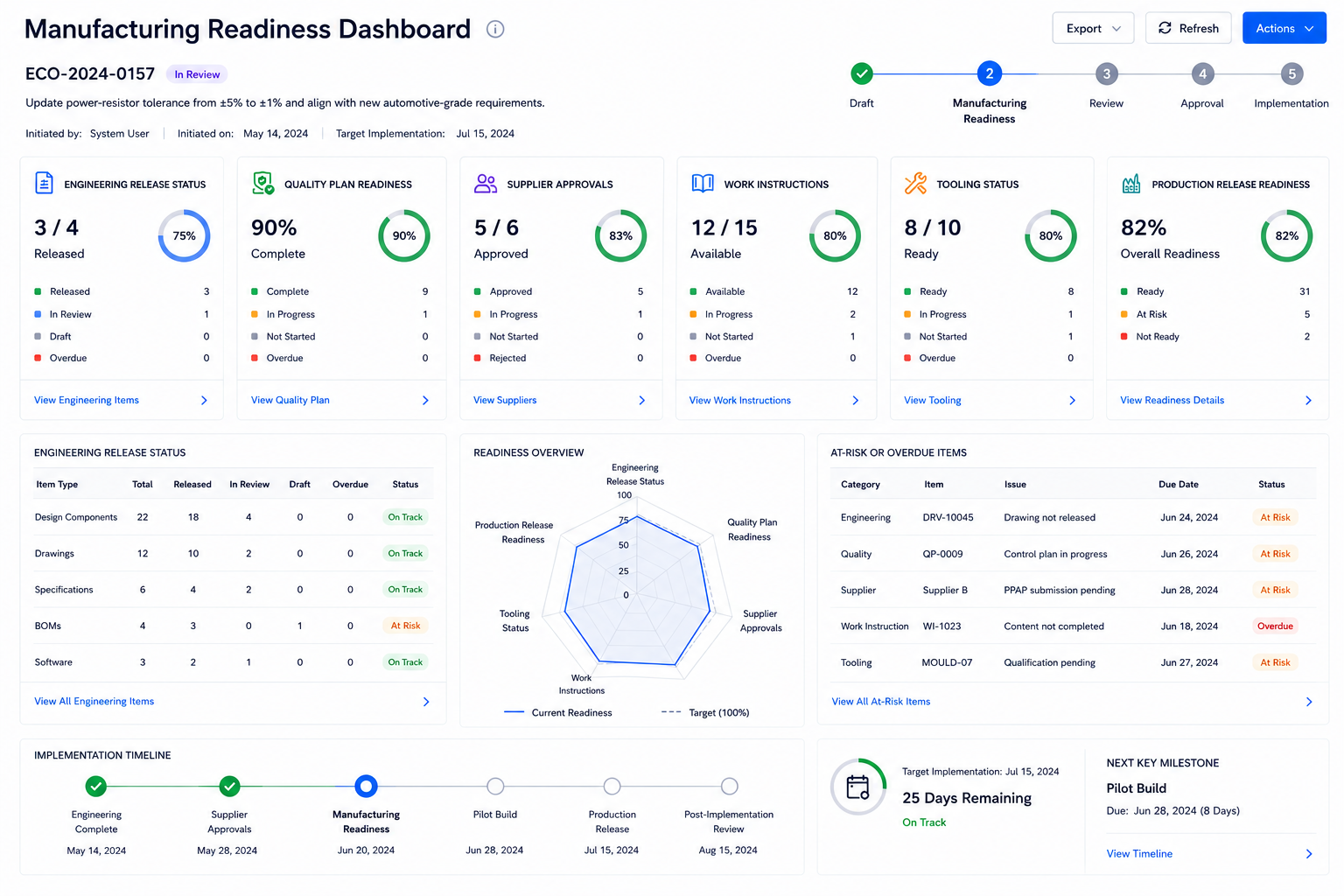
A product can be technically released yet still be operationally unprepared. Manufacturing may require updated work instructions, inspection plans, tooling information, material availability, supplier readiness, and employee training before production can begin successfully. When release decisions occur without operational readiness checks, manufacturing becomes the place where missing information is discovered. Production delays, quality holds, expedited purchasing, and rework often follow.
PLM should connect engineering release with manufacturing readiness. Before a product revision reaches production, the organization should verify that all supporting requirements are complete and available. Management does not need another dashboard that only shows ECO counts, release dates, and standard cycle times because those numbers merely explain the past. Instead, leaders need a view that shows exactly which engineering-to-production decisions must be made right now to prevent supply chain bottlenecks.
Manufacturing readiness should confirm:
Work instruction readiness
Routing and process updates
Inspection and quality plans
Material and supplier readiness
Training and implementation requirements
A global industrial equipment manufacturer processing more than 1,200 engineering changes annually struggled with coordination between engineering, procurement, quality, and manufacturing teams. Before implementing a structured PLM workflow, average ECO cycle times exceeded 23 days, nearly 18% of changes required approval rework, and change-related inventory write-offs exceeded $400,000 annually.
After connecting engineering changes, supplier reviews, documentation updates, manufacturing readiness checks, and approval workflows into a unified process, average ECO cycle times fell from 23 days to 9 days. Approval rework decreased by 54%, while inventory write-offs related to engineering changes declined by 41%. The most significant improvement was not approval speed. It was the reduction of information gaps between departments before product release.
Hard rule: Make it impossible to release a product revision to manufacturing when required work instructions, quality plans, material readiness, or process updates remain incomplete. Business benefit: Smoother production launches, fewer disruptions, lower rework costs, and stronger alignment between engineering and manufacturing.
From Product Data to Product Intelligence
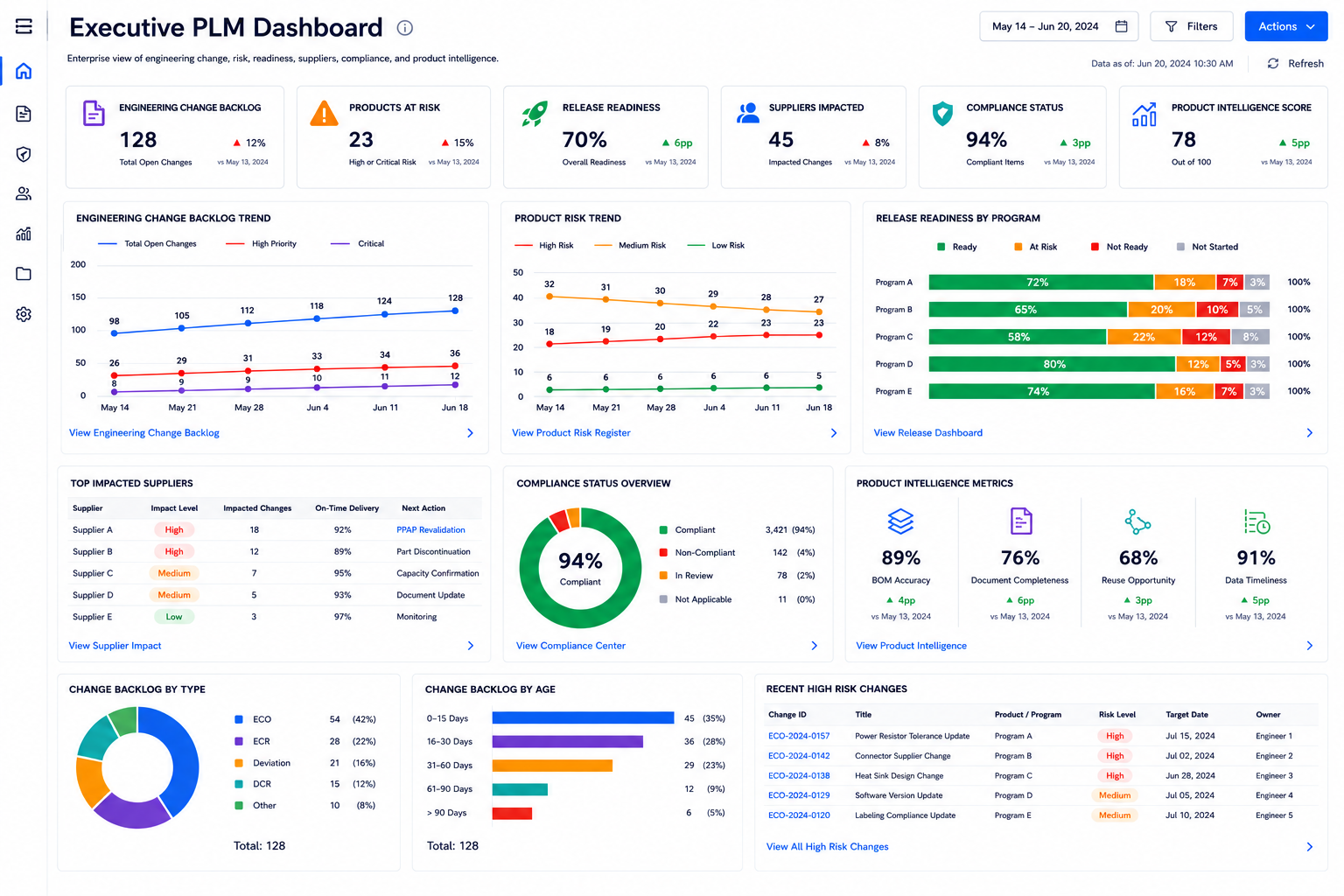
Most organizations begin their PLM journey by managing documents and revisions. The greatest value, however, emerges when product information becomes a source of business intelligence. Management teams need more than document counts and revision histories. They need visibility into recurring engineering changes, release bottlenecks, supplier-driven product risk, compliance exposure, and product performance trends.
This evolution can be viewed through a simple PLM maturity model:
Document Storage
Revision Control
Change Governance
Business Integration
Product Intelligence
Organizations at the first stages focus primarily on controlling files. Organizations at the higher stages use product information to improve manufacturing decisions, supplier management, quality performance, compliance readiness, and innovation planning. The objective is no longer managing product files. The objective is improving product decisions.
A product intelligence view should help management answer:
Which engineering changes are waiting for approval?
Which product releases are blocked?
Which suppliers generate recurring product risk?
Which product families experience the most change activity?
Which compliance requirements require attention?
Which owners must act before release?
Hard rule: Make it impossible to measure PLM success only through document control when product information can support operational decisions and strategic planning. Business benefit: Better governance, stronger management visibility, improved innovation control, and clearer insight into product-related risk.
Why Companies Buy Industry Software
Companies buy Industry Software when product complexity has become difficult to control through folders, spreadsheets, emails, local copies, and disconnected departmental systems. The value is not simply storing product documents in one place. The value is creating a controlled product workflow that connects engineering data, change decisions, documentation, suppliers, manufacturing readiness, compliance records, and management visibility.
Industry Software helps product-centric organizations move from product control to product intelligence. Teams can start with the workflow that creates the most pressure, such as engineering change control, documentation governance, supplier change review, release readiness, or product risk visibility. As needs expand, the system can grow through modular deployment rather than forcing a full process replacement at once.
Industry Software supports PLM through:
Cloud-based access so engineering, procurement, quality, manufacturing, service, and management teams can work from updated product information across locations
Modular deployment for product data control, engineering change management, documentation governance, supplier review, release readiness, or dashboards
Configurable workflows for change approvals, release gates, documentation review, supplier impact checks, and manufacturing readiness
Product data control that keeps structures, revisions, documents, suppliers, and release status traceable
Change impact visibility that connects engineering decisions with inventory, supplier, quality, compliance, manufacturing, and customer impact
Product intelligence dashboards for change backlog, release readiness, supplier-driven risk, compliance exposure, and product decision trends
Dedicated implementation support for workflow setup, product data structure, document control, dashboards, user training, and ongoing optimization
Without this structure, teams spend time searching, validating, correcting, and explaining product information after problems appear. With Industry Software, organizations can control product change earlier, reduce rework, improve release readiness, and turn product data into product intelligence.
Turning PLM Into Better Product Decisions
Product Lifecycle Management creates value when product data, engineering changes, documentation, supplier information, manufacturing requirements, compliance records, and release decisions become part of one controlled product workflow. The goal is not only to manage files or revisions. The goal is to help companies control product complexity, reduce change-related cost, improve release readiness, and make better product decisions.
Industry Software helps product-centric organizations build this foundation through cloud-based access, modular deployment, configurable workflows, product data control, change impact visibility, product intelligence dashboards, and dedicated implementation support.