Inventory Optimization Software: How Better Stock Control Improves Operations

Summary
×Inventory Problems Become Expensive When Stock Is Visible but Not Controllable
A company can have inventory data and still make poor inventory decisions. An industrial distributor can show enough stock across its network but lose 12% of urgent orders in a month because promised items are in the wrong branch, under inspection, or already reserved. A discrete manufacturer can lose 40 minutes per shift because operators wait for material that appears available in the system but has not been cleared for the current production order.
The issue is not simply stock accuracy. The deeper issue is that inventory status, location, demand timing, replenishment logic, and ownership are not connected into operating rules. When stock data does not tell teams what can be promised, used, transferred, replenished, or held, the company still depends on messages, manual checks, and last-minute decisions. The sharper question is: can this stock support this order, production run, service job, or shipment right now? If the answer is unclear, the inventory system is still reporting stock instead of controlling stock.
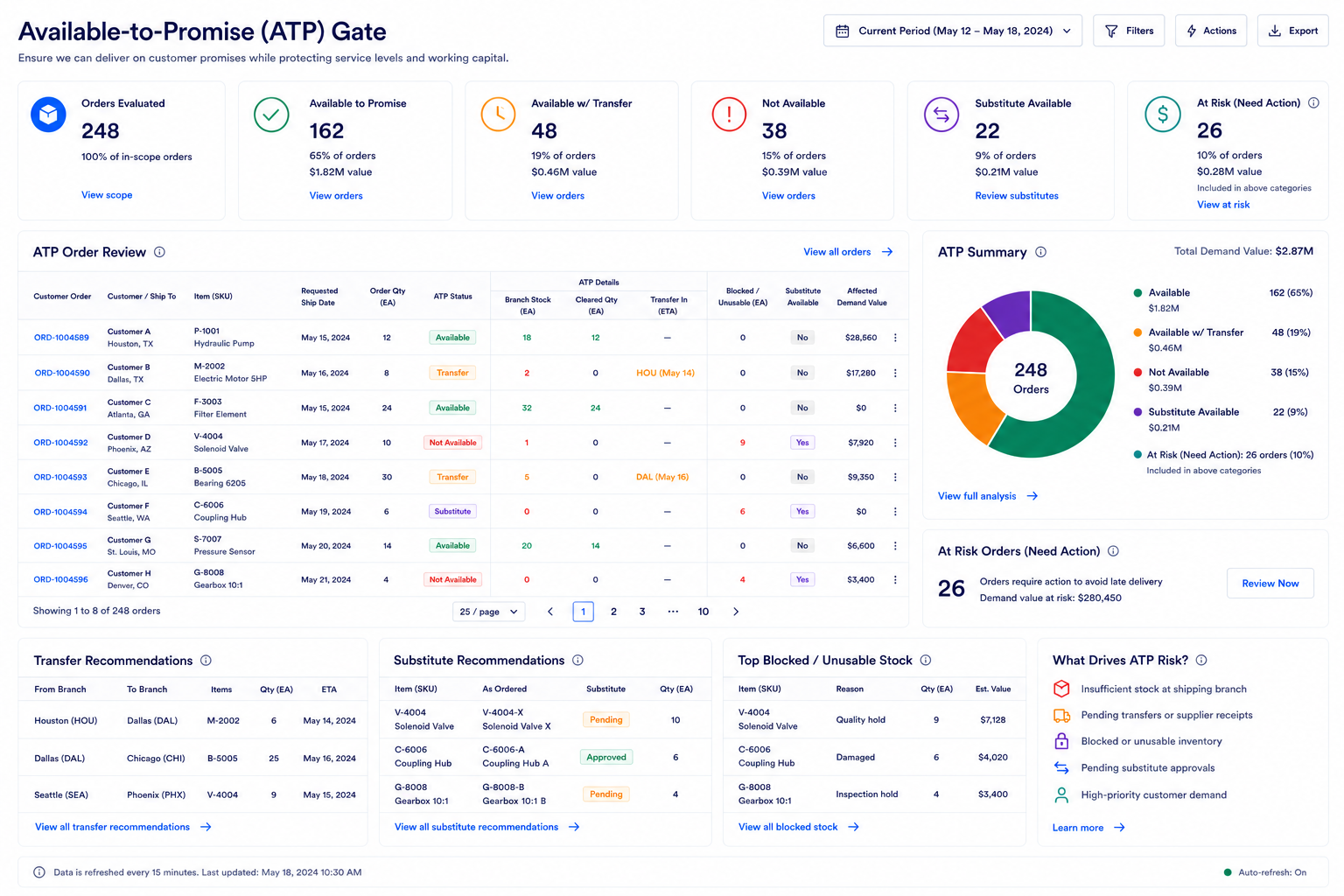
Industrial Distributors Need an Available-to-Promise Gate
Industrial distributors lose time and revenue when sales teams promise stock that cannot actually ship. A bearing, valve, cable, fastener, or control component can appear in total inventory, but that does not mean it can support tomorrow’s customer delivery. Stock in another branch, stock waiting for inspection, stock reserved for another order, and stock available only through an approved substitute should not be treated the same.
An available-to-promise gate makes customer commitments depend on stock that is truly usable for the order:
Block order promise: Make it impossible to promise a customer delivery date when the required stock is not available, cleared, and located to support the shipment window.
Check branch and transfer timing: Allow cross-branch stock only when transfer time can still meet the customer date.
Remove restricted stock from promise quantity: Exclude inspection-pending, damaged, returned, reserved, or blocked inventory from available-to-promise calculations.
Control substitute offers: Require approval before a similar item is offered as a replacement.
Show the affected customer order: Link each availability issue to the order, customer date, and responsible owner.
This changes inventory from a quantity report into a sales commitment rule. Sales can promise with more confidence, warehouse teams know what must move, and management can see whether lost orders are caused by shortage, wrong-location inventory, blocked stock, or weak replenishment.
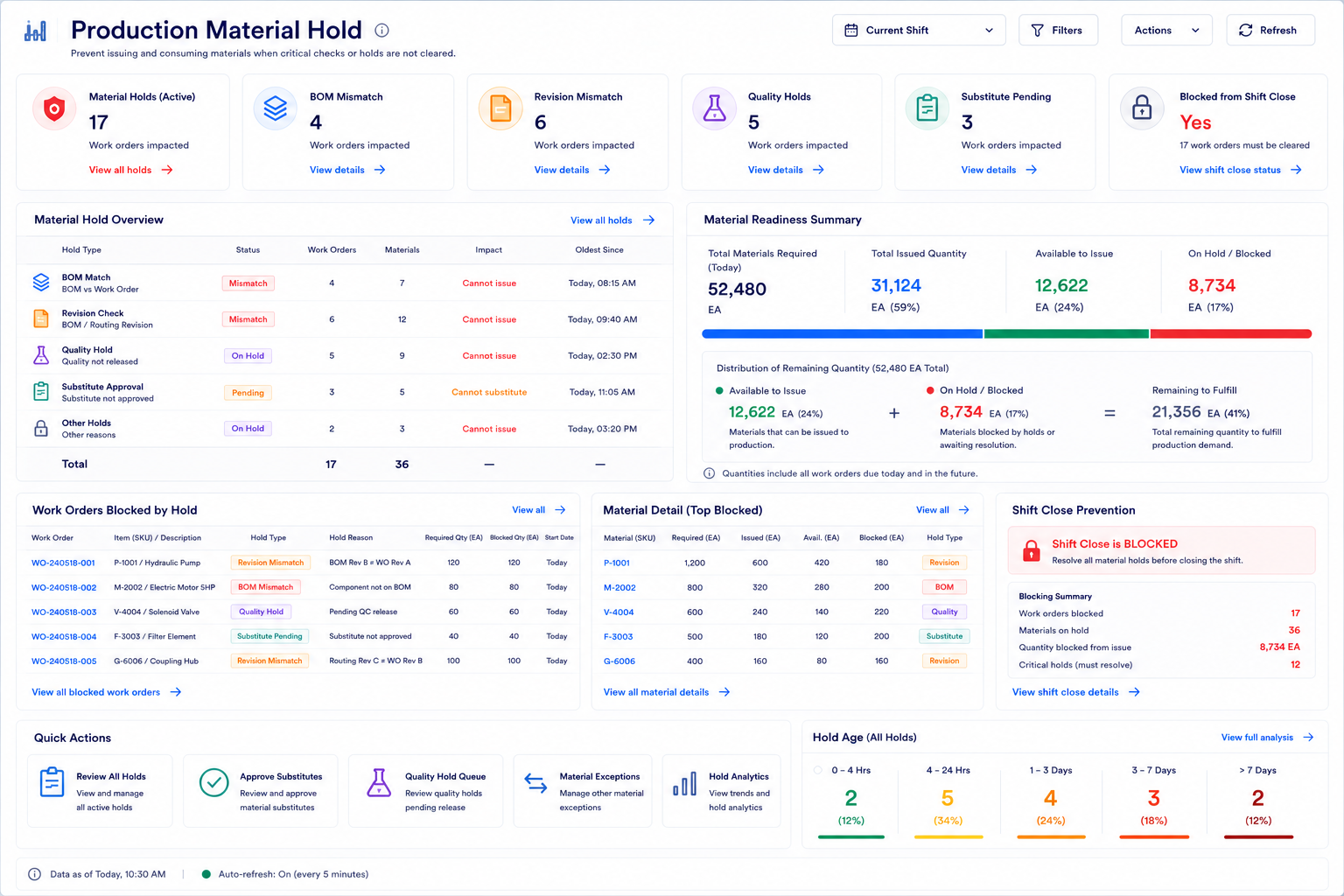
Discrete Manufacturers Need a Production Material Hold
In discrete manufacturing, a work order can fail because one low-cost component is not production-ready. A sensor can have the wrong revision, a gasket can sit under quality hold, a machined part can remain unissued to the line, or a critical connector can be reserved for another job. The system can show inventory on hand, while production still cannot run.
A production material hold stops the work order before operators discover the shortage at the station:
Match material to the BOM: Confirm item, revision, quantity, lot, and required date before production release.
Hold restricted material: Prevent quality-hold, inspection-pending, reserved, or unissued stock from supporting a production order.
Require substitute approval: Route alternate components to engineering or quality before they can be consumed.
Mark non-executable orders: Show supervisors which work orders cannot run because one required material is not ready.
Track consumption to the job: Connect issued, consumed, scrapped, and returned material to the correct work order.
Prevent shift closure: Make it impossible to close a shift while any work order is blocked by material that is visible but not cleared for production.
Service Teams Need a Service Parts Lock
Service companies often carry expensive spare parts and still miss appointment windows. The part can exist somewhere in the network, but not in the city, branch, vehicle, or service location where the technician needs it. This creates a costly pattern: high inventory value, weak service reliability, and repeated emergency transfers.
A service parts lock protects critical parts for confirmed work before they are consumed by lower-priority demand:
Lock parts to confirmed jobs: Reserve critical spare parts for scheduled service work instead of leaving them open for general use.
Protect high-impact parts: Require approval before a critical part is consumed by a lower-priority task.
Recommend transfer before purchase: Check branch, service warehouse, or van stock transfer options before triggering a new order.
Escalate service risk: Alert the service owner when a missing part threatens a committed appointment or SLA.
Review idle high-value parts: Flag expensive parts with little or no recent usage for transfer, reduction, or management review.
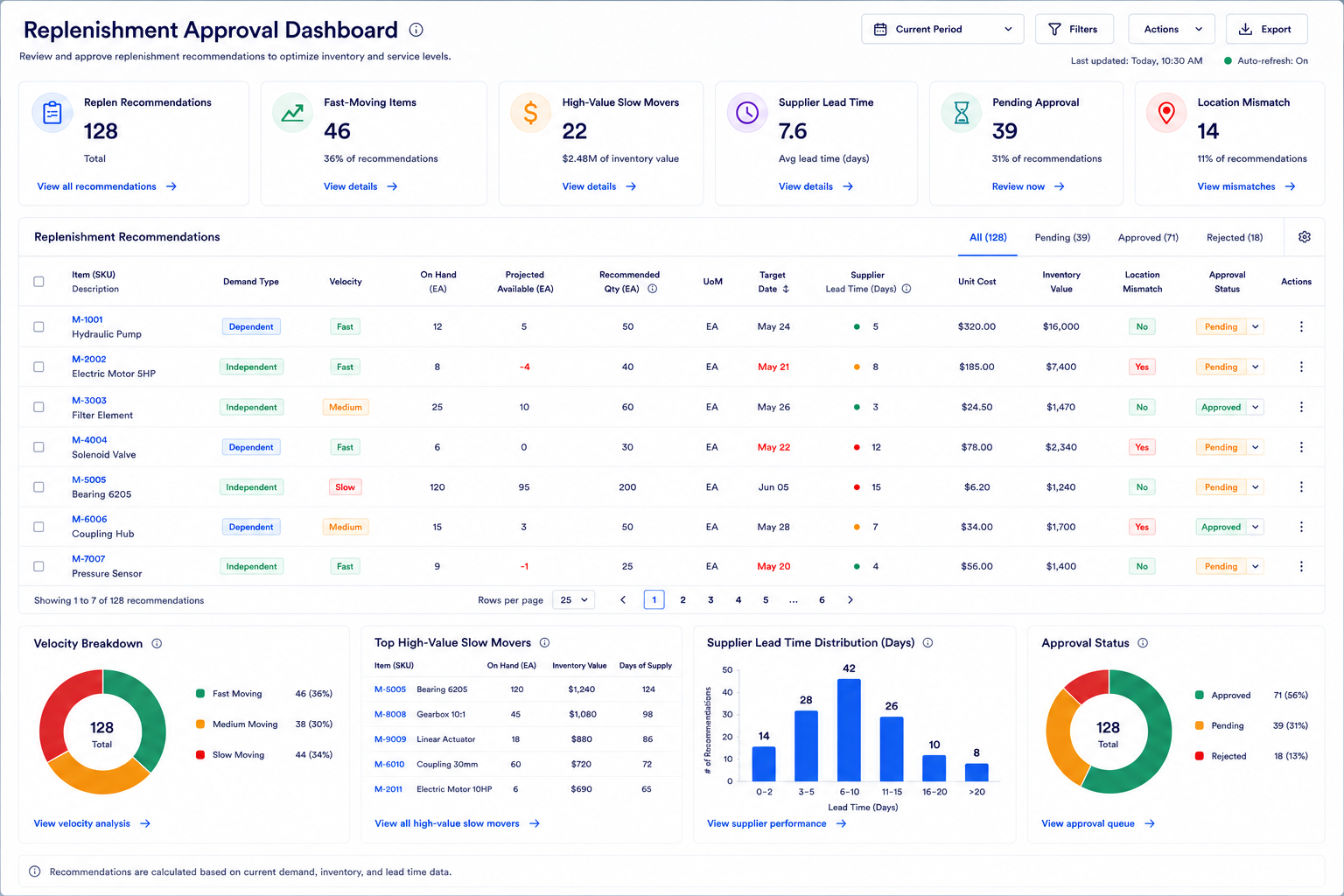
Replenishment Needs an Approval Gate Based on Item Behavior
Replenishment fails when every item follows the same rule. Fast-moving consumables, seasonal products, customer-specific components, critical production parts, and high-value spare parts should not be purchased with the same logic. One item can need automatic replenishment, while another should require approval before one more unit is bought.
A replenishment approval gate applies different rules before the purchase suggestion becomes an order:
Separate demand types: Treat confirmed orders, forecast demand, production demand, service demand, and branch demand differently.
Apply item behavior rules: Use different logic for fast-moving, slow-moving, seasonal, critical, and customer-specific items.
Require approval for high-value slow movers: Stop expensive parts from being reordered automatically just because they fall below a minimum level.
Include supplier timing: Use lead time, lead time variability, minimum order quantity, and package size before recommending purchase.
Flag location mismatch: Mark items that are short in one branch while excessive in another before procurement buys more.
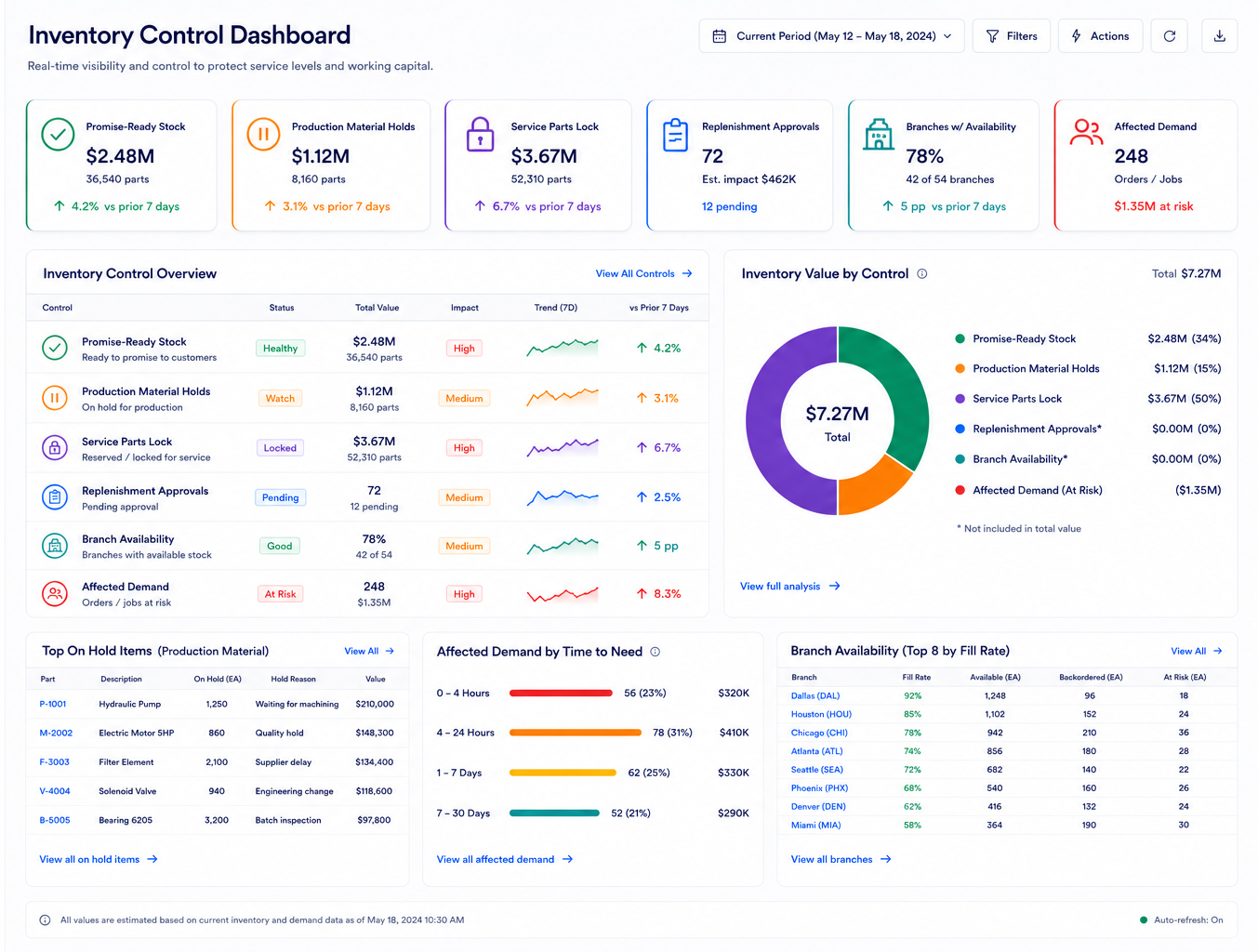
Management Needs an Inventory Action View
Management does not need another dashboard that only shows inventory value, total quantity, turnover, and aging. Those numbers explain the past. Leaders need a view that shows which inventory decisions must be made now. They need clear signals on what to discount, what to reorder, and where capital is trapped today. A true executive tool doesn't just report history; it drives immediate action.
A useful inventory action view should answer:
Which customer orders cannot be promised because stock is not cleared?
Which production orders are blocked by material that is visible but not usable?
Which service jobs are at risk because the part is in the wrong location?
Which replenishment suggestions need approval before cash is committed?
Which items are short in one location and excessive in another?
Which high-value parts are idle and need review?
Which owner must act today to protect delivery, output, service, or cash?
Without this view, teams argue about inventory totals after the business has already slowed down. With it, managers can decide what to buy, transfer, substitute, lock, release, or reduce before the issue reaches customers, production, or service teams. Without this view, companies buy more inventory hoping to fix availability. With it, they know exactly which stock is promise-ready and which is not.
How Industry Software Supports Promise-Ready Inventory Before Operations Slow Down
Industry Software helps companies build promise-ready inventory by connecting availability rules, production material holds, service parts locks, replenishment approval gates, and inventory action dashboards into one practical stock control workflow. Management does not need another dashboard that only shows inventory value, total quantity, turnover, and aging—those numbers merely explain the past. Instead, this unified workflow gives leaders the exact view they need to see which critical inventory decisions must be made right now.
The platform helps operations teams:
Start with the highest-impact inventory problem: Deploy by module, such as available-to-promise control, production material clearance, service parts protection, replenishment approval, or management dashboards.
Configure rules around real inventory behavior: Set different logic for branch stock, production material, critical spare parts, high-value slow movers, customer-specific items, and substitute options.
Support cloud-based visibility: Keep branches, warehouses, plants, service teams, procurement, finance, and management working from updated inventory information.
Refine workflows quickly: Adjust availability rules, approval paths, transfer logic, replenishment thresholds, item categories, and dashboard views as operating conditions change.
Without this structure, inventory systems show what exists but do not control what can be promised or used. With Industry Software, companies can turn stock data into clearer customer commitments, production readiness, service reliability, replenishment discipline, and management action. Inventory without control is just a cost; controlled inventory becomes a competitive lever.