Slow Quotes Usually Start Before Sales Writes the Proposal
In complex sales, quote delays rarely begin when a salesperson opens the proposal template. They usually begin much earlier, when product options are unclear, service scope is incomplete, pricing rules are inconsistent, or approval requirements are handled outside the quoting workflow.
Consider an industrial automation equipment manufacturer selling customized robotic systems, controls integration, commissioning services, and long-term maintenance contracts. Before implementing a structured CPQ workflow, average quote cycle time exceeded 14 days. More than 37% of quotes were submitted below target margin levels, and approval rework affected over half of complex opportunities.
After connecting configuration rules, pricing controls, service scope management, and approval workflows within a single CPQ process, average quote cycle time fell to 3.5 days. Below-target-margin quotes decreased from 37% to 12%, while approval rework dropped from 52% to 18%.
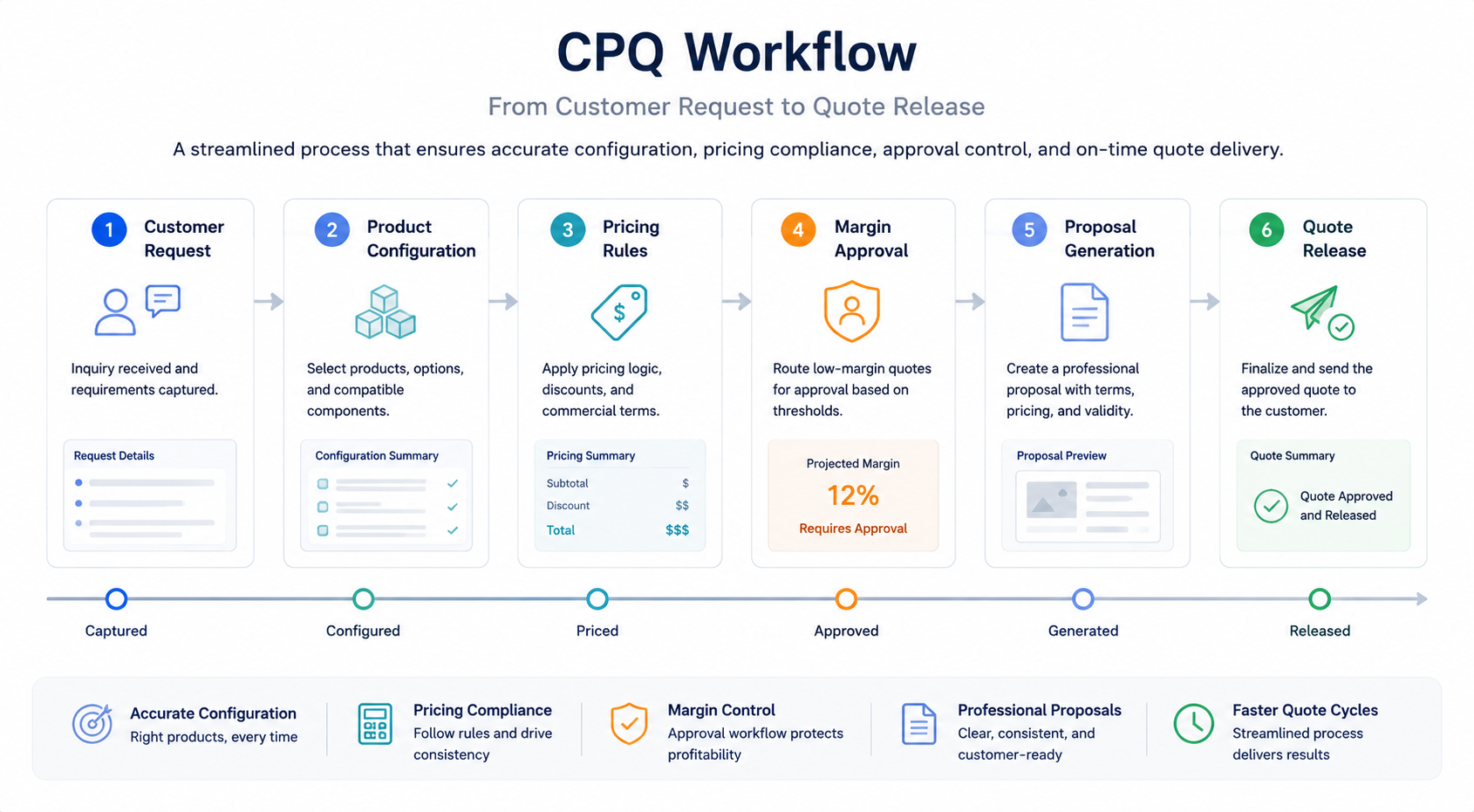
The most significant improvement was not speed. It was consistency. Sales, engineering, finance, and delivery teams began working from the same commercial assumptions before proposals reached customers. CPQ creates value when product configuration, pricing, approvals, and proposal generation become part of one controlled workflow rather than a collection of disconnected activities.
Hard rule: Make it impossible to release a quote when configuration rules, pricing logic, margin approval, or service scope remain incomplete. Business benefit: Faster quote turnaround, fewer quote revisions, stronger customer confidence, and better commercial control.
The Quote Health Index
Many organizations evaluate quoting performance through quote volume or response time. While useful, these metrics do not reveal whether a quote is actually ready to move through the business. A stronger approach is to evaluate quote quality through configuration readiness, margin compliance, approval efficiency, and service completeness. One practical metric is the Quote Health Index. Quote Health Index = (Configuration Completeness × Margin Compliance) ÷ (Approval Cycle Days + Missing Service Scope Items).
For example, a complex industrial equipment quote has:
Configuration Completeness = 95%
Margin Compliance = 88%
Approval Cycle = 3.5 Days
Missing Service Scope Items = 2
The resulting Quote Health Index is: (0.95 × 0.88) ÷ (3.5 + 2) = 0.15. A second quote with complete configuration, approved pricing, and no missing service scope achieves a substantially higher score. The purpose is not mathematical precision. The purpose is visibility. Management gains an objective way to identify quote risk before delays, margin problems, or delivery issues occur. Business benefit: Earlier quote risk visibility, stronger prioritization, faster intervention, and improved proposal quality.
Product Configuration Should Prevent Sales From Quoting What Cannot Be Delivered
Complex products often include dependencies, exclusions, accessories, warranties, service levels, implementation requirements, and regional constraints. A configuration may appear reasonable to sales but later fail engineering or operational review. CPQ software should guide sales through valid product and service combinations. The system should understand which options can be sold together, which components are required, which selections require engineering review, and which configurations create delivery risk.
For example, a customer may request a machine package with a high-output component, custom controls, remote monitoring, and extended service coverage. If the selected component requires a specific control module or special installation conditions, CPQ should identify that dependency immediately rather than waiting for engineering review after the proposal has been prepared.
Configuration controls should focus on:
Valid option combinations
Required component rules
Engineering review triggers
Service compatibility requirements
Delivery and installation constraints
Hard rule: Make it impossible to submit a customer quote when selected product options are incompatible, required components are missing, or engineering review remains incomplete. Business benefit: Fewer invalid quotes, reduced engineering rework, smoother handoff, and stronger proposal reliability.
Pricing Should Protect Margin Before the Deal Is Won
Winning a deal is not the same as winning profitable revenue. Margin often disappears through discounting, bundled services, freight assumptions, implementation effort, special terms, and manual pricing adjustments. By the time finance reviews profitability, the quote may already be committed to the customer. A strong CPQ workflow should show margin while the quote is being built. When sales changes pricing, adds service, modifies quantities, or adjusts terms, the system should immediately recalculate commercial impact.
Pricing controls should focus on:
Customer-specific pricing rules
Discount thresholds
Margin visibility during quote creation
Approval routing for exceptions
Service, freight, and implementation cost inclusion
Hard rule: Make it impossible to release a quote below approved margin thresholds without pricing approval, documented justification, and updated margin visibility. Business benefit: Stronger margin protection, fewer underpriced deals, faster approvals, and improved commercial discipline.
Service Scope Should Be Quoted With the Product
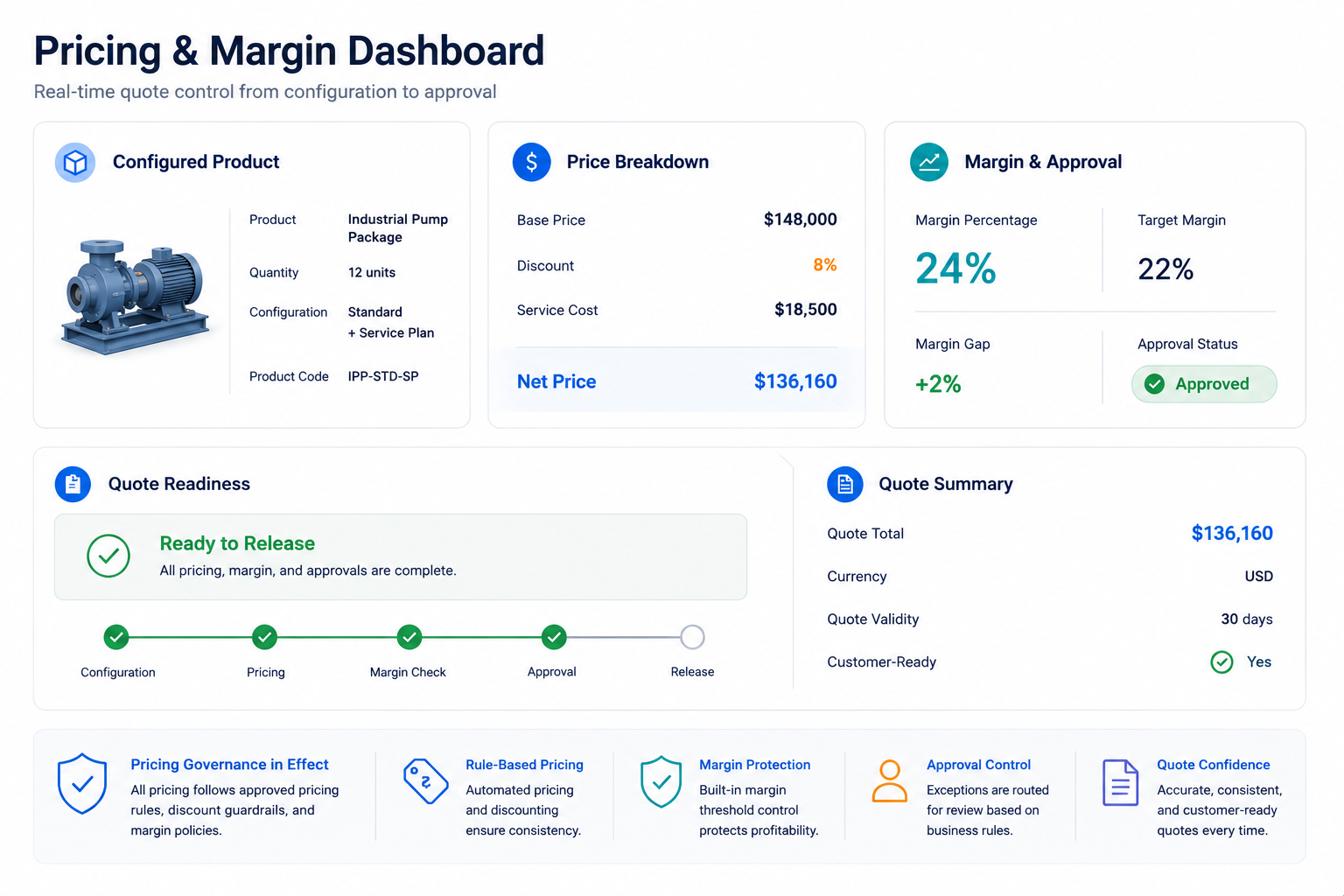
For many organizations, the product is only part of the sale. Delivery may require installation, commissioning, training, maintenance, customization, integration, field services, spare parts, or recurring support. If service scope is managed separately from the quote, the proposal may appear profitable while creating delivery challenges after contract award. CPQ should connect service scope directly to product configuration. Installation assumptions, labor estimates, travel requirements, maintenance packages, and customer responsibilities should be visible while the quote is being built.
Service controls should focus on:
Required service packages
Installation assumptions
Labor and travel estimates
Maintenance options
Delivery handoff requirements
Hard rule: Make it impossible to approve a quote when required installation, training, maintenance, or implementation scope remains undefined. Business benefit: Fewer delivery surprises, stronger service margins, clearer customer expectations, and better execution readiness.
Approvals Should Move With the Quote
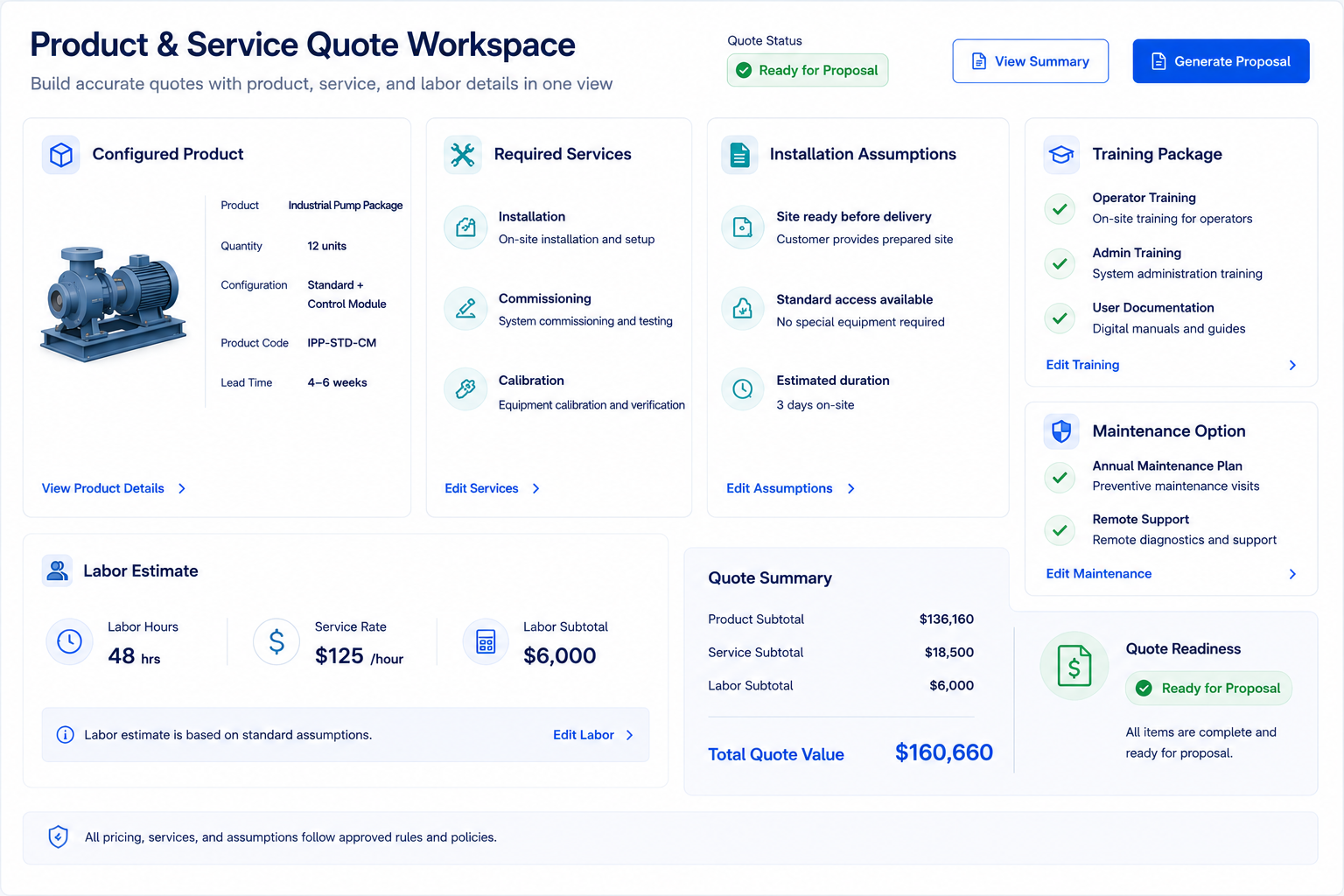
Approval delays remain one of the most common causes of slow quoting cycles. Discount approval may exist in email. Engineering review may occur in separate meetings. Finance may evaluate payment terms after pricing has already been discussed with the customer. CPQ software should keep approvals inside the quote record. When a quote requires review, approvers should immediately see affected margin, selected configuration, service scope, commercial impact, and required actions.
Important approval paths often include:
Discount exceptions
Margin exceptions
Custom configurations
Non-standard service scope
Payment term exceptions
Delivery risk reviews
Hard rule: Make it impossible to send a quote while required engineering, pricing, finance, or management approvals remain open. Business benefit: Shorter approval cycles, clearer accountability, stronger governance, and fewer commercial errors. By gating document generation behind these digital verification rules, the platform removes manual oversight bottlenecks, preventing non-compliant pricing or unvetted specs from reaching the market before internal consensus is reached.
The CPQ Maturity Model
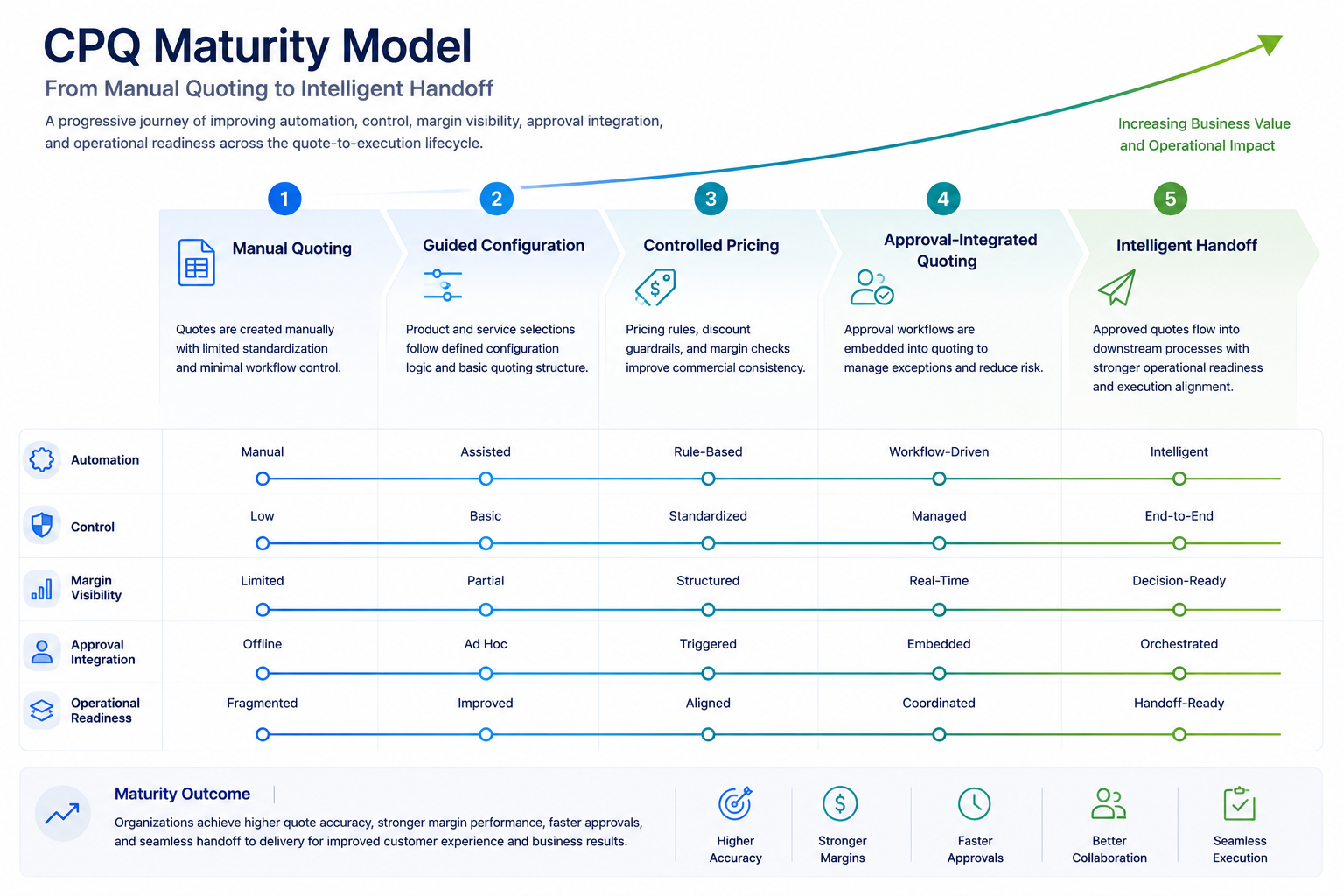
Many companies begin their CPQ journey by trying to automate proposal generation. The greatest value emerges when quoting becomes a controlled commercial workflow. Moving beyond a simple proposal generator, an advanced CPQ model locks in product compliance, dynamic pricing, and embedded approval paths directly into the deal lifecycle. It shifts the tool's focus from mere speed and cosmetics to operational governance. By transforming the quotation stage into a rigorous commercial gatekeeper, organizations don't just accelerate their time to quote, they systematically protect profit margins and eliminate delivery risks before the contract is ever signed.
Organizations typically progress through five stages:
Manual Quoting
Rule-Based Configuration
Margin Control
Synchronized Approval
Intelligent Handoff
At the first stage, sales relies heavily on spreadsheets, email, and individual expertise. As maturity increases, product rules, pricing controls, approvals, and service requirements become embedded within the quoting process. The highest stage is Intelligent Handoff. Accepted quotes flow directly into order processing, project planning, service delivery, and operational execution without requiring teams to rebuild information after the sale. The objective is not quote automation. The objective is commercial control.
Hard rule: Make it impossible for CPQ improvement initiatives to stop at proposal generation when pricing, approval, service scope, and delivery risks remain unmanaged. Business benefit: Stronger scalability, improved governance, reduced commercial risk, and better alignment between sales and operations.
Quote Handoff Should Prepare the Business for Delivery
A quote is not only a sales document. Once accepted, it becomes the foundation for order fulfillment, project execution, finance, service delivery, and customer success. CPQ should preserve configuration details, pricing decisions, approvals, service scope, assumptions, exclusions, and customer commitments in a structured record that downstream teams can use immediately. Operations should understand what was promised. Finance should understand approved pricing and terms. Service teams should understand delivery obligations.
Hard rule: Make it impossible to convert a quote into an order when configuration, pricing, approvals, service scope, or delivery assumptions remain incomplete. Business benefit: Faster order processing, fewer post-sale corrections, stronger execution readiness, and improved customer experience.
Management Needs Quote Control, Not Quote Volume
A dashboard showing quote volume does not reveal quote risk. Management needs visibility into which opportunities are delayed, which quotes are below margin targets, which approvals are blocking revenue, which configurations require review, and which service scopes remain incomplete.
A useful CPQ management view should answer:
Which high-value quotes are waiting for approval?
Which quotes are below target margin?
Which configurations require engineering review?
Which service scopes remain incomplete?
Which proposals exceed target response times?
Which accepted quotes create delivery risk?
Why Companies Buy Industry Software
Companies buy Industry Software when quoting becomes too slow, too manual, or too risky to manage through spreadsheets, email threads, disconnected price lists, and informal approvals. The value is not simply generating quote documents faster. The value is creating a controlled sales workflow that connects configuration, pricing, margin, service scope, approvals, and handoff readiness.
Industry Software supports CPQ through:
Configurable quote workflows
Product and service configuration rules
Pricing and margin controls
Quote Health visibility
Approval management
Modular deployment
Cloud-based access
Dedicated implementation support
Without this structure, sales teams spend time chasing approvals, correcting quotes, rebuilding service assumptions, and explaining margin exceptions. With Industry Software, organizations can quote faster, protect margins, improve sales control, and deliver more reliable customer proposals.
Final Summary
CPQ software creates value when complex product and service sales become easier to configure, price, approve, and deliver. The objective is not only faster quote generation. The objective is producing accurate, profitable, reviewable proposals that can move smoothly into execution.
Industry Software helps organizations build this foundation through configurable workflows, product and service rules, pricing and margin controls, Quote Health visibility, approval management, cloud-based access, modular deployment, and dedicated implementation support.