Revenue Problems Usually Start Before Opportunities Are Lost
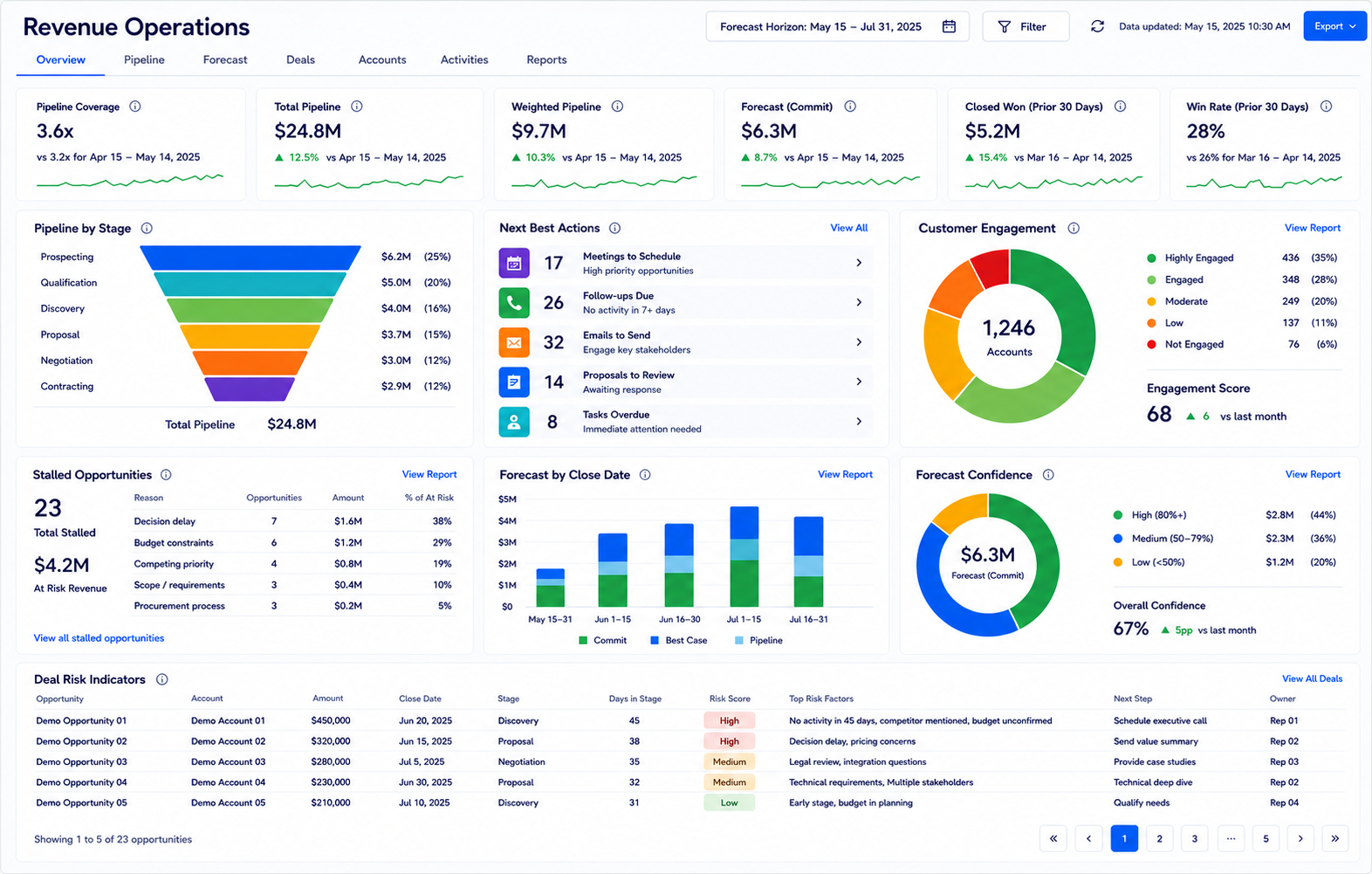
Most organizations know when a deal is lost. Far fewer understand when the risk first appeared. A prospect stops responding after a demonstration, a proposal remains open without follow-up, a decision-maker changes roles, or a competitor gains influence inside the account. Eventually the opportunity is lost, but the warning signals often appeared weeks earlier.
Consider a B2B technology provider managing more than 3,000 active opportunities annually. Before implementing a structured CRM process, forecast accuracy averaged 62%, nearly 30% of opportunities remained inactive for more than 45 days, and pipeline reviews relied heavily on salesperson judgment. After implementing qualification controls, activity capture, opportunity stage governance, and forecasting workflows, forecast accuracy improved to 84%, stalled opportunities declined by 43%, and follow-up compliance increased by 58%. The biggest improvement was not reporting. It was earlier identification of revenue risk. Modern CRM should identify deal slippage before opportunities disappear from the forecast.
Hard rule: Make it impossible for high-value opportunities to remain without a scheduled next action, assigned owner, or customer engagement update beyond a defined period. Business benefit: Higher conversion rates, reduced pipeline stagnation, improved sales accountability, and earlier identification of at-risk deals.
CRM Should Start With a Unified Customer Data Model
A modern CRM is not only a place to store contacts. It should maintain a unified customer data model that connects accounts, contacts, leads, opportunities, activities, campaigns, quotes, service cases, renewals, and account history. Without this structure, sales teams may see one version of the customer while service, finance, or account management teams work from another.
Customer master data should support account hierarchy, parent-child account relationships, territory ownership, opportunity history, and customer lifecycle visibility. This is especially important for B2B organizations with multi-location customers, buying committees, long sales cycles, and recurring revenue models.
A strong CRM data model should connect:
Account and contact records
Lead and opportunity history
Sales activities and engagement timeline
Quotes, proposals, and contract status
Service cases and customer health signals
Renewals, expansion, and account growth opportunities
The Revenue Readiness Score
Pipeline value alone does not determine future revenue. Two opportunities worth $500,000 may have very different probabilities of success. One may have strong engagement, executive access, and clear next steps, while the other may be aging quietly with no recent customer activity.
A practical way to measure opportunity quality is the Revenue Readiness Score: Revenue Readiness Score = (Customer Engagement × Next Action Completion × Decision-Maker Access) ÷ Opportunity Age Factor. For example, a $500,000 opportunity has 90% customer engagement, 80% next action completion, 85% decision-maker access, and an opportunity age factor of 2.
Revenue Readiness Score = (0.90 × 0.80 × 0.85) ÷ 2 = 0.31. A second opportunity with weak engagement and limited stakeholder access may produce a score below 0.10 despite having the same forecast value. The purpose is not mathematical precision, but rather giving revenue teams a practical opportunity scoring method to identify deals that need intervention.
Lead Qualification Creates Pipeline Quality
Many organizations celebrate lead volume. Revenue teams care about qualified pipeline. Marketing may generate hundreds of leads each month, but sales performance depends on how many become realistic opportunities. Modern CRM should support qualification gates before leads become active pipeline. MQL and SQL definitions should be tied to business need, ICP fit, budget, buying timeline, decision-maker access, and competitive context. Without qualification discipline, pipelines become inflated and forecast accuracy declines.
Qualification should evaluate:
Ideal customer profile fit
Business need and use case
Budget availability
Decision-maker access
Buying timeline
Competitive position
Activity Capture Should Drive Pipeline Movement
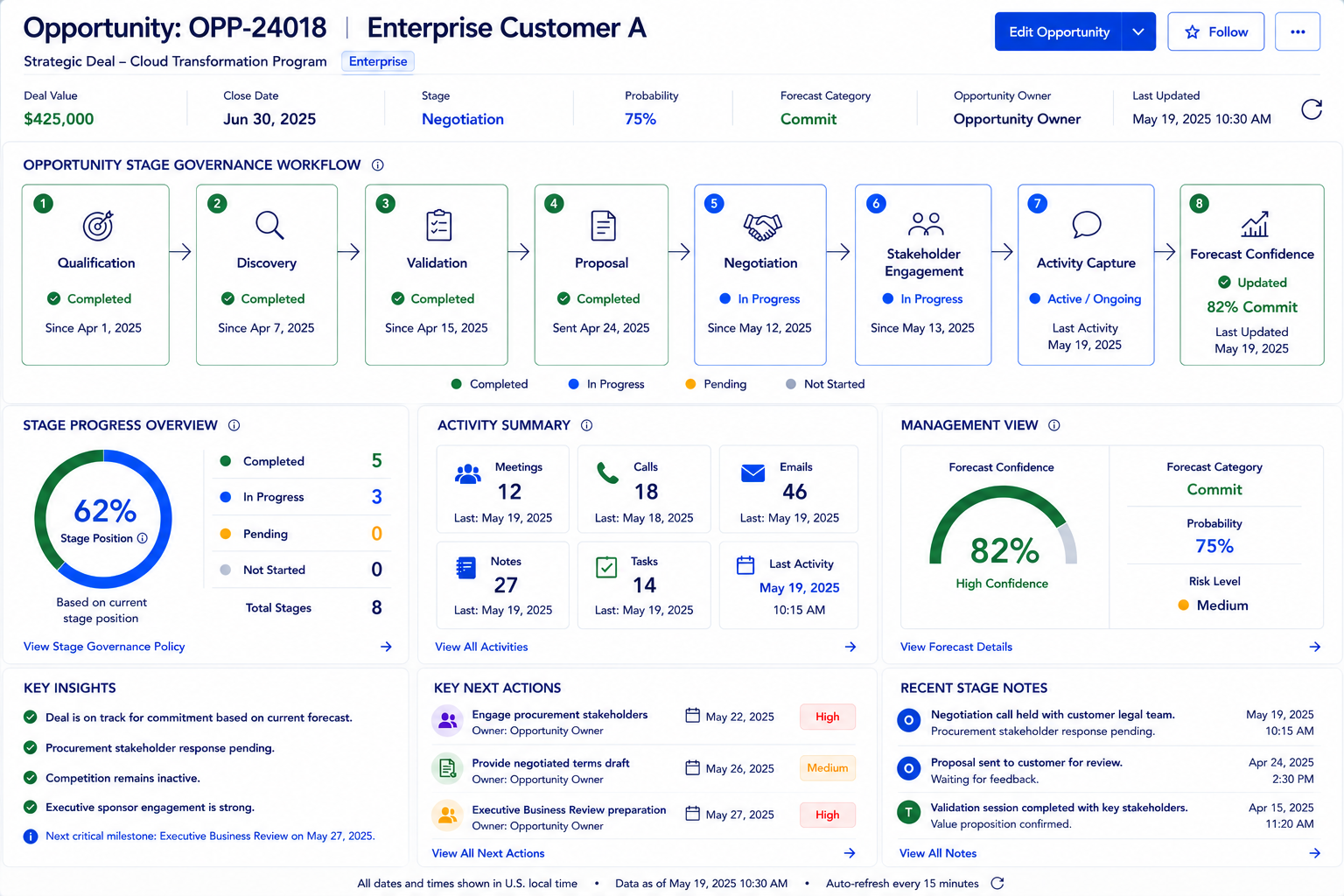
One of the most common CRM failures occurs when opportunities advance through stages based on optimism rather than evidence. A salesperson may feel positive about a deal because conversations occurred, but customer behavior may not support the forecast. Modern CRM should use activity capture to connect email synchronization, calendar synchronization, meeting notes, call logging, demo completion, proposal activity, and follow-up tasks into the opportunity record. Customer engagement data should be captured automatically where possible, rather than depending entirely on manual updates from sales representatives.
Opportunity stage progression should be governed by customer-facing milestones:
Discovery completed
Stakeholders identified
Product demonstration delivered
Technical evaluation completed
Proposal reviewed
Commercial discussion completed
Executive sponsor engaged
Hard rule: Make it impossible to advance opportunities without completing required customer-facing milestones associated with each stage. Business benefit: Improved forecast accuracy, stronger sales discipline, better pipeline visibility, and reduced subjective forecasting.
Pipeline Velocity Matters More Than Pipeline Size
Large pipelines do not automatically create revenue growth. A pipeline worth $20 million may appear strong, but if opportunities are aging, stage conversion rates are falling, and deal slippage is increasing, revenue performance may weaken. Pipeline velocity measures how quickly qualified opportunities move from pipeline creation to closed revenue. Modern CRM should help revenue operations teams monitor sales cycle length, stage-to-stage conversion, opportunity aging, stalled deals, and revenue bottlenecks.
CRM should identify when an opportunity remains too long in a stage, when engagement decreases, or when the close date keeps moving without new customer activity. These signals help sales managers coach earlier and protect revenue commitments. Hard rule: Make it impossible for opportunities to remain in critical pipeline stages beyond defined aging thresholds without review and action plans. Business benefit: Faster revenue realization, better sales coaching, improved forecast quality, and reduced deal stagnation.
Forecasting Should Use a Forecasting Engine, Not Hope
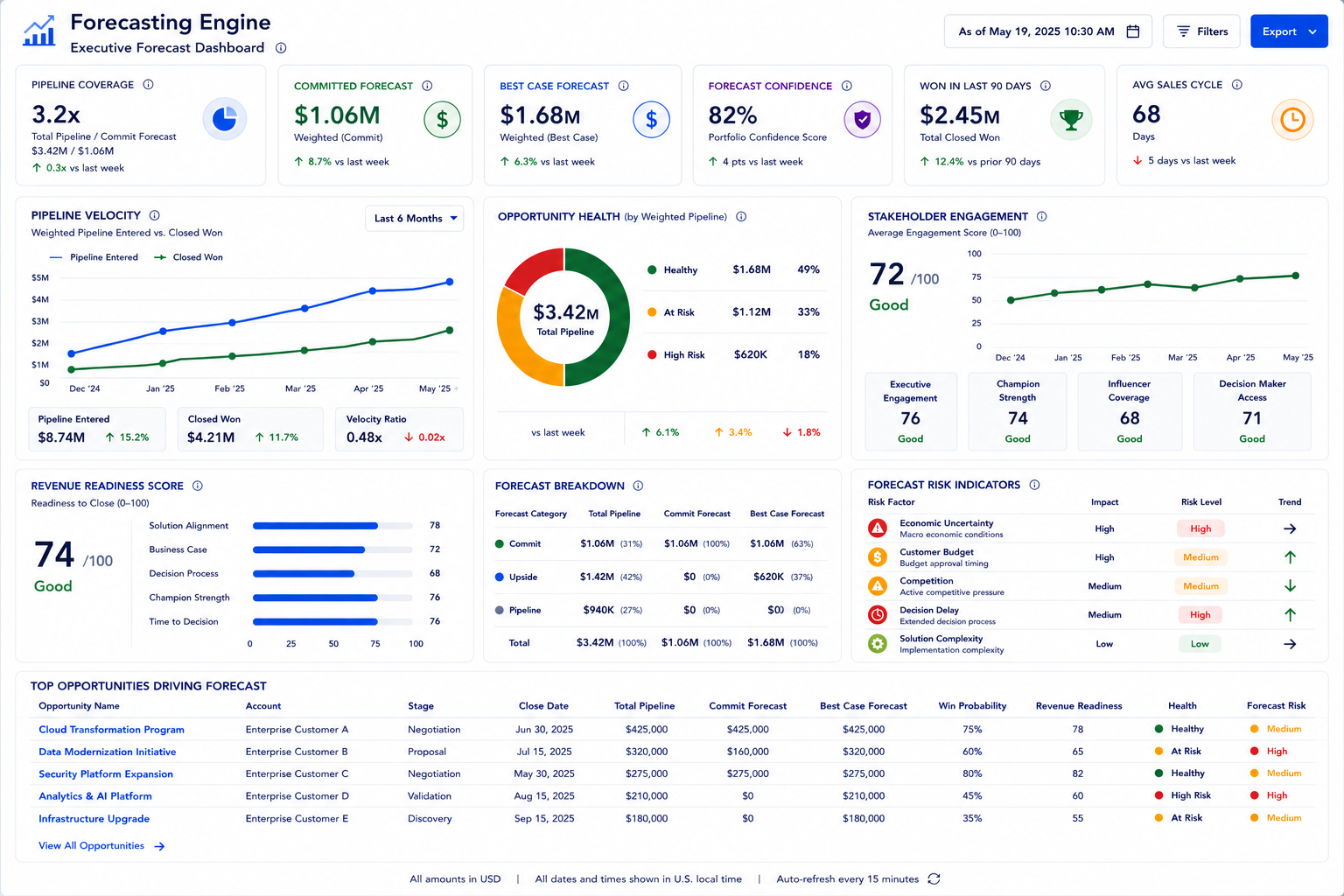
Forecasting remains one of the hardest problems in revenue operations. Many forecasts rely heavily on close dates and salesperson judgment. Optimism is not a forecasting methodology. A modern CRM forecasting engine should combine opportunity value, probability of close, opportunity stage, customer engagement, activity history, stakeholder access, proposal status, opportunity age, and Revenue Readiness Score. It should support forecast categories such as committed, best case, pipeline, and at risk.
A practical forecasting model can still begin with: Forecast Confidence = Opportunity Value × Probability of Close. But probability should be influenced by observable customer behavior, not opinion alone. A $500,000 opportunity in proposal stage should not remain in committed forecast if there has been no customer interaction for 45 days.
Hard rule: Make it impossible to include opportunities in committed forecasts when engagement levels, activity requirements, or decision milestones remain incomplete. Business benefit: Improved forecast accuracy, better resource allocation, earlier risk visibility, and fewer forecast surprises.
Customer 360 Should Connect Sales, Service, and Account Growth
Revenue growth does not depend only on new opportunities. Renewals, upsell, cross-sell, retention, and customer expansion often create greater long-term value. A modern CRM should provide a Customer 360 view that connects sales activity, service cases, contract history, renewal schedules, account health, and expansion opportunities. Customers do not experience organizations by department. They experience one company. If sales, service, support, and account management teams work from different records, customer experience becomes inconsistent and growth opportunities are missed.
Customer 360 should support:
Sales and opportunity history
Service and support activity
Contract and renewal status
Account health indicators
Expansion and cross-sell opportunities
Customer communication history
Event-Driven Workflows Turn Customer Signals Into Action
Modern CRM should not only store activities. It should trigger action when revenue signals change. If a demo is completed, the system should create a follow-up task. If an opportunity is inactive for 30 days, it should notify the owner. If a renewal is approaching and account health is declining, it should escalate to account management. If a proposal is sent but not opened, the system should flag engagement risk.
This is where CRM becomes revenue workflow automation. Event-driven workflows help teams act consistently without relying on memory or manual tracking. They also create better governance because each action, owner, status, and escalation path remains visible.
Hard rule: Make it impossible for critical customer signals such as stalled opportunities, renewal risk, service escalation, or proposal inactivity to remain without owner and next action. Business benefit: Faster follow-up, fewer missed handoffs, stronger sales execution, and better customer lifecycle management.
The CRM Maturity Model
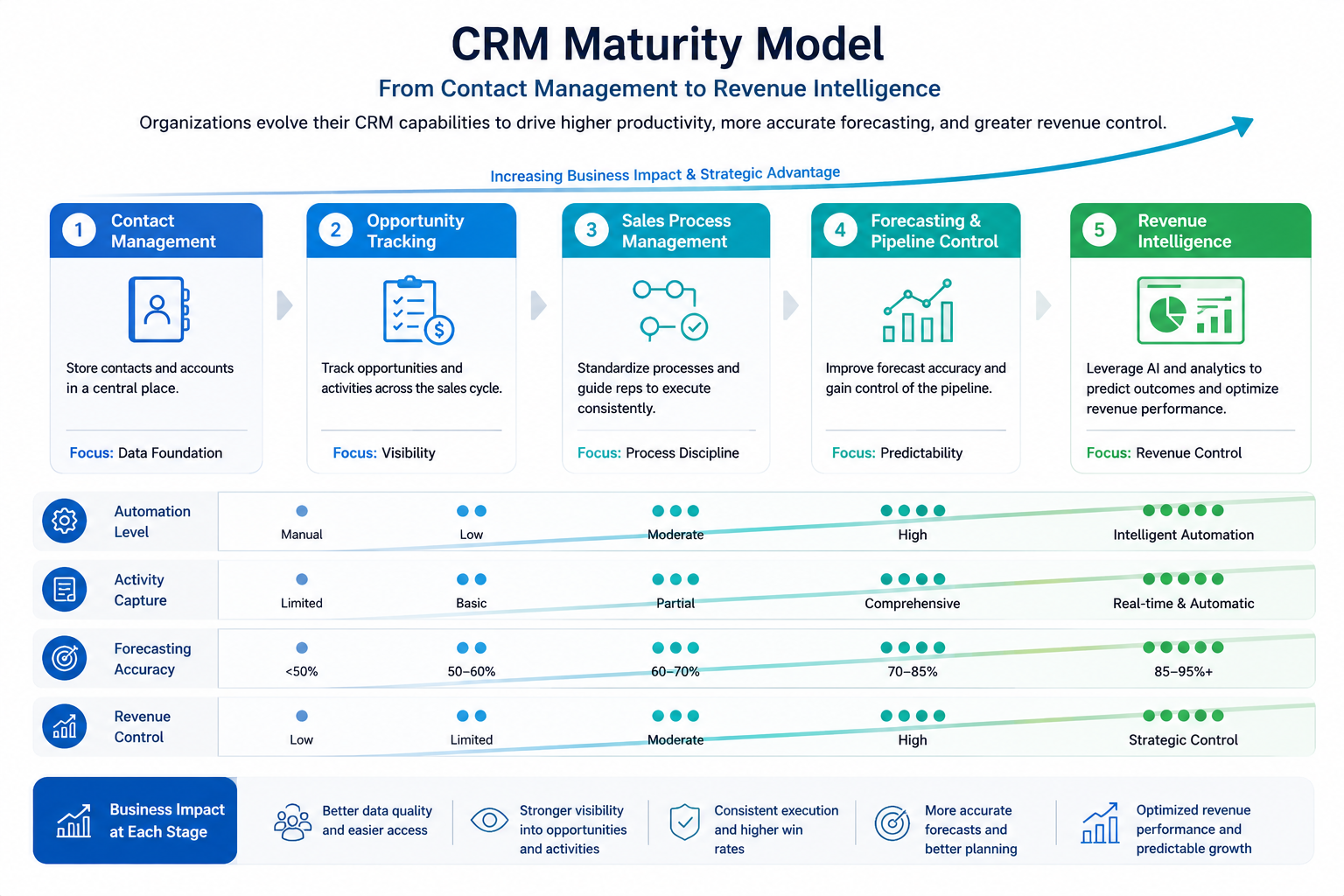
Many companies believe CRM success means storing customer information in one place. High-performing organizations use CRM to manage revenue execution. By transforming the system from a passive historical archive into an active pipeline engine, these leaders link customer touchpoints directly to predictable growth, turning static data fields into a synchronized driver of commercial momentum.
Most organizations progress through five stages:
Contact Management: customer records are centralized, but execution remains manual.
Opportunity Tracking: pipeline becomes visible, but forecasting remains subjective.
Sales Process Control: qualification rules, activity capture, and stage governance improve consistency.
Revenue Forecasting: pipeline health, forecast confidence, and revenue risk become measurable.
Revenue Intelligence: CRM identifies deal risk, account growth opportunities, forecast exposure, and sales performance trends automatically.
Management Needs Revenue Intelligence, Not Pipeline Totals
Pipeline totals do not tell management where revenue risk exists. Leaders need to understand which opportunities have stalled, which accounts show declining engagement, which forecasted deals lack recent activity, which territories are underperforming, and which customers have expansion potential.
A revenue intelligence view should answer:
Which opportunities are at risk?
Which deals show declining engagement?
Which forecasted opportunities lack decision milestones?
Which sales stages have the highest drop-off rates?
Which accounts show renewal or expansion potential?
Which territories or representatives need support?
Event-Driven Workflow Configuration Example
A modern CRM should not only record customer activity. It should convert important customer signals into assigned actions. Event-driven workflows help revenue teams respond consistently when pipeline, engagement, forecast, or account health conditions change. By translating real-time buyer behaviors into structured playbooks, the platform replaces reactive account management with prescriptive next steps, preventing critical revenue risks and expansion opportunities from slipping through the cracks.
A simple event-driven CRM workflow can be configured as follows:
Trigger: No customer activity for 30 days on an opportunity above $100,000
Condition: Opportunity is in proposal, negotiation, or committed forecast stage
Action: Create follow-up task for opportunity owner
Escalation: Notify sales manager if no action is completed within 5 business days
Forecast impact: Move opportunity from committed to at-risk if engagement remains inactive for 45 days
Dashboard update: Flag the deal in revenue intelligence view as deal slippage risk
This type of workflow makes CRM more than a database. It becomes a revenue control system that helps teams act before pipeline risk becomes missed revenue. Hard rule: Make it impossible for high-value opportunities to remain inactive without automated follow-up, escalation, and forecast review. Business benefit: Faster sales response, better pipeline hygiene, reduced deal slippage, and stronger forecast reliability.
Key Metrics and Calculation Summary
The strongest CRM programs measure revenue quality, not only sales activity. These formulas give leadership a practical way to evaluate pipeline health, forecast confidence, and customer engagement. By shifting the management lens from brute-force volume to quality-driven velocity, the platform translates raw CRM metrics into institutional predictability, arming executives with the objective evidence needed to validate growth projections.
Revenue Readiness Score = (Customer Engagement × Next Action Completion × Decision-Maker Access) ÷ Opportunity Age Factor. Used to evaluate whether an opportunity is truly ready to progress toward revenue.
Forecast Confidence = Opportunity Value × Probability of Close. Used to estimate expected revenue based on deal value and evidence-based close probability.
Pipeline Velocity = Qualified Opportunities × Win Rate × Average Deal Size ÷ Sales Cycle Length. Used to measure how quickly qualified pipeline converts into revenue.
Deal Slippage Rate = Delayed Opportunities ÷ Forecasted Opportunities × 100%. Used to identify how much committed or forecasted revenue is moving out of the expected period.
Account Growth Potential = Expansion Signals × Account Health × Stakeholder Engagement. Used to identify accounts with realistic upsell, cross-sell, or renewal growth opportunities.
Hard Rule Checklist for CRM Control
A revenue-focused CRM should enforce sales discipline without creating unnecessary administrative burden. The following rules help organizations improve pipeline quality, forecast reliability, and customer relationship management. By embedding prescriptive validation rules directly into the natural flow of deal execution, the platform removes friction for the field while creating a clean, high-fidelity data foundation for executive decision-making.
Make it impossible to move a lead into active pipeline without required qualification criteria.
Make it impossible to advance opportunities without required customer-facing milestones.
Make it impossible for high-value opportunities to remain inactive without next action, owner, and engagement update.
Make it impossible to include opportunities in committed forecast when required decision milestones are incomplete.
Make it impossible for stalled opportunities to remain in late-stage pipeline without management review.
Make it impossible for renewal-risk accounts to remain without assigned owner and follow-up plan.
Make it impossible for sales, service, and account teams to work from disconnected customer records.
Make it impossible for forecast reviews to rely only on salesperson judgment when activity, engagement, and stage data show risk.
Why Companies Buy Industry Software
Organizations buy CRM software because they need more than customer records. They need a configurable revenue operating system that connects customer data, activity capture, opportunity governance, forecasting, account growth, and management visibility. By combining these critical pillars into a single, cohesive interface, the platform turns everyday sales interactions into structured revenue intelligence, helping teams scale their commercial operations on an objective, repeatable foundation.
Industry Software supports CRM through:
Cloud-based access across sales, marketing, service, account management, and leadership teams
Modular deployment for lead management, opportunity tracking, forecasting, account management, service visibility, or dashboards
Unified CRM data model for accounts, contacts, leads, opportunities, activities, quotes, cases, renewals, and account hierarchy
Customer 360 visibility across sales history, service activity, account health, and expansion opportunities
Activity capture and engagement tracking through email, meetings, calls, tasks, and customer interactions
Opportunity stage governance with qualification gates, milestone rules, and pipeline hygiene controls
Forecasting engine for committed forecast, best case forecast, pipeline forecast, and at-risk opportunities
Event-driven revenue workflows for follow-up tasks, deal slippage alerts, renewal risk, and management escalation
Revenue intelligence dashboards for pipeline velocity, forecast confidence, account health, territory performance, and sales execution
Dedicated implementation support for workflow configuration, data setup, reporting, dashboards, user training, and ongoing optimization
Companies can begin with sales pipeline management and expand into forecasting, account growth, service visibility, executive reporting, and revenue intelligence as their needs evolve. The objective is not simply managing contacts. The objective is building a scalable revenue operating model.
Final Summary
Modern CRM software creates value when customer data, activity capture, opportunity management, forecasting, account health, and revenue operations become part of one connected workflow. Organizations that connect these processes gain stronger visibility, better forecasting accuracy, improved sales discipline, and more predictable revenue growth.
Industry Software helps organizations build this foundation through cloud-based access, modular deployment, unified CRM data models, Customer 360 visibility, activity capture, opportunity governance, forecasting engines, event-driven workflows, revenue intelligence dashboards, and dedicated implementation support.