Results Snapshot
Estimate opportunities moved into one shared view, giving sales a clearer picture of every quote stage
Approved scope, price, materials, labor, and deposit requirements required less manual rechecking
Project managers could see what the customer approved, where the quote came from, and what budget assumptions were in place
Finance gained earlier visibility into tax, deposit terms, and project value, reducing downstream accounting gaps
Project Context
The contractor manages residential and light commercial remodeling work, including bathroom renovations, kitchen updates, and small interior projects. The projects are not always large, but customer communication moves quickly, quote versions can change, and approved work needs to move into scheduling, purchasing, and field preparation without delay. The main challenge was not creating a quote; it was making sure the team could act on it after the customer said yes.
Core Problem: The Customer Was Ready to Start, but the Team Was Still Checking the Quote
After approval, sales expected the project to move into handoff, but the project manager still needed to confirm scope, version, and cost detail, while finance had to recheck tax, deposit terms, and payment assumptions. The customer was waiting for next steps, but internally the team was still aligning numbers, responsibilities, and the final accepted version. This bottleneck affected margin and trust.
Misaligned scope could create field disputes, unclear costs could make the budget harder to protect, and inconsistent versions could make change orders and payment conversations more difficult. After the project was won, the real question was whether the team could pick it up, understand the numbers, and move forward without delay. For this contractor, the quote had to become more than a document sent to the customer; it had to become the starting point for project work.
Quote Status Feature: Giving Every Estimate a Next Step
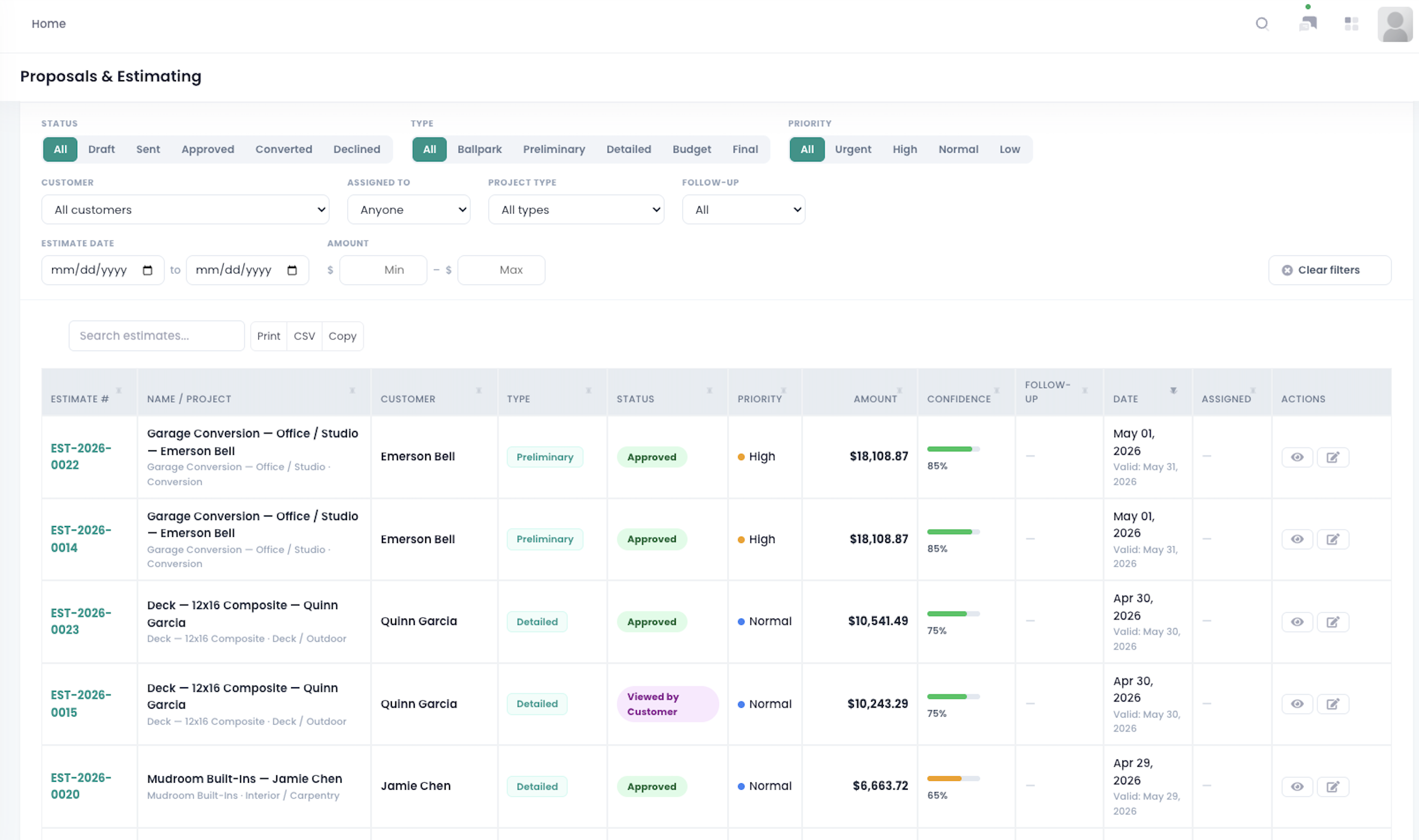
For this contractor’s high-volume quoting and frequent customer follow-up, the team moved all estimates into a shared quote status view. Each quote showed customer, owner, project type, value, priority, and current status, so sales leaders could quickly see which bathroom remodels, kitchen updates, or small interior projects were still drafts, which had been sent, which customers had viewed them, and which were close to approval. Quotes no longer lived in each salesperson’s files, inbox, or message history; they became a list the team could filter, review, and move forward.
This feature made the contractor’s sales follow-up process clearer. Draft estimates still needed scope details, material choices, or labor assumptions; sent estimates needed customer follow-up; viewed but unapproved quotes often required clarification on price, scope, or deposit terms; approved quotes could prompt project managers and finance to step in earlier. Instead of asking, “Where does this customer stand?” the team could see each quote’s status, owner, and next action.
This type of feature is also useful for other contractors that quote frequently. Many companies do not struggle because they lack quotes; they struggle because once quote volume grows, it becomes hard to see which deal is close, which one is waiting on the customer, and which one still needs cost detail. A quote status view turns customer inquiries into a managed work queue and gives project teams an earlier view of future workload.
Estimate Detail Feature: Keeping Customer, Address, and Scope on One Page
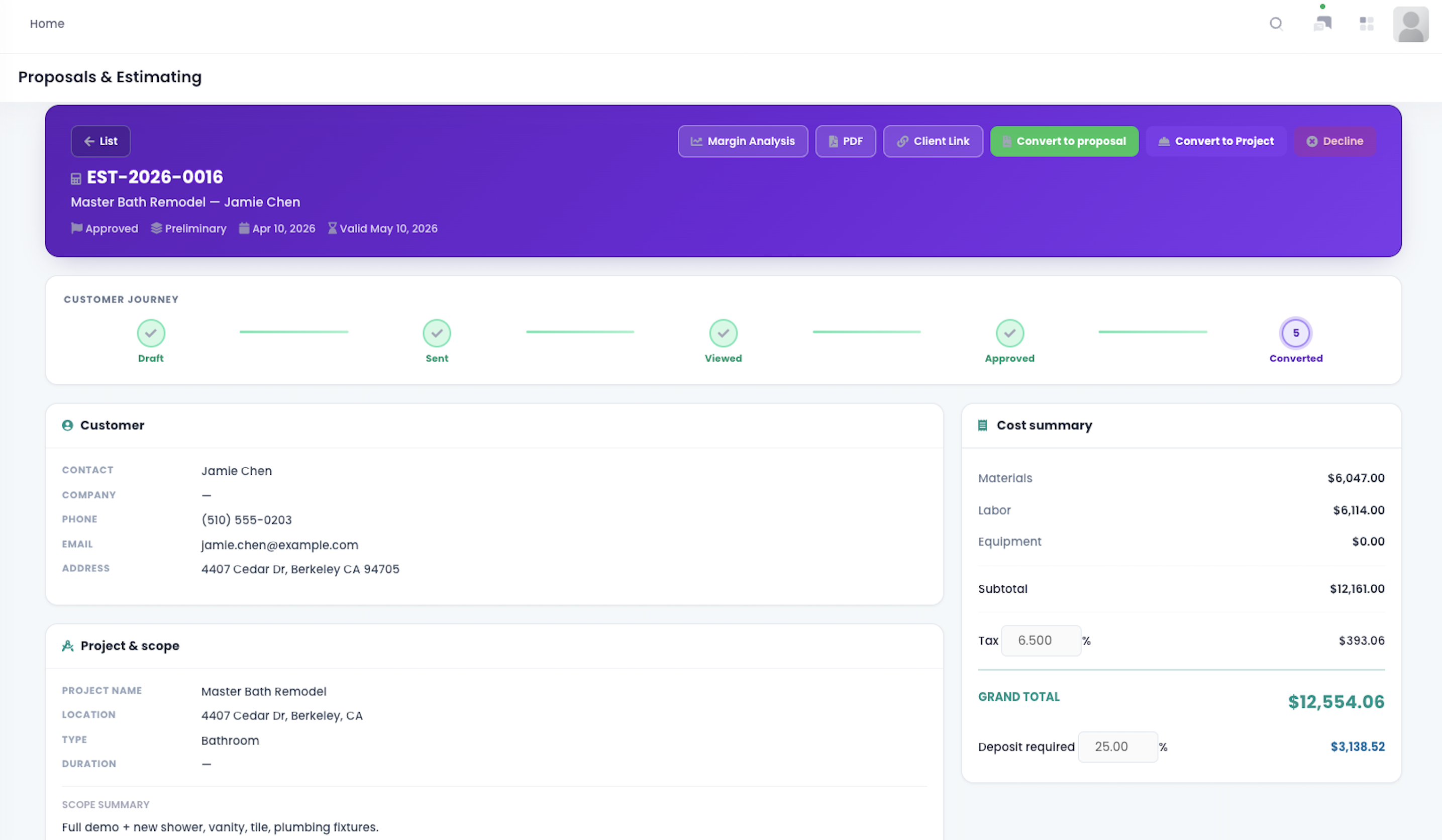
For each quote, the team used the estimate detail page to keep customer information, project address, project type, scope description, owner, quote status, and cost summary in one place. When sales created a bathroom remodel estimate, they did not just enter a total price; they recorded who the customer was, where the work would happen, what was included, and where the quote stood. The path from creation to sent, viewed, approved, and converted stayed attached to the same page.
This feature reduced back-and-forth during handoff. Previously, after customer approval, a project manager might still need to ask sales, “Which version did the customer accept?” “Was demolition and haul-away included?” “Are the new shower, plumbing, tile, and vanity part of the approved scope?” Now the project manager could open the estimate detail page, review customer, address, scope, and approval status first, and only follow up on special cases. Handoff became less of a verbal retelling and more of a direct transfer of a business record with context.
This matters for any construction business that moves work from sales to project delivery. Remodeling projects often involve several trades, material items, and customer conversations, so if customer, address, scope, and approval status are not kept together, project managers end up reopening basic questions. The estimate detail page preserves the information already confirmed during sales, so project startup does not begin from zero.
Cost Breakdown Feature: Clarifying Materials and Labor Early
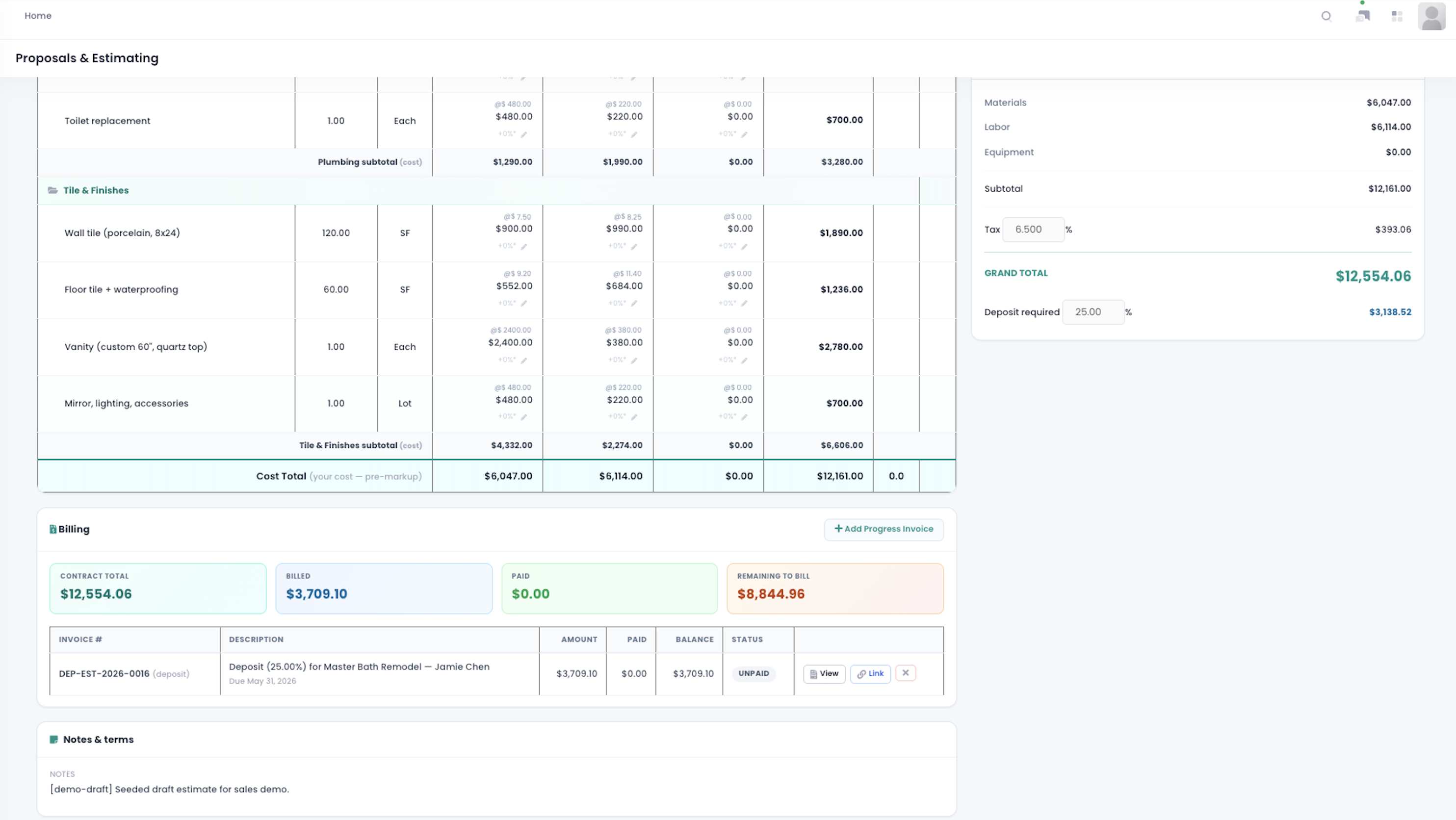
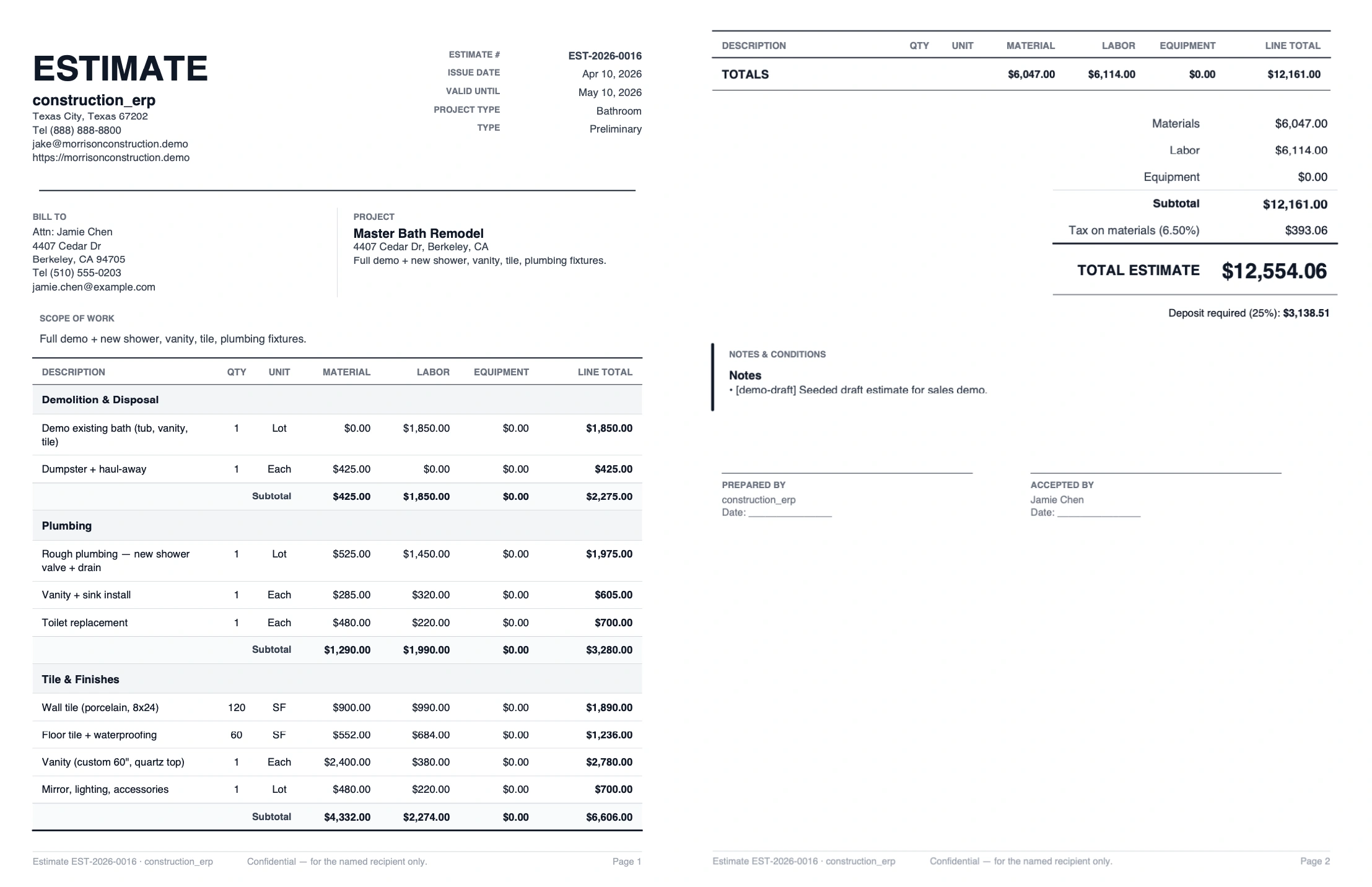
During estimating, the team broke the total price into materials, labor, equipment, and line totals instead of giving the customer only one final number. In the Master Bath Remodel example, the quote was organized by demolition and disposal, plumbing, tile, and finishes, with separate material, labor, equipment, and line totals. The PDF quote showed $6,047.00 in materials, $6,114.00 in labor, $393.06 in tax, a total estimate of $12,554.06, and a 25% deposit requirement.
This feature kept the contractor from having to rebuild cost detail after customer approval. Sales could explain why the quote included demolition, plumbing, tile, and finishes; project managers could see which parts needed purchasing and which required labor planning; finance could confirm tax, total value, and deposit requirements earlier. Once the quote was approved, the team could carry the same cost structure into purchasing, scheduling, budgeting, and payment decisions.
This type of feature is valuable for construction businesses that depend on material purchasing and labor scheduling. Budget problems often happen not because teams do not know the total price, but because material, labor, and scope assumptions were not clear early enough. Materials-heavy jobs can trigger earlier checks on pricing and lead times, while labor-heavy jobs can prompt earlier attention to duration, crew planning, and field productivity.
Standard Quote PDF Feature: Matching the Customer Version with the Internal Version
For customer communication, the team used a standard quote PDF generated from estimate data instead of having sales manually create a separate document. The PDF included project scope, itemized costs, tax, total value, deposit requirement, and signature areas. Customers received a formal quote, while the internal team kept the same data source behind it.
This feature reduced the risk that the customer-approved version and the internal working version would drift apart. In the previous workflow, if sales edited a document manually, the customer confirmed a scope item by email, and the project manager later received a different version, project startup could become confusing. Now, what the customer approved could be traced back to the related estimate record and PDF. When the team collected deposits, ordered materials, discussed changes, or confirmed scope, sales, project management, and finance could use the same reference point.
This is practical for construction teams because many disputes do not come from the work itself; they come from version mismatch. The customer may believe a scope item is included, while the project team believes it is excluded, creating pressure on change orders, payment, and trust. A standard quote PDF aligns the customer confirmation file with the internal execution record, giving the team clearer boundaries after approval.
Project Conversion Feature: Moving Approved Quotes Directly into Projects
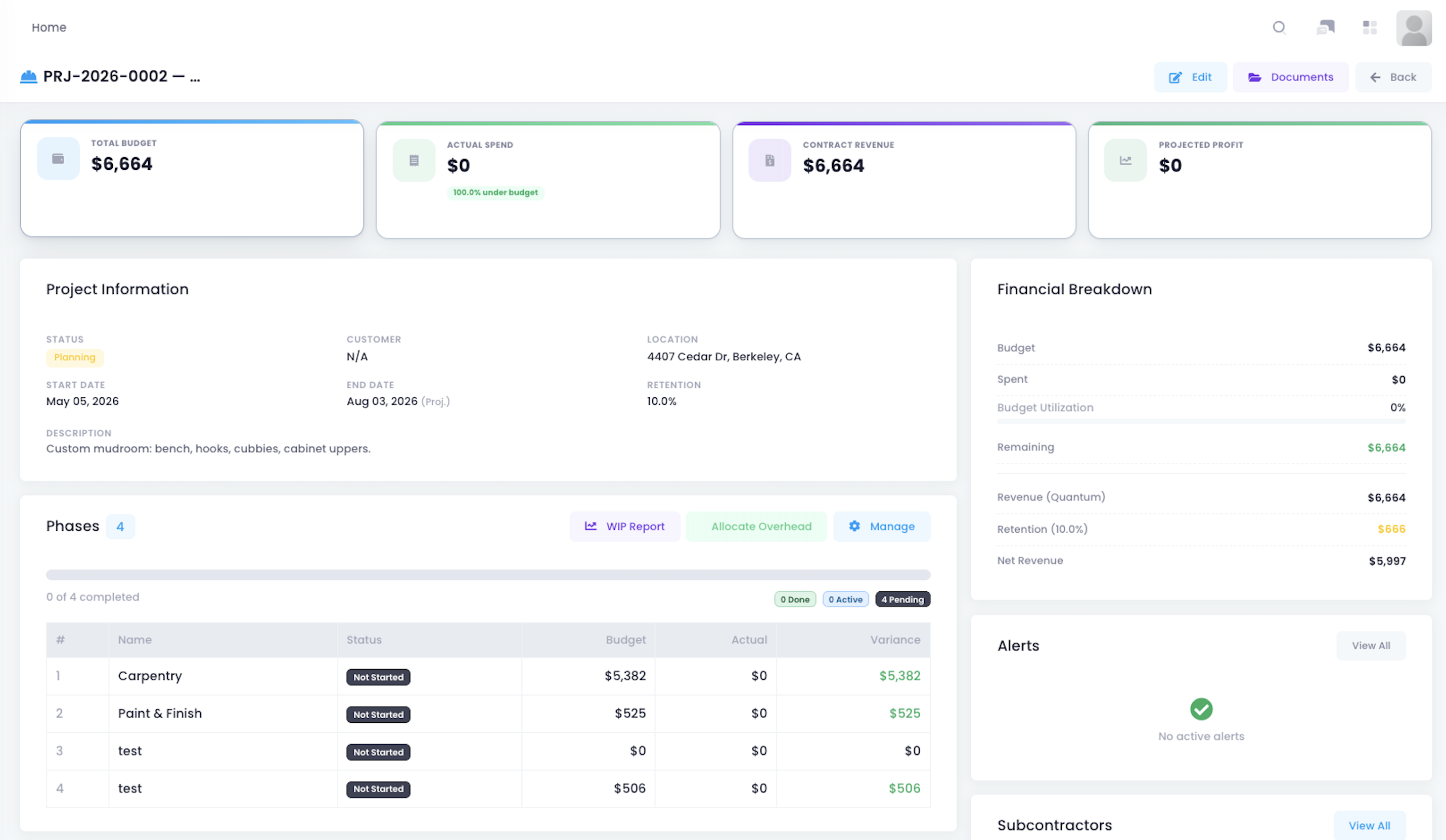
After customer approval, the team did not create the project from scratch; it carried confirmed quote information into the project detail page. When the project manager took over, they could see budget, actual spend, contract revenue, projected profit, phases, and financial breakdown. Sales-stage information did not stop inside the quote file; it continued into project preparation, resource planning, and budget management.
This feature connected “customer approved” directly with “project startup.” Previously, after the customer said yes, sales might still need to write a separate handoff note, the project manager might ask how the quote had been built, and finance might wait until work began before aligning contract value, deposit terms, and cost structure. Now, when a bathroom remodel quote was approved, the project manager could begin thinking through demolition, plumbing, tile, vanity installation, and field scheduling, while finance could see deposit and contract value at the same time. Project startup became more than creating a project name; it became the continuation of an approved quote into execution.
This type of feature is especially important for contractors with fast-moving projects. After the customer approves, internal teams should not lose momentum by recreating records, reconfirming scope, and rebuilding budgets. Project conversion allows sales-stage data to keep serving the project stage, making it useful for any construction business trying to reduce handoff gaps between sales and operations.
Budget Tracking Feature: Seeing Material and Labor Variance from Day One
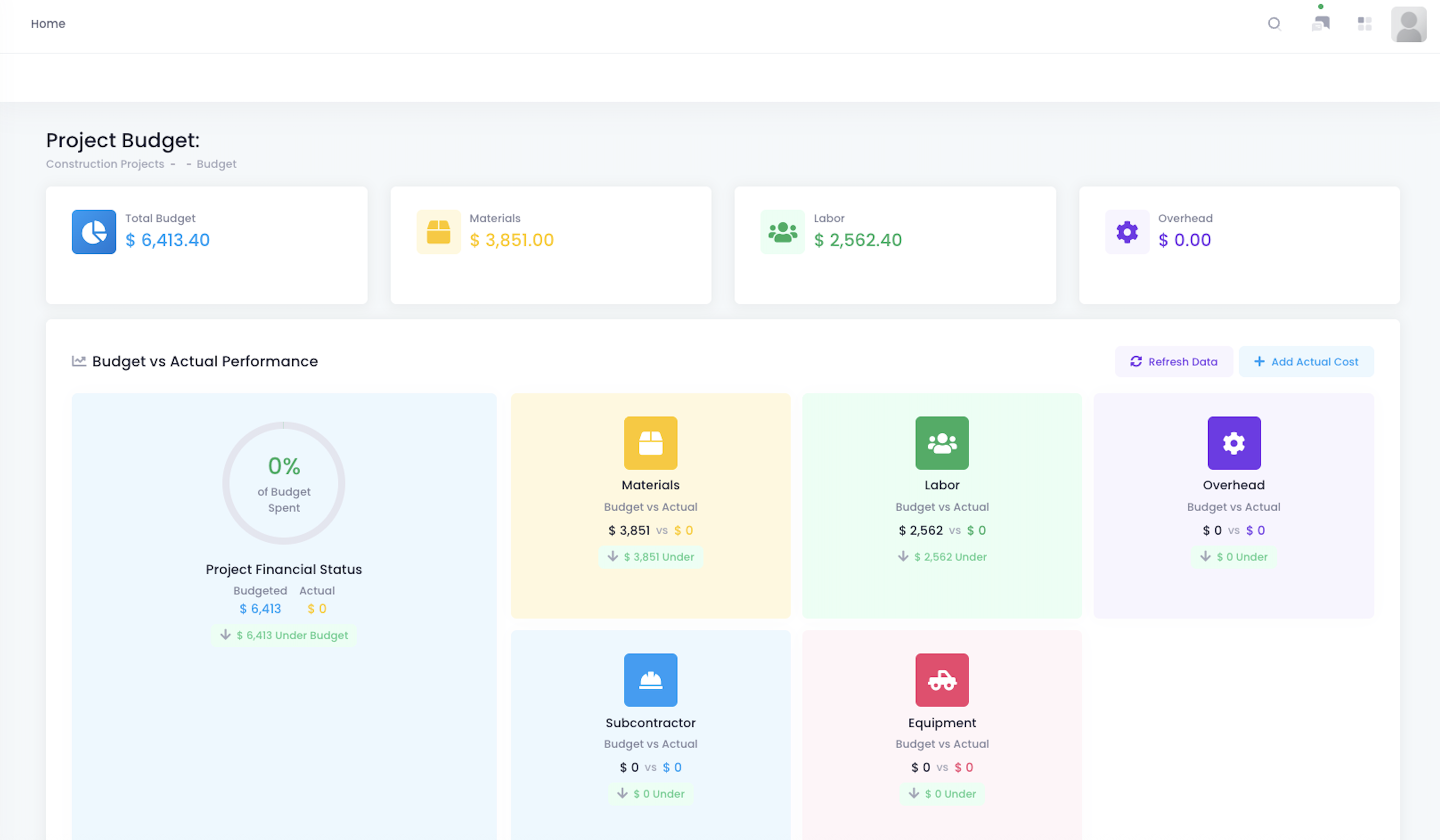
After project startup, the budget tracking view placed total budget, material budget, labor budget, overhead, and budget-versus-actual performance in one workspace. As the project moved forward, the team could enter actual spend and compare it against the original budget. The cost assumptions from the quote stage became a budget baseline that could be checked during execution.
This feature helped the contractor see cost variance earlier. If tile materials were more expensive than expected, the project manager could review purchasing decisions quickly; if labor spend grew too fast, the team could check for rework, scheduling issues, or extended field time; if actual spend began approaching the budget limit, management could decide earlier whether a change order or customer conversation was needed. Budget was no longer only something to review after completion; it became a control point during the work.
This type of feature applies to any construction team that wants earlier cost control. Field conditions will still change, but if material, labor, and actual spend can be compared with the original quote from day one, the team does not have to wait until the end to discover that margin has been compressed. The value of budget tracking is not another table; it is knowing earlier where money is going, where overrun risk may appear, and when the team should intervene.
The Result: Fewer Handoffs, Earlier Risk Visibility
After the workflow change, sales, project, and finance teams spent less time reconciling different versions of the same quote. Sales knew where each quote stood, project managers knew what the customer had approved, and finance could see value, tax, and deposit requirements earlier. The team reduced more than data entry; they reduced the back-and-forth that often slows down project startup and weakens customer confidence.
For management, the larger value was earlier risk visibility. Cost structure was visible during estimating, customer status was visible during approval, budget and contract value were visible at project startup, and budget-versus-actual comparison continued during execution. Field conditions could still change, but the team no longer had to search backward for the quote logic after problems appeared.
Client Quote
“Before, when a customer said yes, we still had to check the quote again internally. The project manager needed the scope, finance needed the deposit details, and sales had to find which version had actually been sent. Now everyone is looking at the same record after approval, so there is much less back-and-forth during handoff.”
Business Value Recap
For this contractor, the value was not only faster quoting; it was the connection between estimates, customer approval, material and labor detail, deposits, project startup, and budget tracking. For construction businesses that manage frequent remodeling quotes and need to start approved work quickly, the same workflow logic can address similar gaps: sales teams no longer rely on memory to manage opportunities, project managers no longer restart scope confirmation from scratch, and finance no longer waits until work begins to verify value and cost structure. When a quote affects purchasing, scheduling, budgeting, and payment, turning it from a customer document into a project starting point gives the team earlier risk visibility and a stronger way to move won work forward.