Results Snapshot
Centralized asset records with stronger data consistency
Clearer work order flow and faster response
Higher preventive maintenance completion and less unplanned downtime
Faster management visibility into asset status, fault trends, and maintenance progress
Customer Profile
The customer is a large manufacturing organization with multiple production areas, hundreds of critical assets, and maintenance coordination needs across several teams. As operations expanded, the number of assets, maintenance activities, and failure scenarios increased, while legacy tools became harder to manage at scale.
Business Challenge
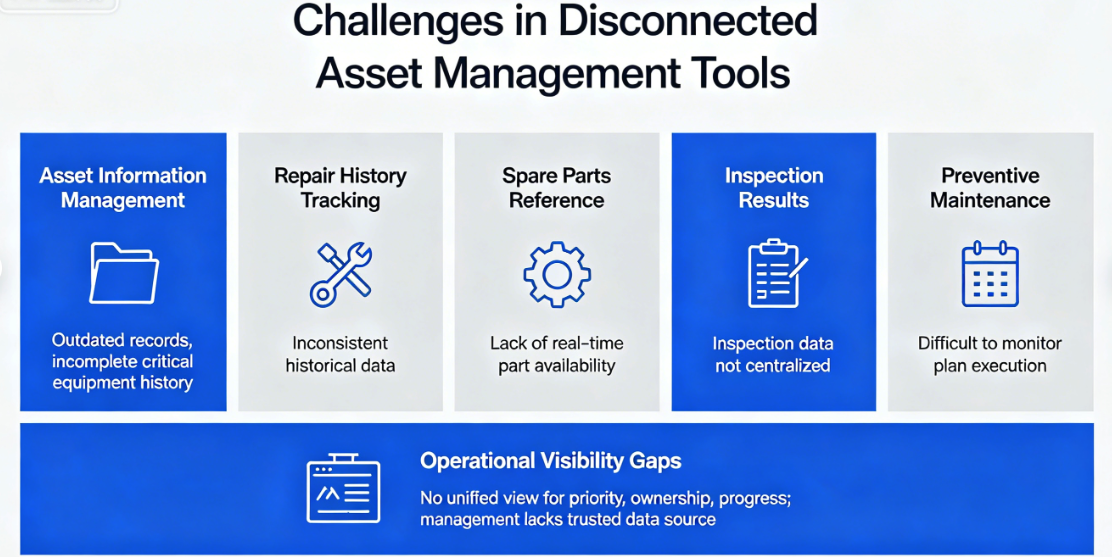
The customer relied on a set of disconnected tools to manage asset information, repair history, spare parts references, and inspection results. The maintenance team could complete daily tasks, but the broader process lacked a unified operational view, creating several persistent issues.
Asset records were not always current, and historical information for some critical equipment was incomplete. Once maintenance requests entered execution, priority, ownership, and progress were not fully transparent. Preventive maintenance plans existed, but execution was difficult to monitor consistently, which allowed some tasks to slip. Management also struggled to review asset reliability and maintenance performance through a single trusted source of data.
Why Change Was Needed
The customer needed an asset management platform built for real operational use, with the ability to manage the asset lifecycle, maintenance work, and field execution in one system. Compared with the older approach built around disconnected tools and manual coordination, the new platform needed to achieve several goals.
First, it had to establish a single asset data foundation so equipment details, location, ownership, and maintenance history were traceable. Second, inspections, service requests, work orders, preventive maintenance plans, and closeout confirmation needed to run through one connected process. Third, managers needed real-time visibility into key indicators such as fault frequency, work-order backlog, downtime causes, and maintenance completion. Fourth, the platform had to be configurable enough to support different production lines, asset types, and maintenance strategies.
Solution Approach
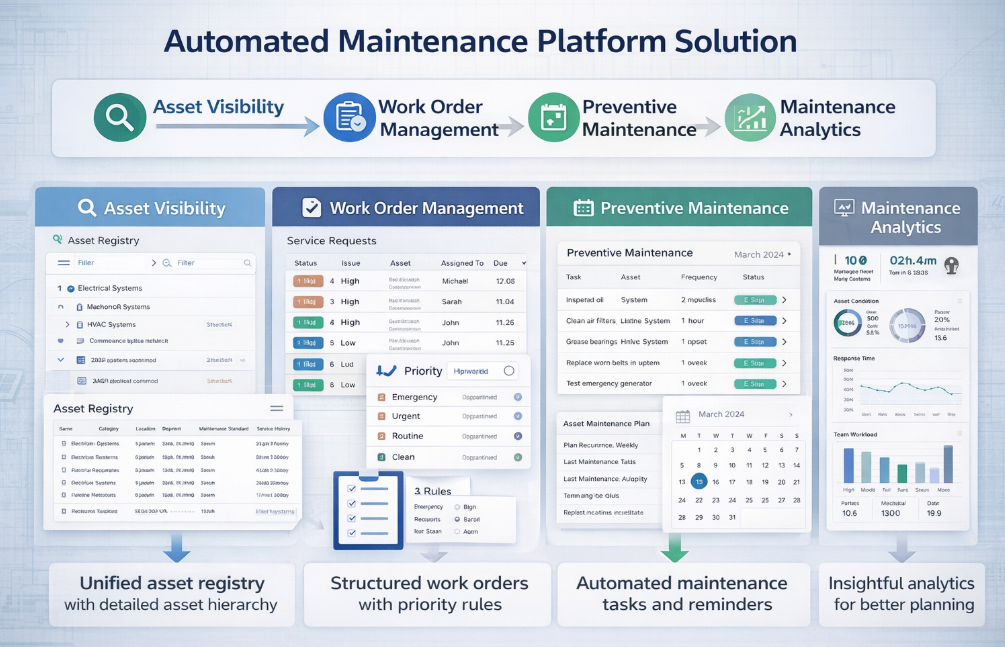
Industry Software deployed an AMP solution centered on four operational priorities: asset visibility, work order management, preventive maintenance, and maintenance analytics.
At the asset level, the project team first structured the critical equipment hierarchy and created a unified asset registry. Asset category, location, responsible department, maintenance standard, and service history were all brought into the platform. This allowed field teams and office teams to work from the same asset data foundation.
At the process level, the system standardized service requests, assignment, execution, verification, and closeout. Different issue types could follow defined priority and ownership rules, reducing communication gaps and improving transparency across the workflow.
At the management level, dashboards provided visibility into asset condition, failure distribution, response time, repeat issues, and team workload, supporting better planning and resource allocation.
For preventive maintenance, the platform generated recurring maintenance plans based on asset requirements and operating conditions, issued task reminders automatically, and recorded completion results. Maintenance leaders could quickly see which tasks were on schedule and where intervention was needed.
Implementation and Adoption
The rollout followed a phased approach. The first phase focused on critical production areas and high-value assets, prioritizing asset data cleanup and work-order process adoption. The second phase expanded into preventive maintenance, inspections, and management reporting. The third phase extended the platform further into spare-parts linkage, performance tracking, and broader site coordination.
To support adoption, Industry Software preserved practical elements of the customer’s existing workflow while removing repetitive data entry and unnecessary switching between systems. Maintenance supervisors, equipment engineers, field technicians, and operations managers received role-specific views and permissions, which reduced training effort and improved execution consistency.
Business Outcomes
The first visible improvement after go-live was a clearer asset picture. Information that had previously been spread across multiple locations was brought into one platform, making asset condition, maintenance history, and current activity easier to track.
Execution also improved. Work orders moved faster from request to assignment, ownership became clearer, and the maintenance team could identify backlog earlier and rebalance workloads more effectively. With better visibility into preventive maintenance, scheduled work became more consistent and previously delayed activities were brought under stronger control.
Broader Business Impact
The value of the AMP project extended beyond digitizing maintenance tasks. It gave the customer a more controlled and visible operating model for asset management, creating a stronger foundation for governance, scalability, and continuous improvement. It also positioned the business to extend the platform across more sites, more asset classes, and deeper operational analysis over time.
Customer Testimonials
A unified asset management platform finally connected our equipment, maintenance activity, and execution. The team has better visibility and can act faster.