Industrial organizations increasingly recognize that the real challenge in asset management is not whether systems exist to record equipment. The challenge is whether asset condition, maintenance actions, field feedback, approvals, and management decisions are truly connected. Many companies already have asset records, work-order tools, reporting environments, and partial automation. Yet when those capabilities remain fragmented, they cannot support consistent execution or strong cross-team coordination. The issue is often not missing software. It is the lack of a shared operating rhythm.
That is where Industry Software AMP creates value. Through configurable workflows, modular deployment, cloud-based access, and a unified operational view, businesses can bring asset condition, maintenance planning, incident handling, spare-parts coordination, and management decisions into one platform. The result is a clearer, more stable, and more scalable way to operate.
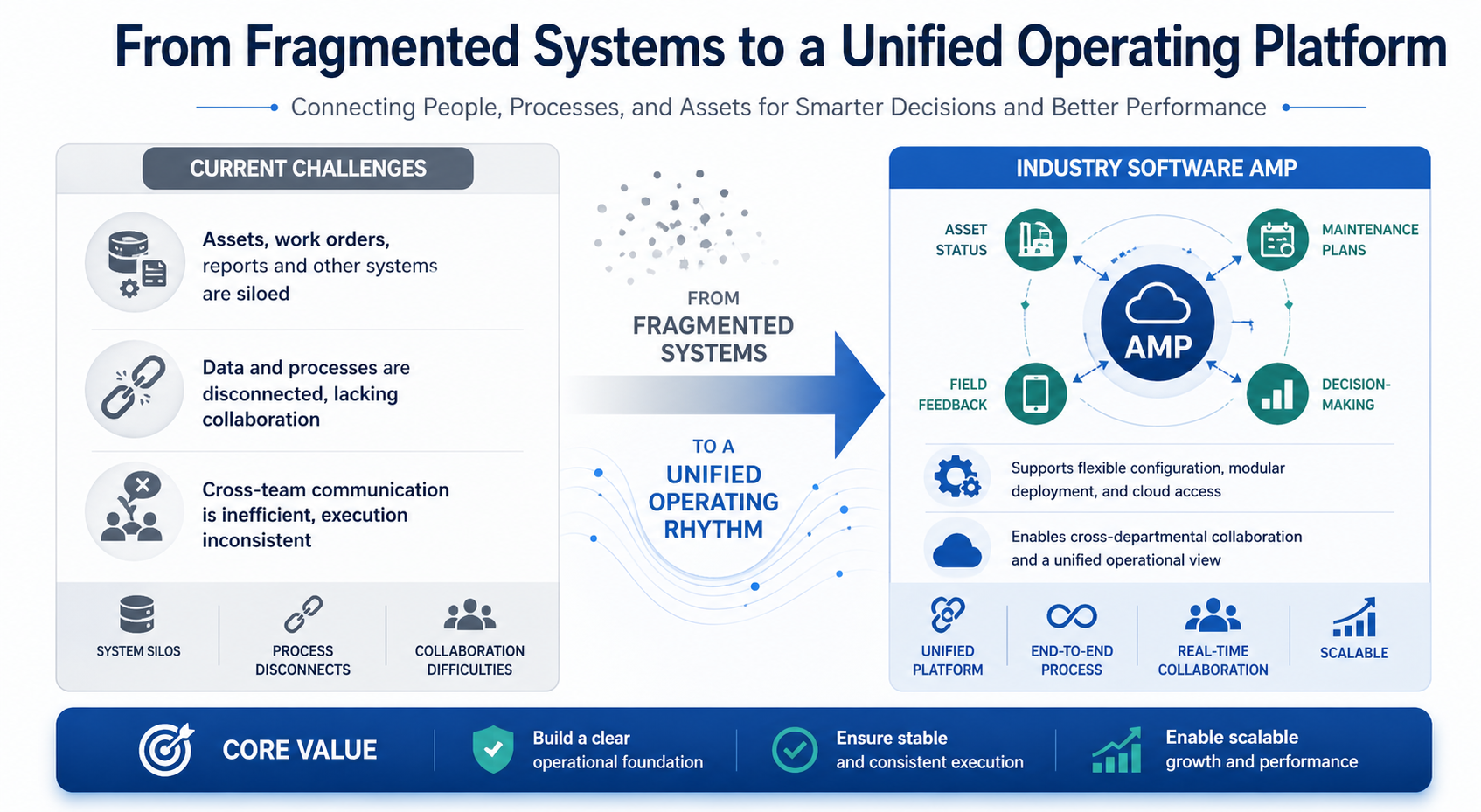
The real bottleneck often appears where workflows break apart
Many organizations already maintain digital asset records and use local tools for work-order management, inspections, and service requests. The real problem often begins once work has to move across boundaries. Who sets priority after an incident is found. Who coordinates resources after a shutdown. How is a spare-parts shortage escalated. When does leadership gain visibility into rising risk. If those actions cannot move through one connected process, the organization accumulates operational friction.
For that reason, an asset management platform cannot simply be a database for equipment information. It must also be a platform that helps work move. The most valuable AMP does not only identify what happened to an asset. It helps the business respond with greater speed, clearer accountability, and more consistent execution.
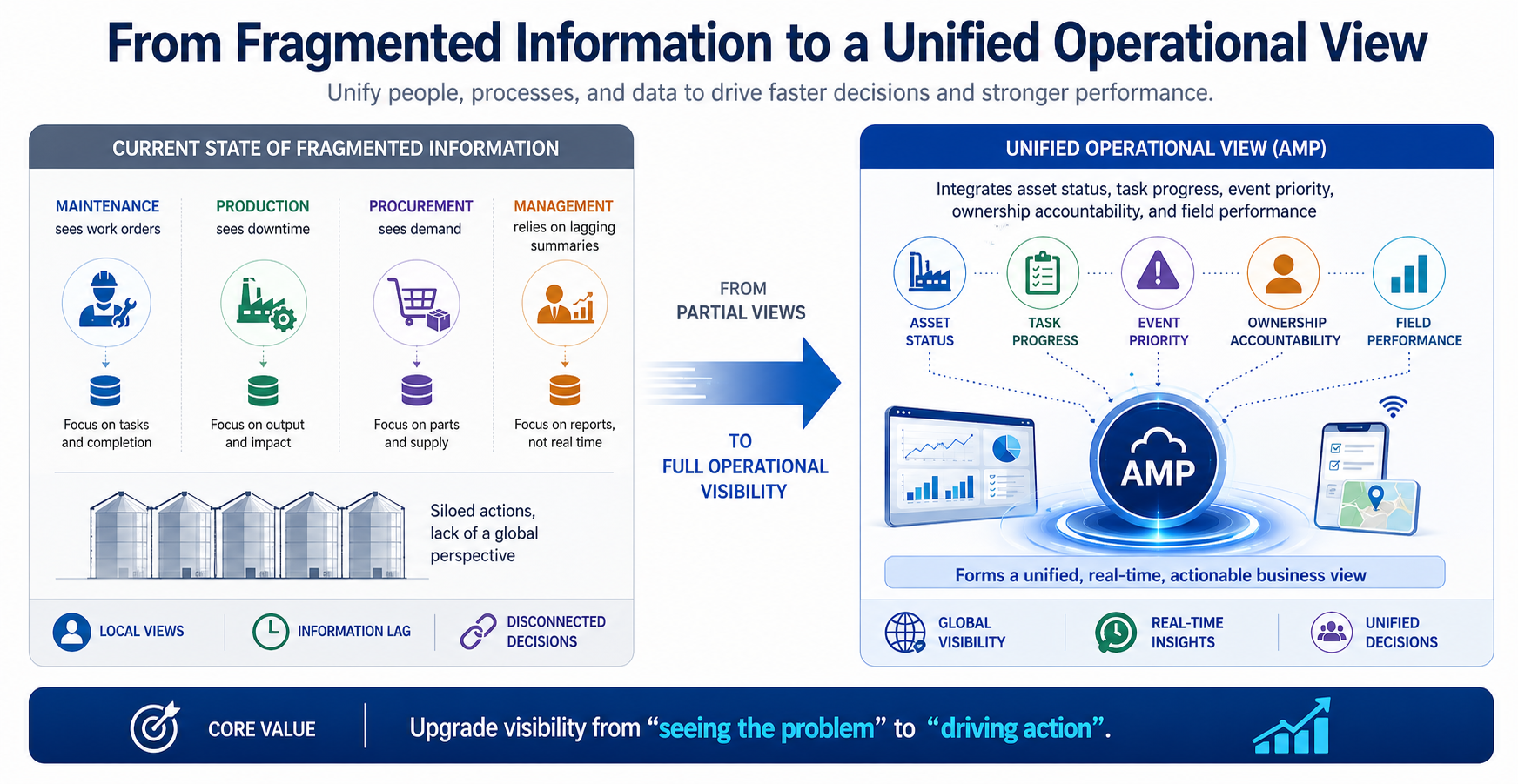
A unified view makes status risk and ownership visible at the same time
When asset-related information lives across separate systems, organizations are left with partial truths. Maintenance teams see work orders. Production teams see downtime impact. Procurement sees parts demand. Leadership sees delayed weekly summaries. Everyone sees a fragment, but no one sees the full picture. That weakens both judgment and execution.
Industry Software AMP addresses this by bringing asset condition, task progress, incident severity, ownership, and site performance into one operating view. Leadership can identify high-risk backlog and recurring failures earlier. Field teams gain a clearer understanding of priority and workflow context. Visibility becomes more than display. It becomes a tool for faster operational action.
Configurability determines whether the platform can enter real operations
Industrial organizations differ not only by equipment type, but also by responsibility models, approval paths, compliance demands, and site management practices. Software with many fixed features does not automatically fit a complex operating environment. Platforms that can configure workflow rules, form fields, role permissions, alert logic, and status progression are far more likely to become part of daily execution.
Industry Software AMP is built around business reality rather than forcing the business to reorganize around the software. That approach helps companies create stronger governance while preserving the flexibility needed at the site level. In multi-site and multi-team environments, this matters greatly.
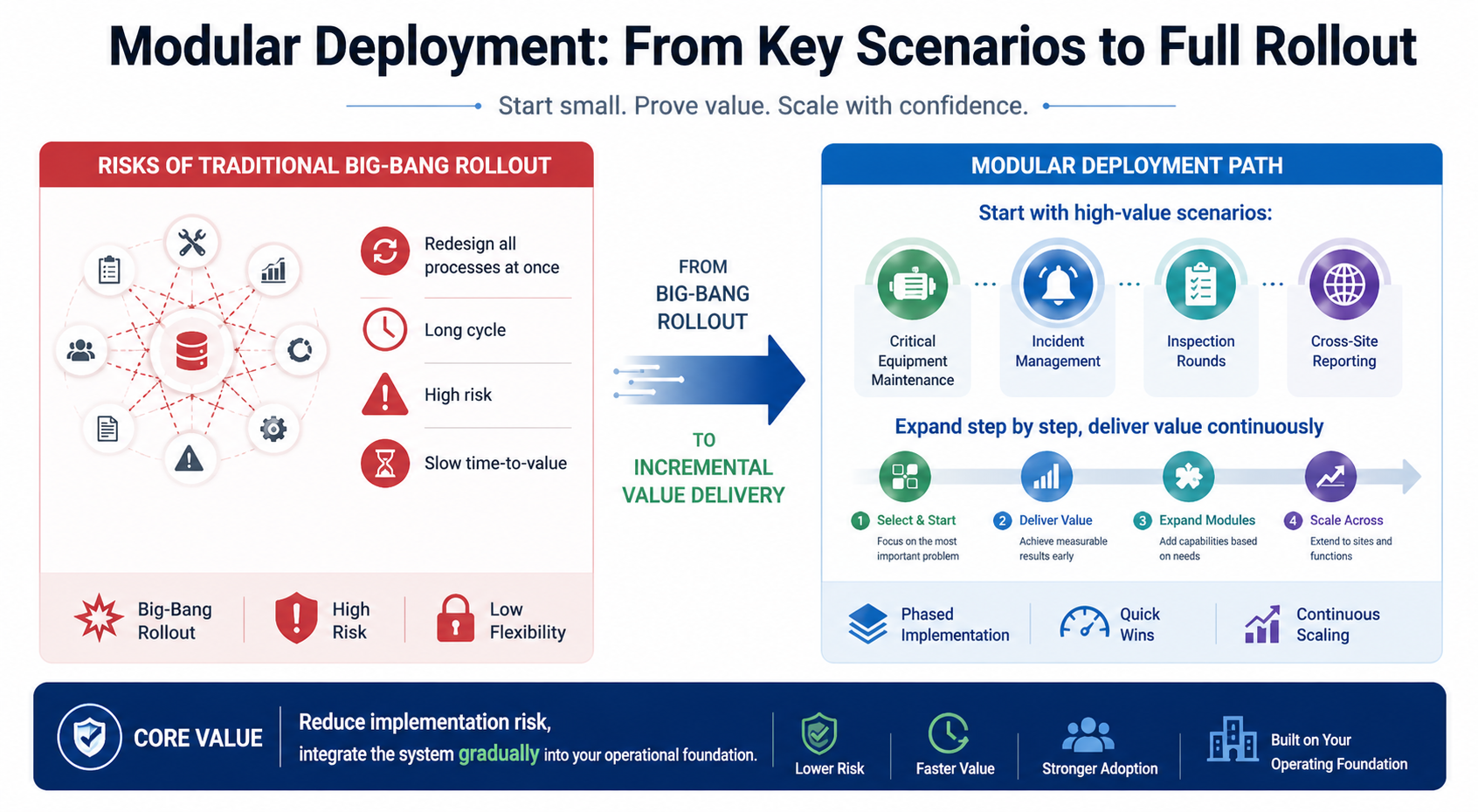
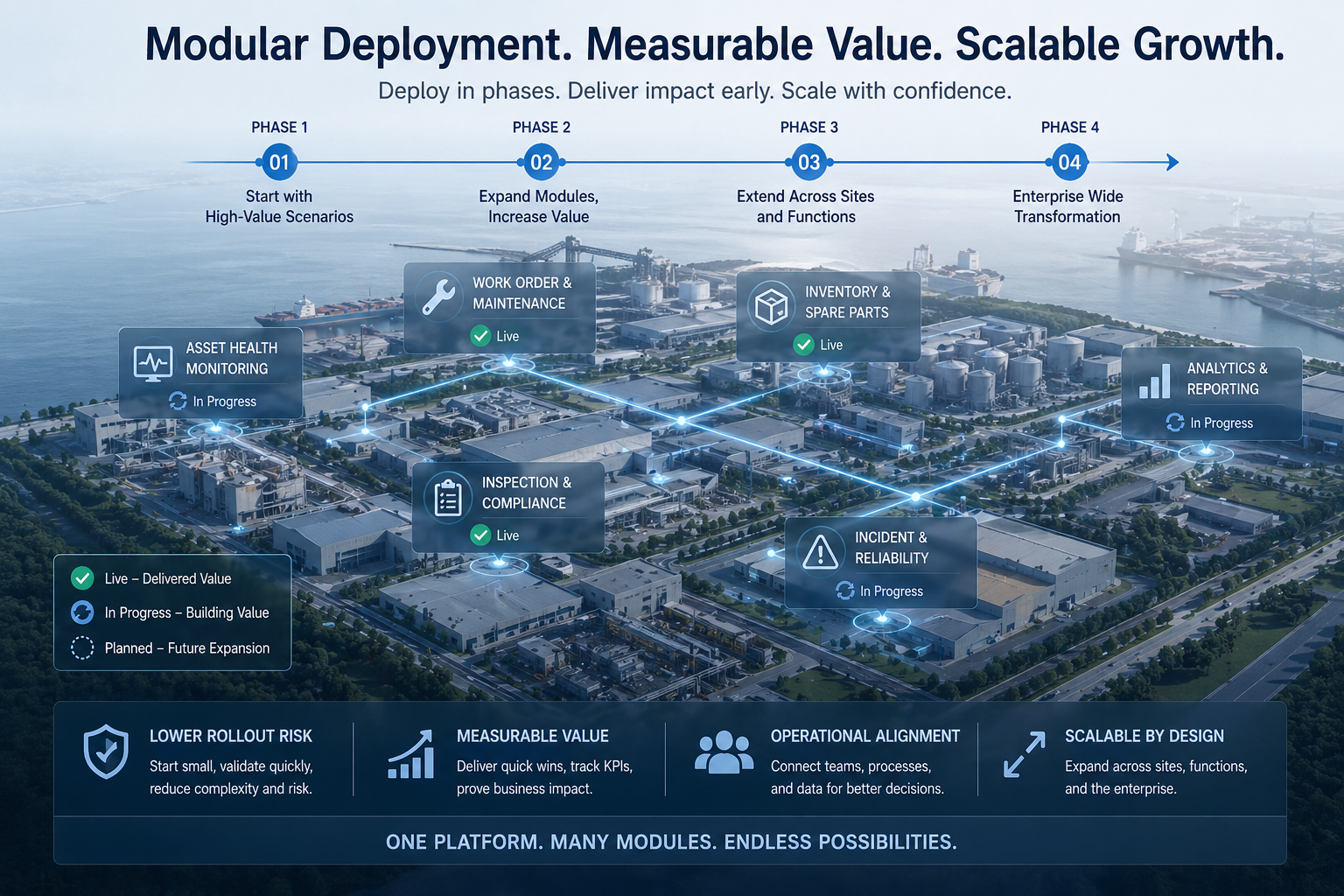
Modular deployment fits the way industrial organizations actually roll out change
Very few companies redesign all asset-related workflows at once. A more realistic path begins with high-value use cases such as critical asset maintenance, incident closure, inspection management, or cross-site reporting. A modular platform allows the organization to start with the most important problem, establish measurable value, and expand from there.
This lowers rollout risk and aligns better with the way industrial organizations manage resources and change. Operational teams can see practical improvement early, and leadership can use early gains to support broader expansion. In that way, the platform does not simply get deployed. It gradually becomes part of the organization’s operating foundation.
The core value of AMP is turning record-keeping into execution capability
In many older environments, software mainly serves as a record-keeping layer. Tasks are entered after completion. Incidents are documented after they occur. Reports are assembled when the reporting cycle arrives. That approach preserves information, but it does not drive action. The business can review the past without truly controlling the present.
The central value of AMP is that it transforms software from passive documentation into active execution support. An equipment issue can trigger a work order. The work order can drive ownership assignment. Ownership can move approvals and resource coordination. Leadership can then gain timely visibility into critical deviation. Software shifts from storing results to moving work forward. That is one of the most important transitions in modern industry software.
A cloud-based platform connects office teams and field teams through one working environment
For businesses operating across multiple sites, external service groups, or regional structures, consistency of access and speed of information flow are essential. A cloud-based platform gives different roles a more unified environment in which to work, reducing version inconsistency, delayed updates, and isolated local data.
The value of Industry Software AMP in this setting is not only easier access. It is the fact that office teams, site supervisors, maintenance personnel, and leadership can work from the same operational truth. An effective platform is not one that simply increases logins. It is one that brings people into the same logic of execution.
Modern asset operations need a platform rather than more isolated tools
The future strength of industrial organizations will increasingly depend on how reliably they use assets, how early they identify risk, how consistently they execute maintenance, and how quickly leadership can turn insight into action. Those capabilities are not created by adding more disconnected tools. They are created by connecting workflows, ownership, and data in one platform.
Industry Software AMP provides that kind of foundation. It helps organizations build visibility, strengthen execution, support coordination, and preserve room for future expansion across more workflows and use cases. For companies focused on improving operational maturity and organizational alignment, AMP is more than an asset system. It is a more modern software foundation for industrial operations.