Warehouses play a deceptively simple yet critical role in manufacturing enterprises. Materials arrive, are stored, picked, and shipped. Each cycle repeats with the same rhythm. Warehouse staff verify documents, operate forklifts, and conduct cycle counts, ensuring materials appear at the right place when needed. Yet beneath this orderly surface lies a vast efficiency drain.
Traditional warehouse management systems focus on recording. They record receipts, storage locations, and shipments. These records are essential for traceability but offer limited value for optimization. When orders fluctuate, inventory is misplaced, or aisles become congested, the system passively records outcomes without actively improving processes.
Artificial intelligence is driving WMS from a recording system to an optimization engine. Intelligent WMS no longer merely tracks where materials are located. It plans in real time how materials should flow. It forecasts order peaks, optimizes picking routes, dynamically adjusts storage locations, and autonomously schedules equipment, transforming warehouses from static storage facilities into dynamic flow hubs.
The core proposition of intelligent WMS is not to replace warehouse personnel but to equip them with the insights needed for real-time decision-making, ensuring every movement is optimized and every inch of space is utilized.
The Warehouse Black Hole
Warehouses are often the least transparent link in the supply chain. Raw materials arrive from suppliers, pass through receiving, quality inspection, and putaway, then disappear into the depths of the racks. Production departments issue material requests, warehouse staff navigate the aisles searching for items, time consumed in walking and hunting. Finished goods move from production lines to storage, awaiting shipment, yet may linger in aisles because no suitable storage location can be found.
The consequences of this opacity are multifaceted. Inventory accuracy declines as system records diverge from physical reality. Operational efficiency suffers as pickers walk unoptimized paths, wasting time on non-value-added movement. Space utilization falls short as high-bay racks sit empty while floor aisles fill with overflow. Equipment coordination breaks down as forklifts crisscross the warehouse without necessarily executing the most urgent tasks.
Intelligent Warehousing
Traditional WMS operates on fixed rules. Upon receipt, materials are assigned to storage locations according to predefined rules. Picking processes orders sequentially in the order received. Replenishment is triggered by fixed thresholds. These rules function adequately under stable volumes but degrade rapidly when fluctuations occur.
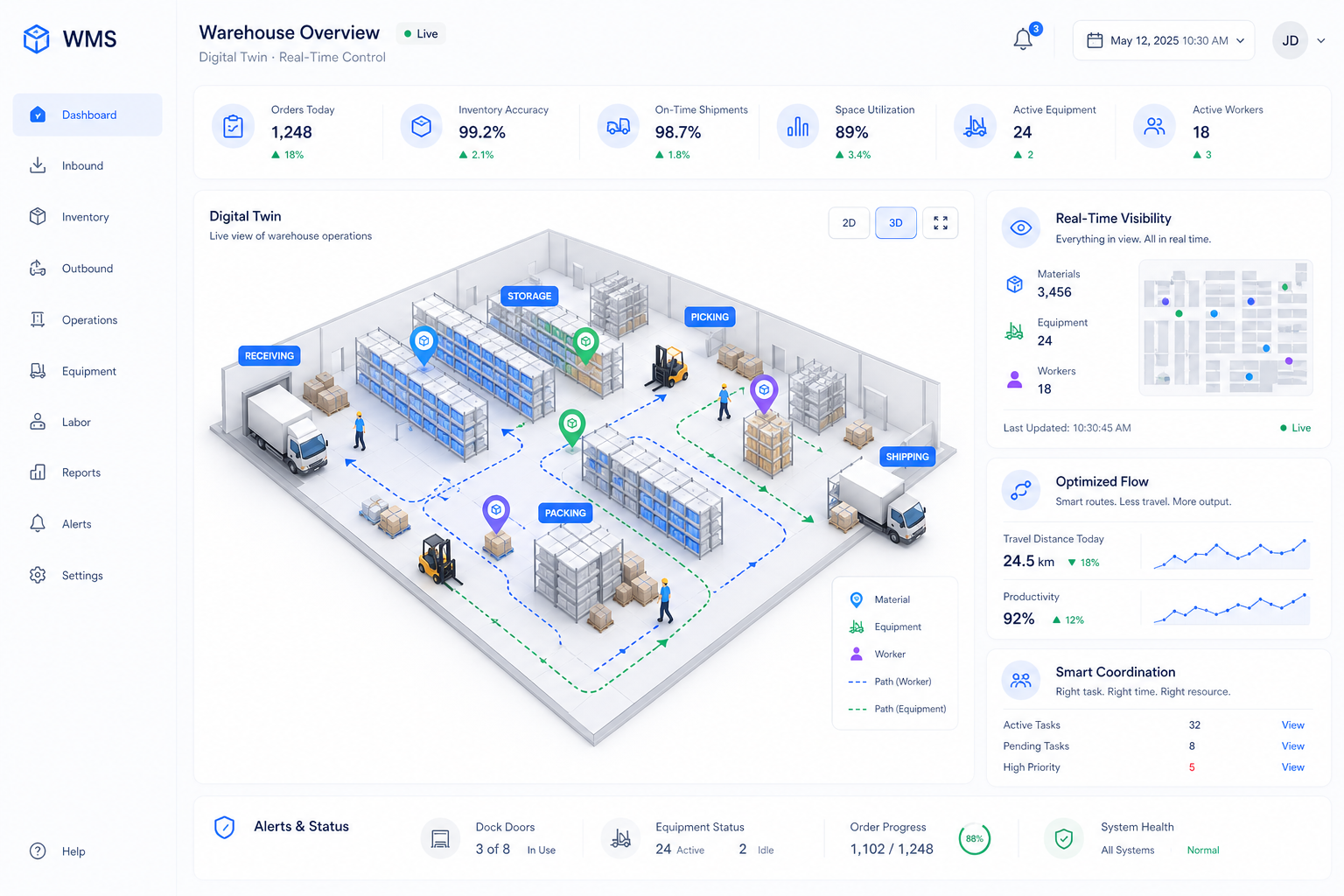
Intelligent WMS shifts operational logic from rule-driven to optimization-driven. The system analyzes order structures, inventory distributions, equipment status, and personnel locations in real time, dynamically generating optimal execution plans for every task.
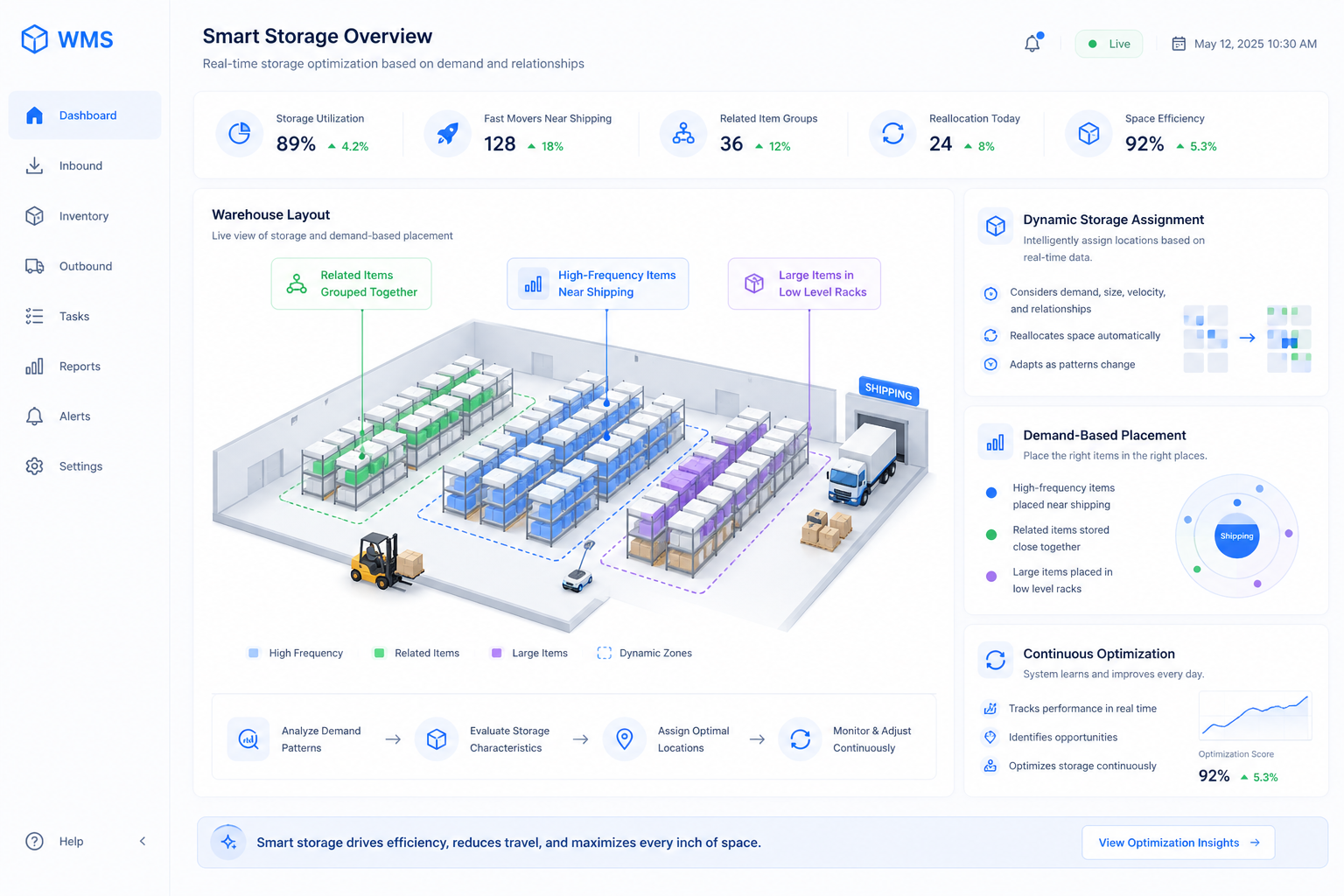
During receiving, the system dynamically assigns storage locations based on historical outbound frequency, storage characteristics, and associations with other materials. High-frequency materials are placed near shipping areas. Associated materials are positioned in adjacent bins. Large items are allocated to low-level racks for easy access. Storage assignment is no longer static but continuously optimized as demand patterns evolve.
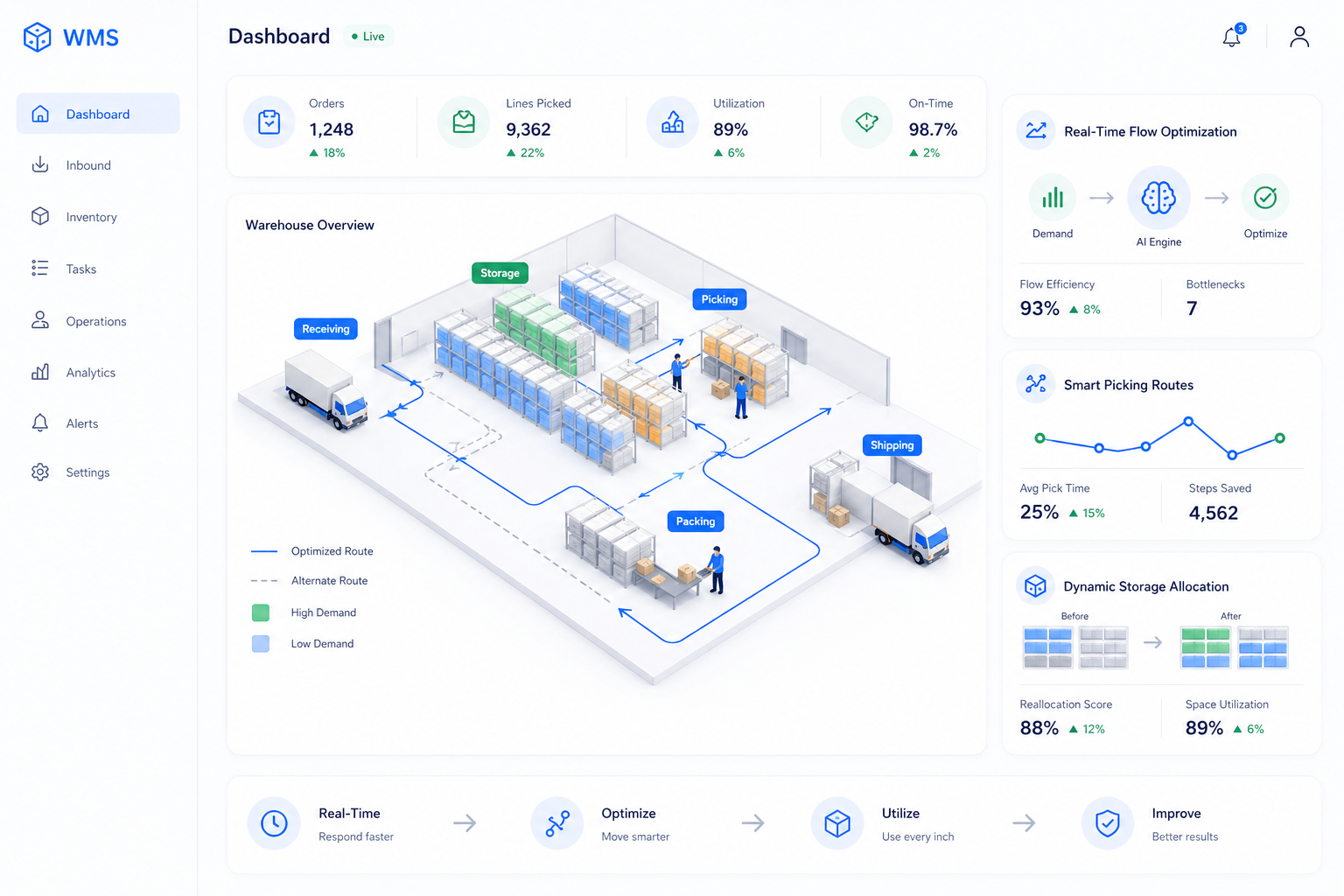
During picking, the system consolidates multiple orders into waves, optimizes picking routes, and minimizes travel distance. It considers picker current locations, equipment availability, and order priorities when dynamically assigning tasks. Urgent orders can jump the queue while non-urgent orders wait for batch processing. Pickers receive not static route sheets but dynamically generated task sequences, each step guiding them to the optimal next action.
Dynamic Wave and Route Optimization
Wave picking is a critical lever for warehouse efficiency. Consolidating multiple orders into a wave allows a single picker walk to fulfill several orders simultaneously, dramatically reducing redundant movement. Traditional wave management relies on fixed rules such as time windows or order type classifications. These rules work under stable order profiles but lose efficiency when facing diverse order structures.
Intelligent WMS transforms wave management from static rules to dynamic optimization. The system analyzes pending orders in real time, considering order urgency, item location distribution, picking equipment capabilities, and shipping time windows, dynamically generating optimal wave combinations. Waves are no longer triggered at fixed intervals but automatically formed when conditions are optimal.
Route optimization is the foundation of wave management. Given a list of items in a wave, the system must plan the optimal picking route to minimize travel distance and time. Traditional route planning relies on static maps, while intelligent WMS route planning is dynamic. The system senses aisle congestion, equipment occupancy, and personnel locations in real time, dynamically adjusting route recommendations. When an aisle becomes temporarily congested due to forklift operations, the system automatically plans alternative routes, preventing pickers from waiting idly.
Space Optimization
Warehouse space is a finite resource, yet traditional warehouse management treats space allocation as static. Once a storage location is assigned, it remains fixed even as material demand patterns shift. The result is some locations sitting idle while others overflow with slow-moving inventory, and fast-moving materials have nowhere to go.
Intelligent WMS transforms space management from static allocation to dynamic optimization. The system continuously monitors utilization rates for each location, turnover rates for each material category, and activity levels for each zone, dynamically adjusting storage layouts. High-frequency materials are automatically migrated to premium locations near shipping areas. Low-frequency materials are moved to remote areas. Obsolete inventory is consolidated for disposition.
This dynamic space management must be closely coordinated with operational scheduling. Material relocation itself consumes resources, and the system must balance relocation costs against long-term benefits. Only when benefits exceed costs does the system trigger automatic relocation tasks. Relocation tasks are scheduled during low-activity periods, executed by idle equipment, without impacting normal operations.
Equipment Coordination
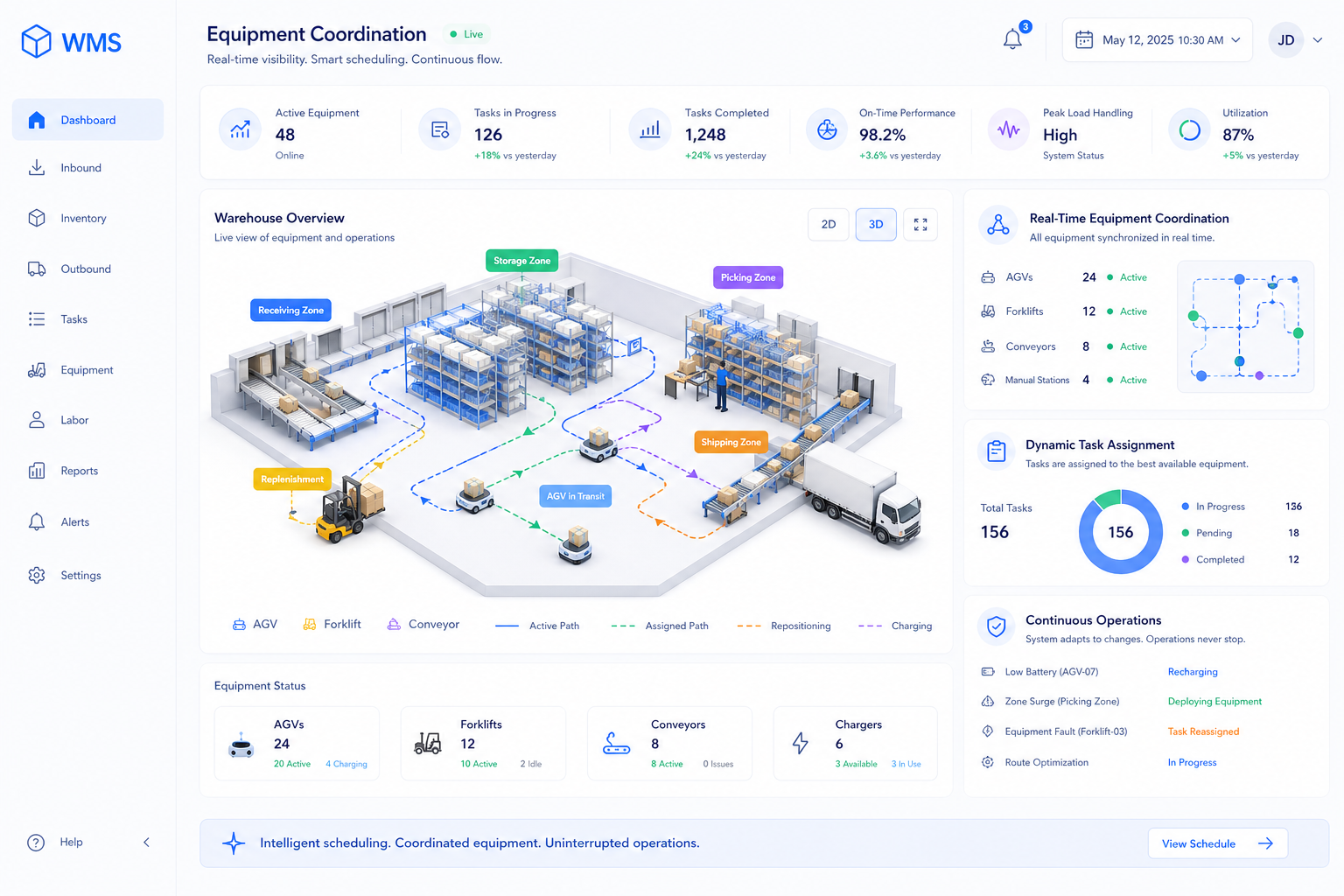
Modern warehouses operate with a mix of manual and automated equipment. Forklifts, AGVs, conveyors, and sorters each have distinct roles. Traditional WMS manages equipment in isolation, with each type operating independently without global coordination.
Intelligent WMS transforms equipment management from isolated control to coordinated scheduling. The system monitors all equipment status, locations, and tasks in real time, dynamically assigning work. AGVs are dispatched for long-distance transport. Manual forklifts handle complex operations. Conveyors accelerate during peak periods. Equipment no longer operates in silos but coordinates around shared objectives.
When an AGV battery runs low, the system automatically directs it to return to the charging station while dispatching other equipment to take over its tasks. When activity surges in a zone, the system automatically deploys additional equipment to prevent bottlenecks. When equipment fails, the system immediately reassigns affected tasks to ensure operational continuity.
Value Anchors
Enterprises that have deployed intelligent WMS report measurable improvements in warehouse operations.
Inventory accuracy improves to over 99%. Real-time tracking and automated recording eliminate manual entry errors, keeping system records aligned with physical inventory.
Picking efficiency increases by 30% to 50%. Dynamic wave and route optimization dramatically reduce travel distance, with pickers processing significantly more orders per unit time.
Warehouse space utilization improves by 20% to 30%. Dynamic storage allocation ensures high-bay racks are fully utilized while floor aisles remain clear.
Equipment utilization improves by 15% to 25%. Coordinated scheduling reduces idle time and empty travel, keeping AGVs and forklifts operating efficiently.
From Warehouse to Hub
The evolution direction of intelligent WMS is not about making warehouses more automated but about making them more intelligent. Automation addresses the replacement of repetitive labor. Intelligence addresses the optimization of complex decisions.
When a warehouse possesses real-time sensing, dynamic optimization, and coordinated scheduling capabilities, it ceases to be merely a storage facility for materials. It becomes a flow hub for the supply chain. Materials no longer sit idle but pass through briefly before moving quickly to their next destination. The warehouse rhythm synchronizes with production, sales, and supply, becoming the metronome of the entire supply chain.
In this evolution, the role of warehouse personnel shifts from material handlers to coordinators. The system handles the heavy work of route planning, task assignment, and equipment scheduling. Warehouse personnel focus on exception handling, process optimization, and equipment maintenance. They are no longer physical laborers but operations managers.