Quality management has traditionally been viewed as a necessary cost of doing business. Inspection stations scattered across the production line, quality engineers responding to customer complaints, and rework teams salvaging nonconforming parts. The quality function operates as a gatekeeper, catching defects after they have already been created.
Artificial intelligence is now transforming quality management from a reactive inspection function into a proactive prevention engine. Intelligent QMS no longer merely records defects. It predicts where defects are likely to occur, identifies root causes before they proliferate, and prescribes corrective actions that prevent recurrence.
The Quality Paradox
Quality occupies a paradoxical position in manufacturing enterprises. Every stakeholder agrees that quality is essential, yet the quality function is often viewed as an impediment to throughput. Production teams see quality inspections as bottlenecks. Management sees quality costs as overhead. Customers see quality issues as failures that erode trust.
This paradox stems from a fundamental misalignment. Traditional quality management operates after value has been added. Parts are produced, then inspected. Defects are found, then reworked. Customers complain, then corrective actions are issued. Quality is always playing catch-up, and the cost of poor quality accumulates with each passing hour.
Intelligent QMS resolves this paradox by moving quality activities upstream. Instead of inspecting at the end of the line, quality controls are embedded at each critical operation. Instead of reacting to customer complaints, quality signals are monitored in real time. Instead of reworking defects, processes are adjusted to prevent defects from occurring in the first place.
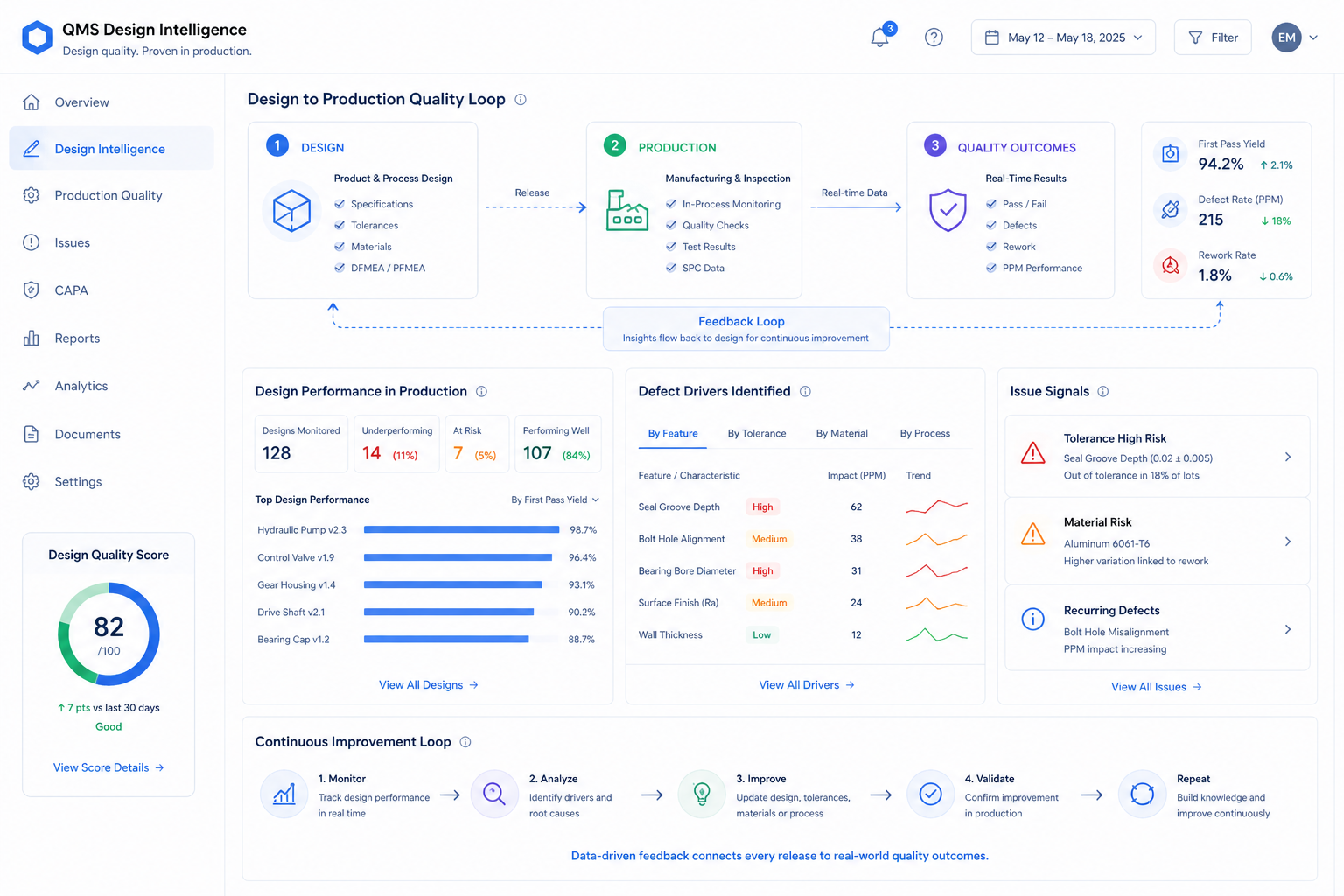
Design Quality: Where Most Defects Begin
Research consistently shows that 70% to 80% of product quality is determined during the design phase. Yet design quality has traditionally been the least instrumented part of the quality management process. Design engineers work in isolation, releasing specifications to manufacturing without visibility into how those specifications perform on the shop floor.
Intelligent QMS closes this loop by connecting design with production. When a product is released to manufacturing, the system tracks how its specifications translate into actual quality outcomes. Features that consistently cause defects are flagged. Tolerances that are difficult to hold are identified. Material selections that lead to quality issues are documented.
This feedback loop enables continuous improvement in design quality. Engineers no longer release specifications and wait months to learn whether they work. They receive real-time feedback on how their designs perform in production. Over time, the system learns which design patterns correlate with high-quality outcomes and can suggest proven configurations to engineers during the design process.
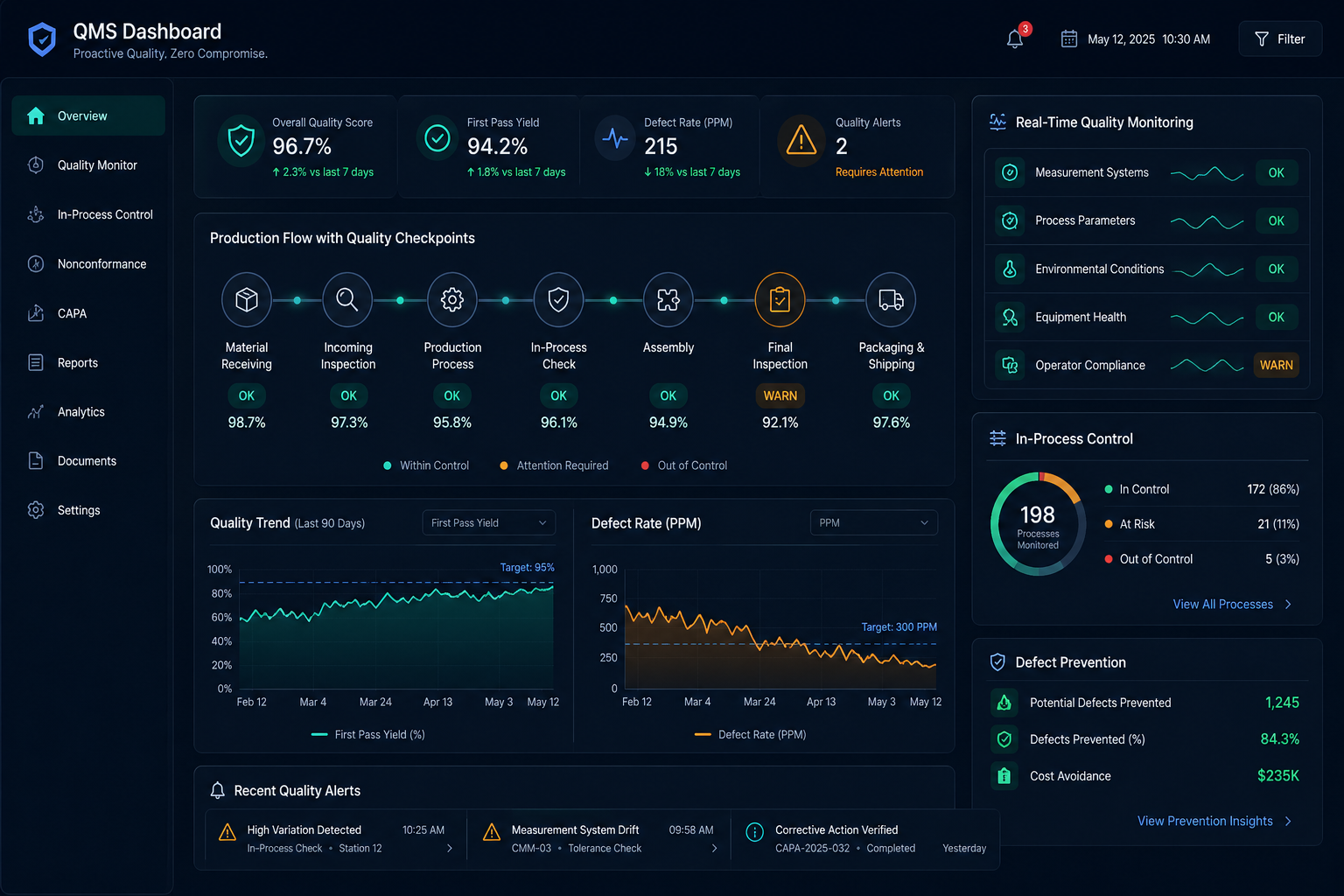
Process Quality: Real-Time Control
Traditional process quality relies on sampling and statistical process control. Operators measure a sample of parts at regular intervals, plot the measurements on control charts, and look for trends that indicate process drift. This approach works but has significant limitations. Sampling intervals leave gaps during which defects may be produced undetected. Control chart interpretation requires trained personnel. Corrective actions are implemented after the process has already drifted.
Intelligent QMS replaces sampling with continuous monitoring. Sensors embedded in machines capture real-time process parameters. Vision systems inspect every part, not just a sample. Machine learning models analyze the relationship between process parameters and quality outcomes, identifying the precise conditions that lead to defects.
When process parameters begin to drift, the system alerts operators before defects occur. The alert includes not only the fact of drift but also the likely cause and recommended correction. Operators can intervene proactively rather than reactively. The result is a shift from defect detection to defect prevention.
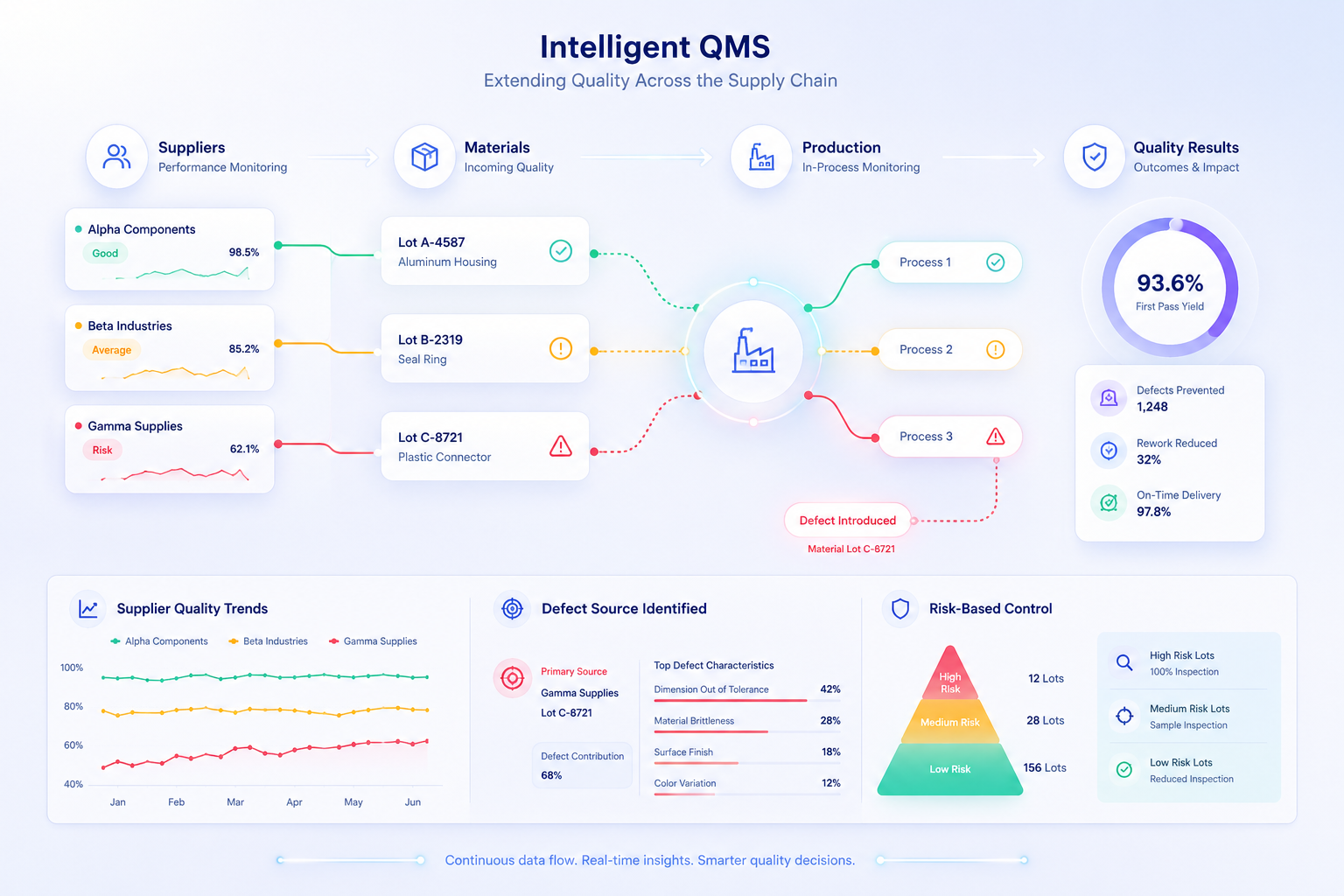
Supplier Quality: Extending the Quality Perimeter
For most manufacturers, a significant portion of quality issues originate outside the four walls of the factory. Incoming materials from suppliers account for a substantial share of defects, rework, and production delays. Yet supplier quality management has traditionally been fragmented, relying on incoming inspection and periodic audits.
Intelligent QMS extends the quality perimeter to include the entire supply chain. Supplier performance data is continuously collected and analyzed. Incoming materials are tracked from receipt through production, linking supplier lots to downstream quality outcomes. When a supplier lot causes defects, the system automatically flags the supplier and identifies the specific characteristics of the lot that contributed to the issue.
This visibility enables more strategic supplier management. High-performing suppliers can be recognized and prioritized. Low-performing suppliers can be targeted for improvement or replacement. Incoming inspection can be risk-based, with high-risk lots receiving additional scrutiny while proven suppliers enjoy reduced inspection burden.
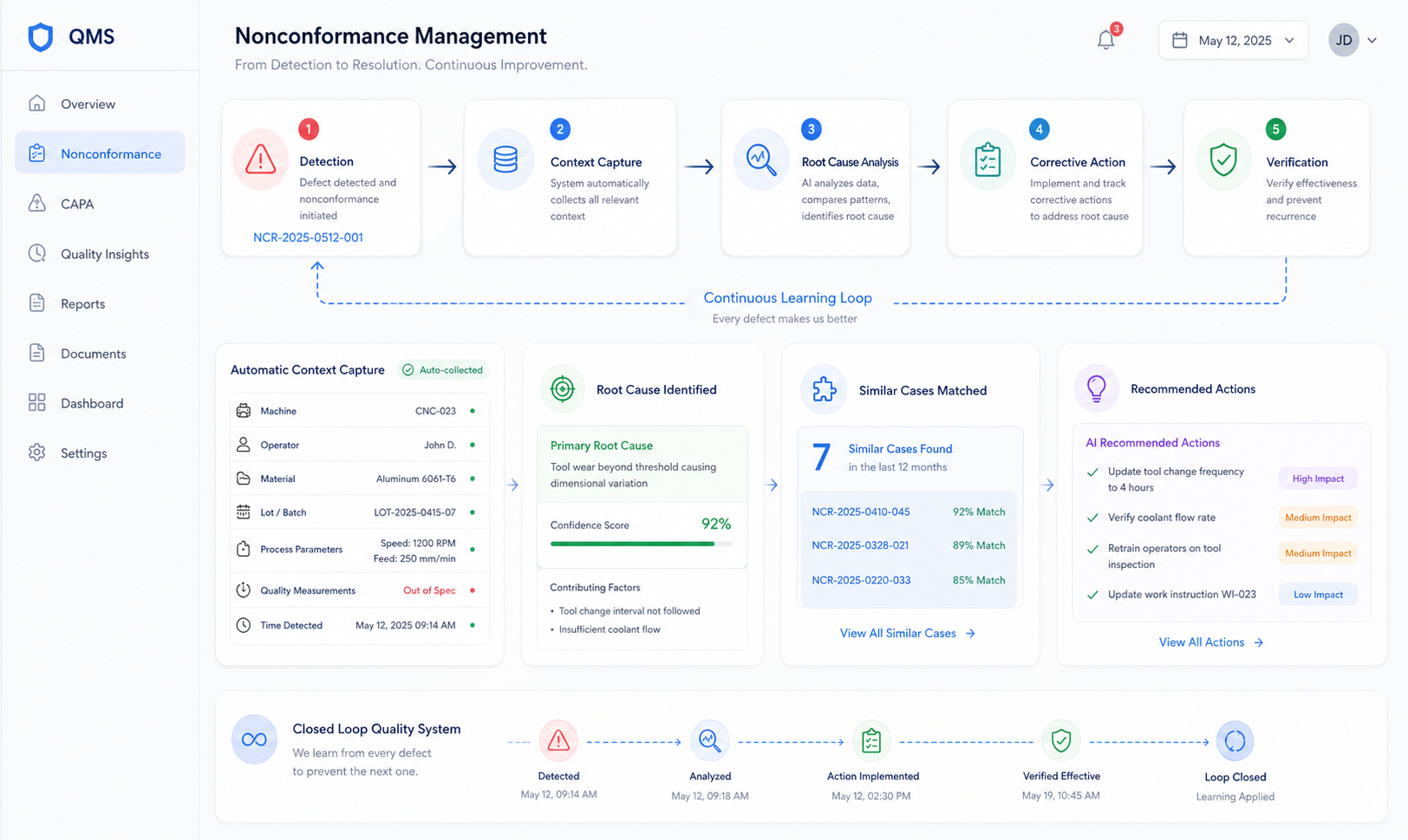
Nonconformance Management: From Documentation to Resolution
Nonconformance management is the heart of traditional quality systems. When a defect occurs, a nonconformance report is created. The report documents what happened, what parts are affected, and what disposition is recommended. The report is reviewed, approved, and filed. In many organizations, the process stops there. The nonconformance is resolved, but the root cause remains unidentified, and the same defect recurs weeks or months later.
Intelligent QMS transforms nonconformance management from documentation to resolution. When a defect occurs, the system automatically captures all relevant context: the machine that produced it, the operator who ran it, the materials used, the process parameters at the time, and the quality measurements that flagged it. This context is automatically assembled, eliminating the manual effort of data gathering.
The system then analyzes the data to identify root causes. It compares the current defect to historical patterns, identifying similar events and their resolutions. It suggests corrective actions that have proven effective in the past. It tracks the implementation of corrective actions and monitors whether they prevent recurrence. The result is a closed-loop quality system that learns from every defect and improves over time.
Customer Quality: Closing the Final Loop
The ultimate measure of quality is customer satisfaction. Yet traditional quality systems have limited visibility into customer experience. Customer complaints are captured in service systems, but the connection between complaints and production data is weak. Quality engineers struggle to trace a customer complaint back to the specific production event that caused it.
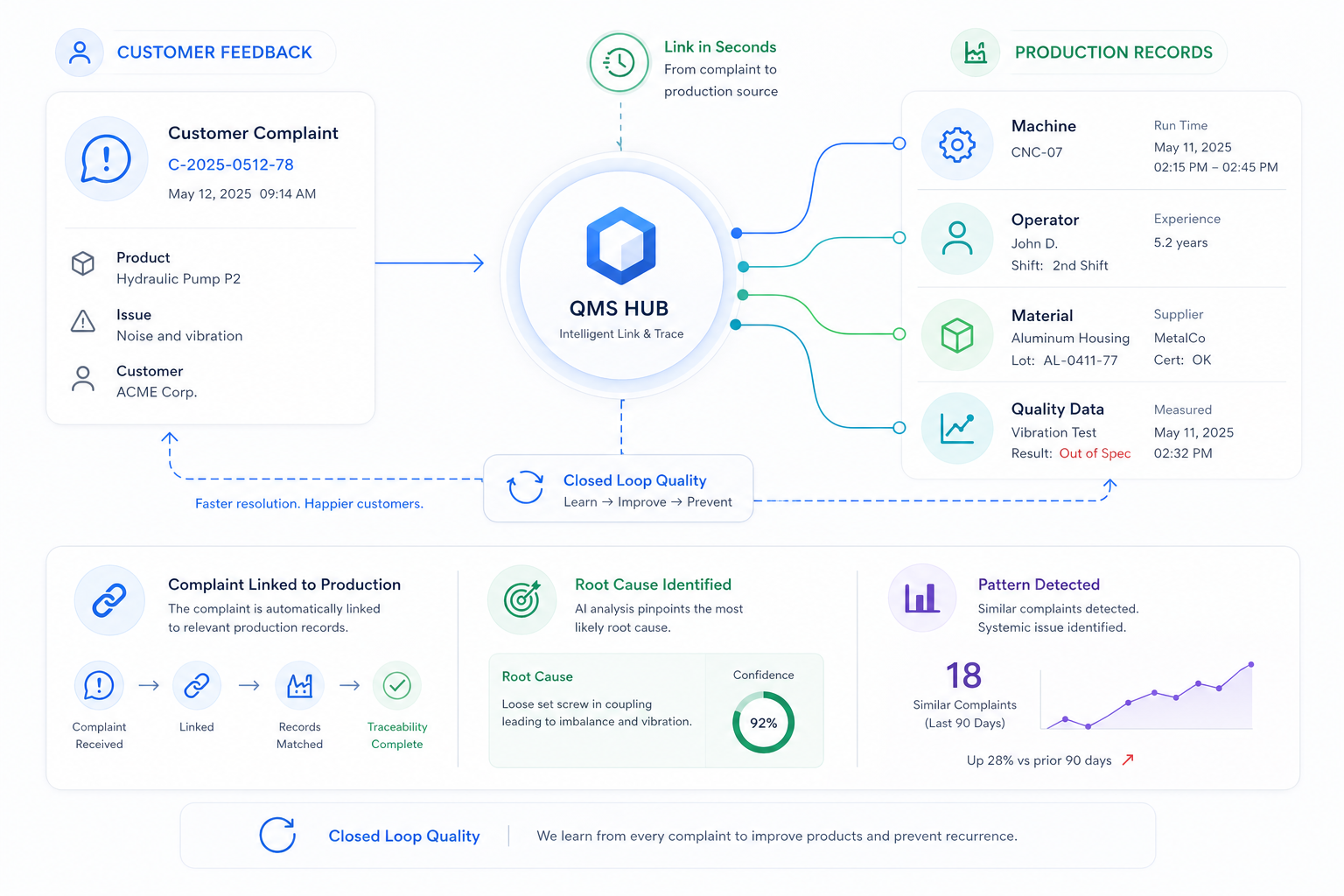
Intelligent QMS closes this loop by integrating customer feedback with production data. When a customer complaint is received, the system automatically links it to the relevant production records. Which machine produced the product. Which operator ran it. Which materials were used. Which quality measurements were recorded. The system assembles this information instantly, eliminating the days or weeks typically spent on complaint investigation.
This integration enables faster, more effective complaint resolution. Quality engineers can identify root causes in hours rather than days. Corrective actions can be implemented before the issue affects more customers. The system also identifies patterns across complaints, revealing systemic issues that might otherwise remain hidden.
Value Anchors
Enterprises that have deployed intelligent QMS report measurable improvements across quality metrics and business outcomes.
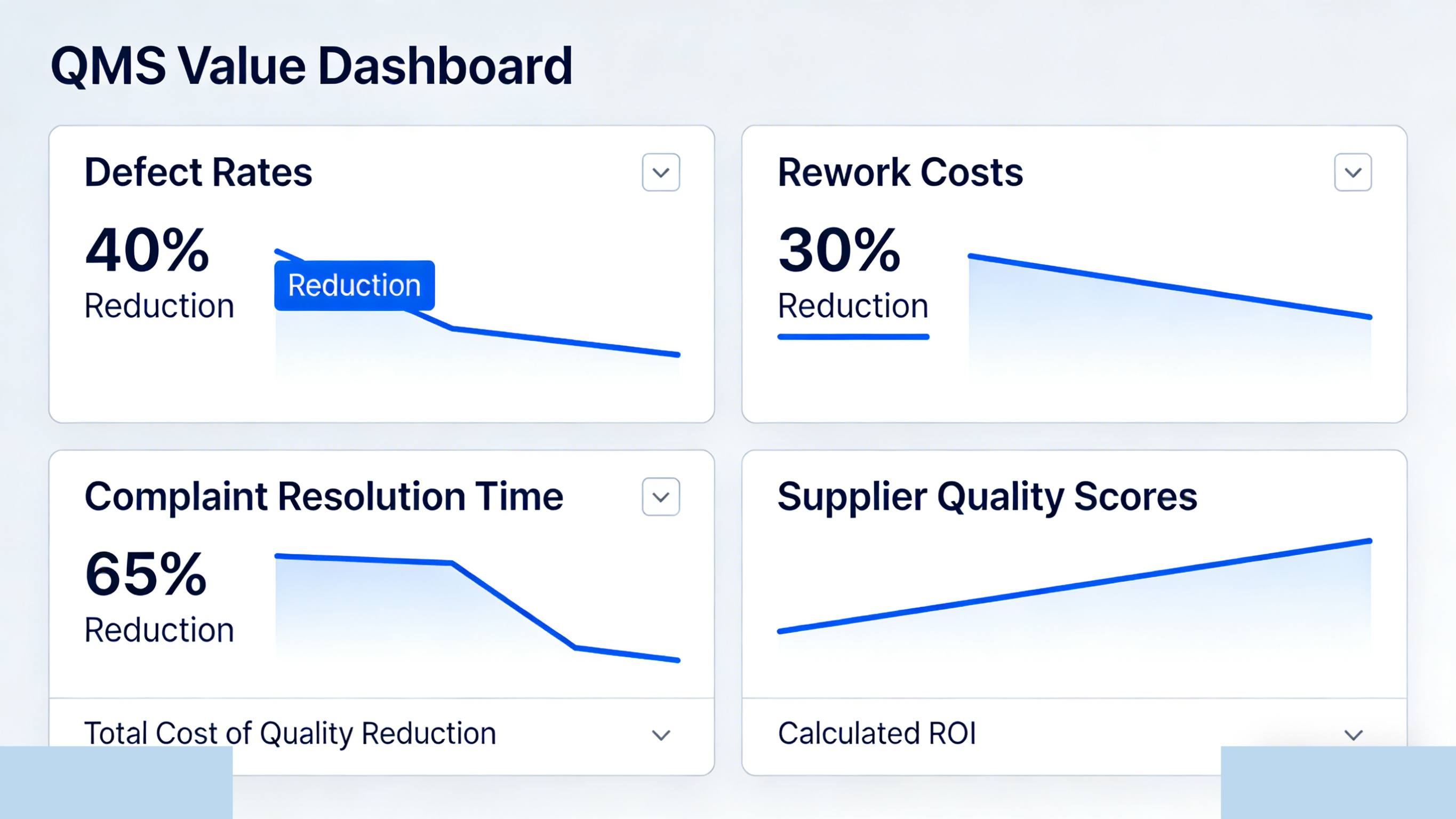
Defect rates decrease by 30% to 50%. Real-time process control catches deviations before they produce defects, and predictive models identify high-risk conditions before they lead to quality issues.
Rework and scrap costs decline by 25% to 35%. Defects are prevented rather than corrected, and nonconformance resolution cycles shorten dramatically.
Customer complaint resolution time decreases by 50% to 70%. Automated traceability eliminates investigative delays, and root-cause identification shifts from manual analysis to pattern recognition.
Supplier quality improves by 20% to 30%. Continuous monitoring and risk-based inspection focus attention on the suppliers that need it most, while high-performing suppliers are rewarded with reduced oversight.
The Quality Culture
Intelligent QMS is not merely a technology implementation. It represents a shift in how organizations think about quality. In traditional organizations, quality is the responsibility of the quality department. In intelligent organizations, quality is embedded in every function.
Design engineers consider quality implications of their decisions. Process engineers optimize for both throughput and quality. Procurement teams evaluate suppliers on quality performance. Operators monitor quality signals alongside production metrics. Quality professionals shift from inspectors to coaches, from report writers to problem solvers.
This cultural shift is enabled by technology but driven by leadership. When every employee has visibility into quality performance and the tools to improve it, quality ceases to be a separate function and becomes a shared responsibility. The result is not just better products but a more engaged workforce and a stronger competitive position.
The Zero-Defect Trajectory
Zero defects has long been an aspirational goal, celebrated in quality slogans but rarely achieved in practice. The gap between aspiration and reality has traditionally been attributed to the inherent variability of manufacturing processes. People make mistakes. Machines drift. Materials vary. Defects are inevitable.
Intelligent QMS challenges this assumption. By predicting defects before they occur, preventing them through real-time control, and learning from every nonconformance to prevent recurrence, the system progressively reduces defect rates. What was once considered inevitable becomes increasingly rare.
The trajectory toward zero defects is not a straight line. Early gains come quickly as obvious sources of variation are identified and controlled. Later gains require more sophisticated analysis as the remaining defects become more subtle and less frequent. But with each improvement, the system learns and becomes more capable.
In this trajectory, the role of quality professionals evolves from firefighters to architects. They no longer spend their days responding to emergencies. They spend their time designing systems that prevent emergencies from occurring. They build the intelligence that enables the organization to learn from every defect, every complaint, every near miss.