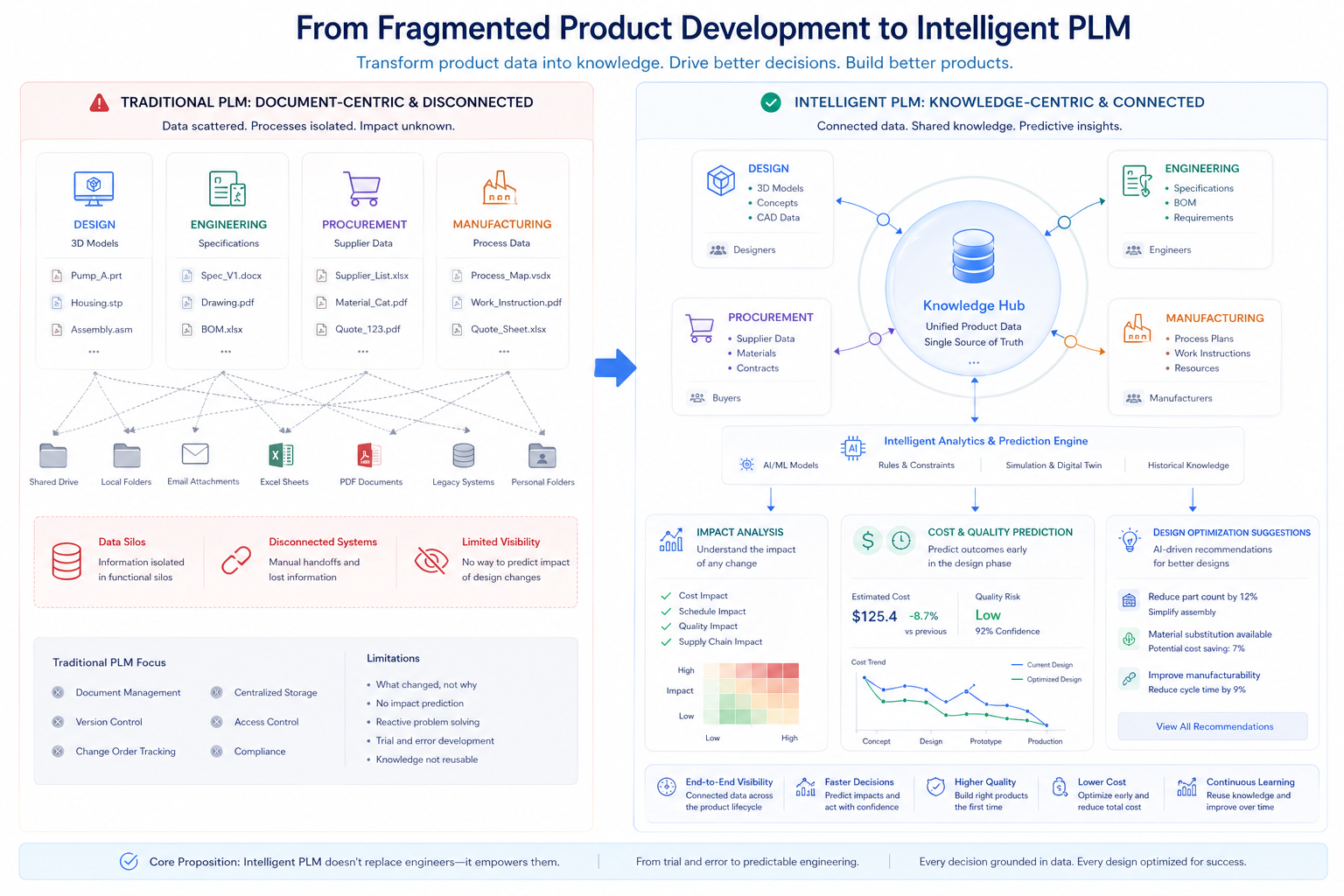
Product development is the most creative activity in manufacturing enterprises, and also one of the most chaotic. Designers define product forms in three dimensional models. Engineers annotate technical specifications on drawings. Procurement personnel search supplier catalogs for suitable materials. Manufacturing departments verify process feasibility on the shop floor. Each step generates vast amounts of data, scattered across different systems, different folders, and different individuals.
Traditional product lifecycle management systems focus on document management. They centralize drawings, specifications, and change orders, ensuring everyone can access the latest versions. This centralization is essential for resolving document chaos but offers limited value for optimizing product development processes. When product designs change, the system records what changed but cannot predict the impact on cost, quality, or supply chain.
Artificial intelligence is driving PLM from document management to knowledge engine. Intelligent PLM is no longer merely a product archive but a knowledge hub for product definition and evolution. It connects design, engineering, procurement, manufacturing, and service, transforming product data into knowledge assets that can be analyzed, predicted, and optimized.
The core proposition of intelligent PLM is not to replace engineer creativity but to transform product development from a trial and error process into a predictable engineering activity, ensuring every design decision is grounded in data.
The Design Disconnect
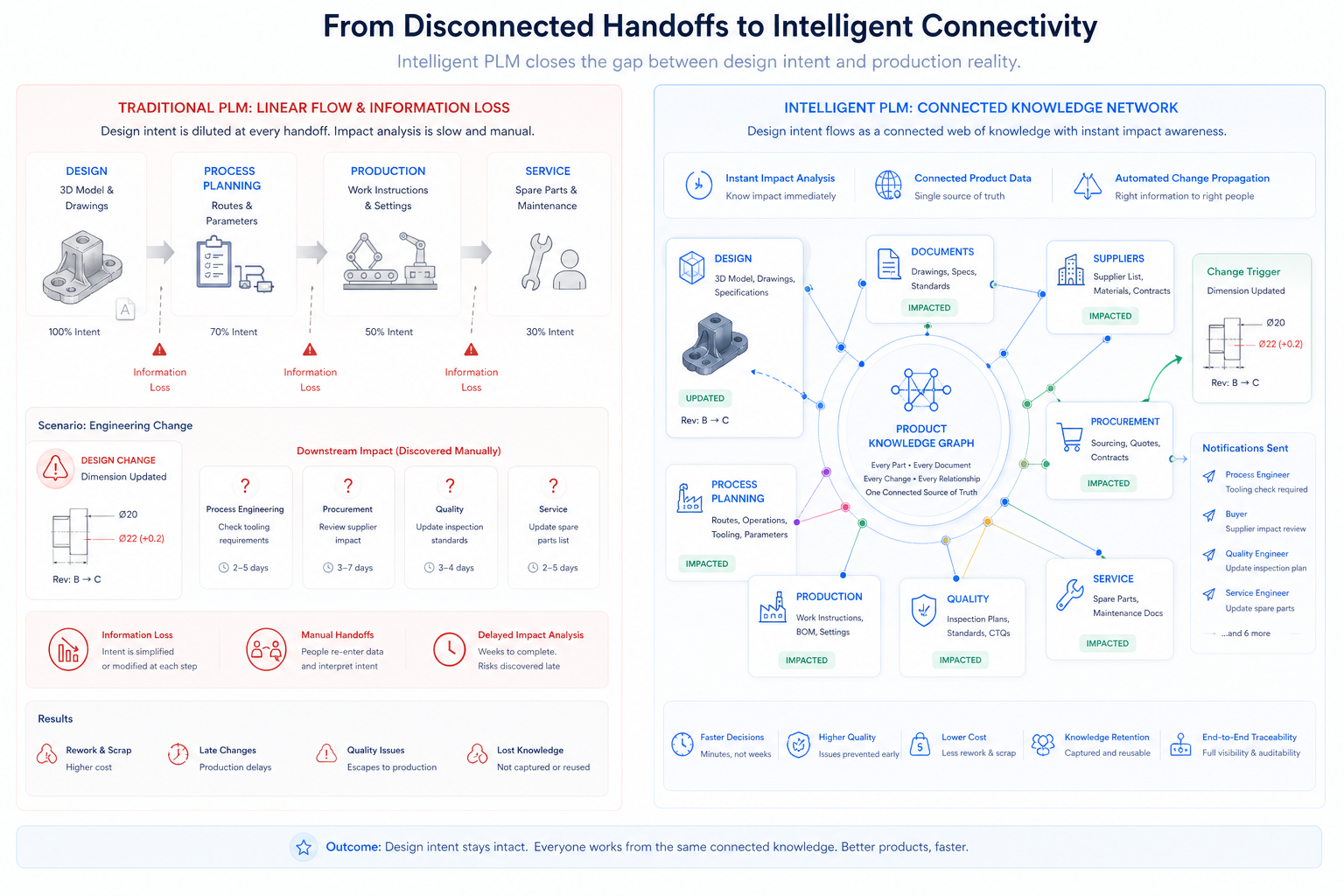
The most insidious efficiency killer in product development is the disconnect between design information across different stages. Intentions expressed by designers in three dimensional models are simplified when passed to process planning. Parameters established in process planning are adjusted when passed to production execution. Knowledge accumulated during production is filtered when fed back to design. Each transmission attenuates information, ultimately creating a gap between design intent and production reality.
A typical scenario is engineering change. A design engineer modifies a part dimension, and the three dimensional model and drawings update automatically. But the impact of this change extends far beyond. Process engineering must verify whether new tooling is needed. Procurement must confirm whether the new dimension affects supplier selection. Quality must update inspection standards. Service must update spare parts lists. In traditional PLM, change orders are created, approved, and distributed, but impact analysis and coordination depend on manual effort, often taking weeks to complete.
Intelligent PLM addresses the design disconnect by constructing a unified product knowledge graph. Every product, every part, every document, and every change is assigned a unique identifier, with the system automatically establishing relationships between them. When a design engineer modifies a part dimension, the system immediately identifies affected process routes, supplier lists, and service parts, pushing impact notifications to responsible personnel. Design intent no longer travels as a linear relay but as a networked web of knowledge.
Unified Product Knowledge Graph
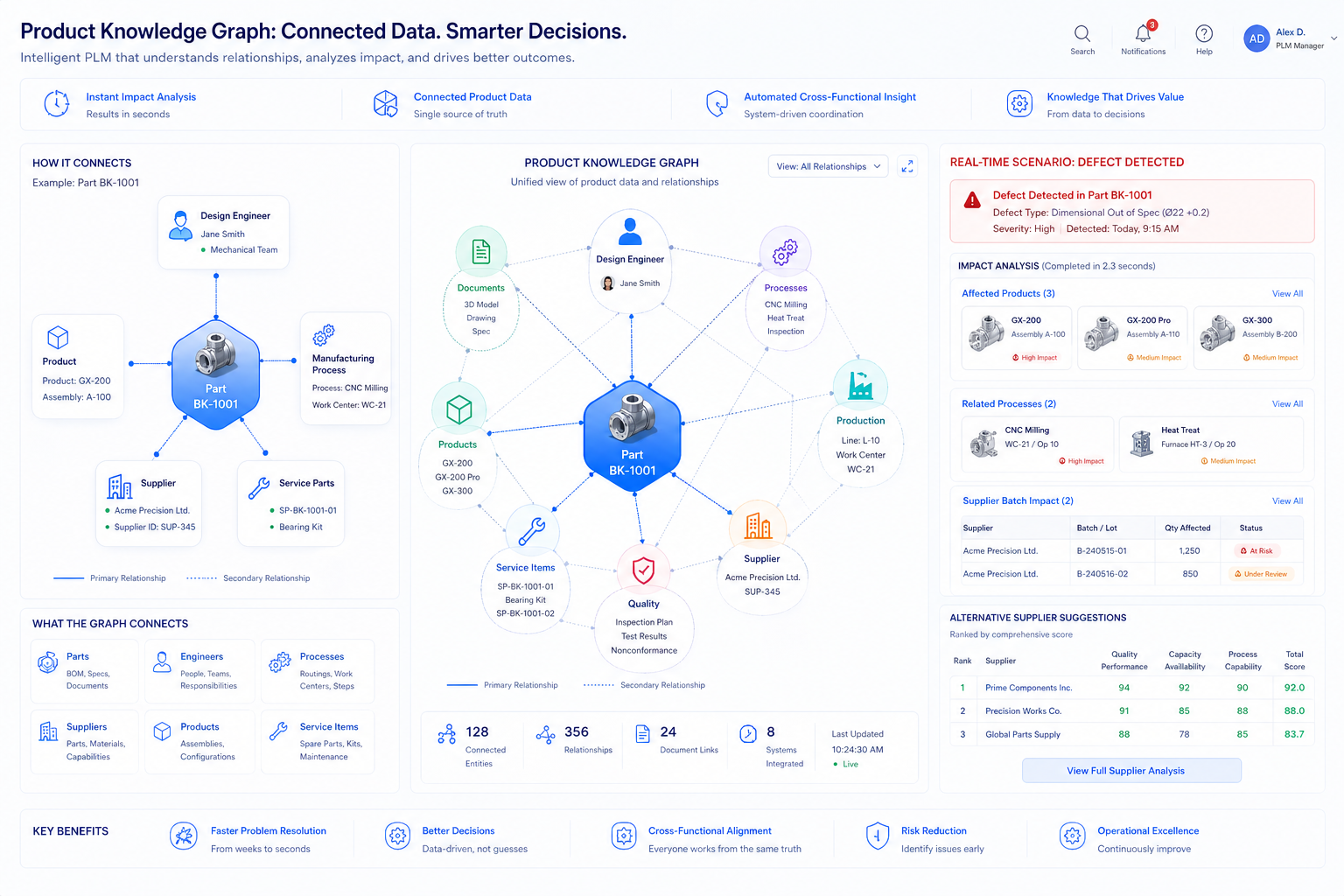
The product knowledge graph is the core of intelligent PLM. It organizes all product related data in a graph structure, with nodes representing entities and edges representing relationships. A part node connects to the engineer who designed it, the process that manufactures it, the supplier that provides it, the products that contain it, and the service parts that use it. This structure enables the system to understand the semantics of product data rather than merely storing documents.
The knowledge graph transforms cross functional coordination from manual effort to system driven. When quality discovers a defect in a part, the system automatically retrieves which products use that part, which process steps may be affected, and which suppliers provided the affected batch. Quality engineers no longer need to trace manually; the system presents complete impact analysis in seconds. When procurement needs to identify alternative suppliers, the system automatically analyzes which suppliers possess required process capabilities, historical quality performance, and current capacity, ranking options by comprehensive scores.
Design Closed Loop
In traditional product development, a design engineer work is considered complete when drawings are released. Whether the design is reasonable, easy to manufacture, or cost optimal, these questions remain unanswered until products enter production. By then, the cost of design modification has already increased substantially.
Intelligent PLM transforms design from one way output to closed loop feedback. When products enter manufacturing, the system continuously collects production data, analyzing gaps between design specifications and actual performance. Which design features consistently cause quality issues, which tolerances are difficult to hold, which material selections lead to cost overruns, this information is systematically fed back to design engineers.
This closed loop enables design engineers to optimize designs based on actual production data rather than theoretical calculations or experience based guesses. An issue appearing in a new product may stem from design patterns already present in past products. The system can identify these patterns and alert engineers before issues occur. Design is no longer a cycle of guessing and verification but a continuous optimization process.
Change Impact Analysis
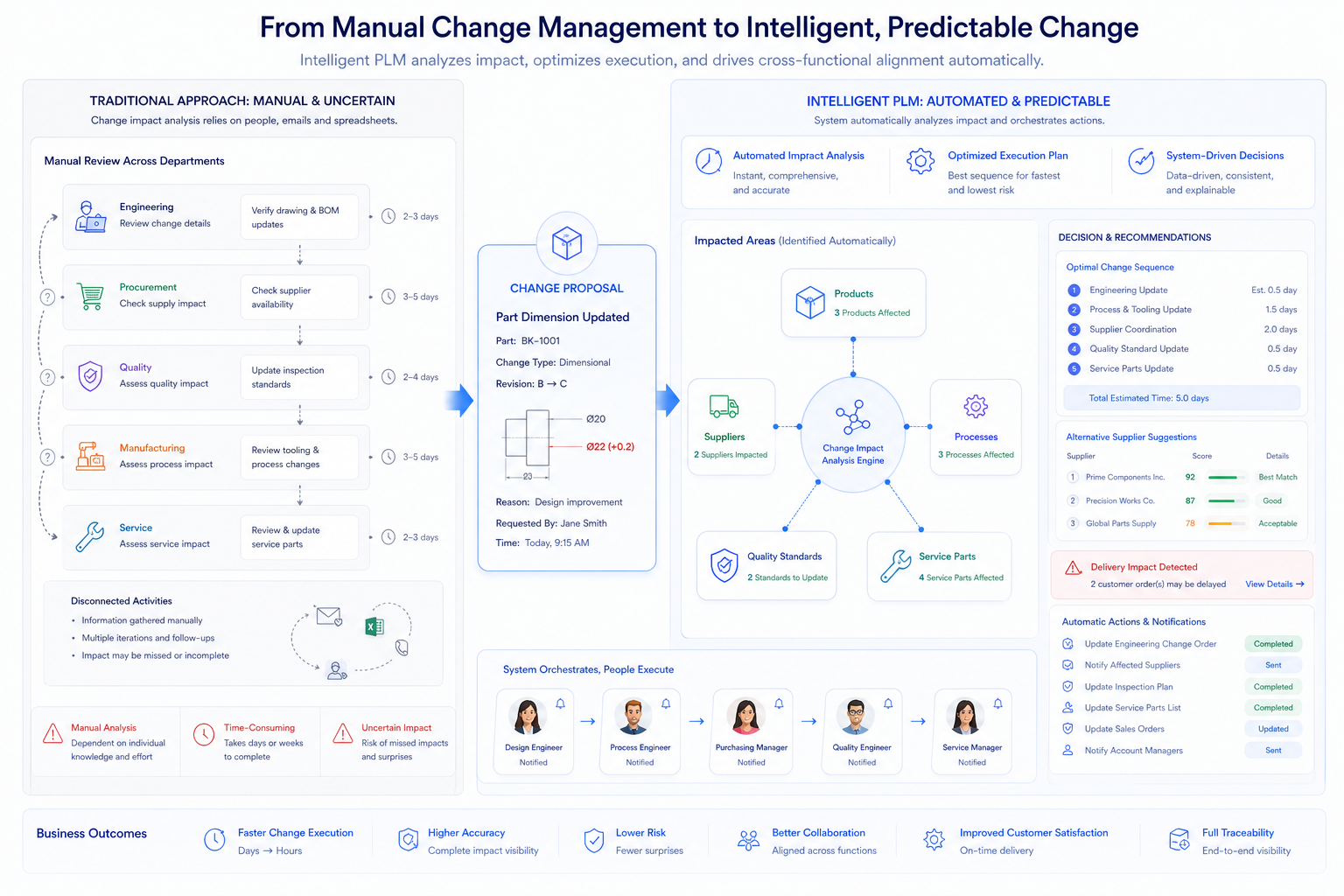
Engineering change is the most complex and error prone aspect of product development. A seemingly simple dimension adjustment can trigger cascading effects including cost increases, delivery delays, and quality risks. In traditional PLM, change impact analysis relies on manual judgment. Experienced engineers can anticipate some impacts but comprehensive coverage is difficult to achieve.
Intelligent PLM transforms change impact analysis from manual judgment to system calculation. When an engineer proposes a change, the system automatically analyzes all related entities affected by the change. Which products use the part, which suppliers provide the material, which tooling requires adjustment, which quality inspection standards need updating, which service parts must be replaced.
The system also provides change implementation optimization suggestions. When multiple changes occur simultaneously, the system analyzes their interactions and recommends the optimal execution sequence. When a change risks supply chain disruption, the system automatically identifies alternative suppliers or alternative materials. When a change affects customer delivery commitments, the system automatically updates sales orders and notifies account managers. Change is no longer an isolated event but a predictable, manageable engineering activity.
Compliance and Standardization
Product development must comply with various industry standards, safety regulations, and environmental requirements. In traditional PLM, compliance checking relies on manual review, time consuming and prone to omissions. When products are sold to different markets, compliance requirements vary by region, making compliance management even more complex.
Intelligent PLM transforms compliance management from manual review to system verification. The system incorporates regulatory knowledge bases, automatically checking compliance during product design. When a design engineer selects a material, the system automatically verifies whether the material meets environmental regulations for target markets. When product structure changes, the system automatically checks whether safety certifications are affected. When regulations update, the system automatically identifies affected products and parts, notifying responsible personnel.
This automated compliance management dramatically reduces compliance risk. Product development is no longer after the fact compliance remediation but before the fact compliance by design. Standardized knowledge is systematically captured, enabling engineers to naturally follow best practices in design rather than relying on individual experience.
Value Anchors
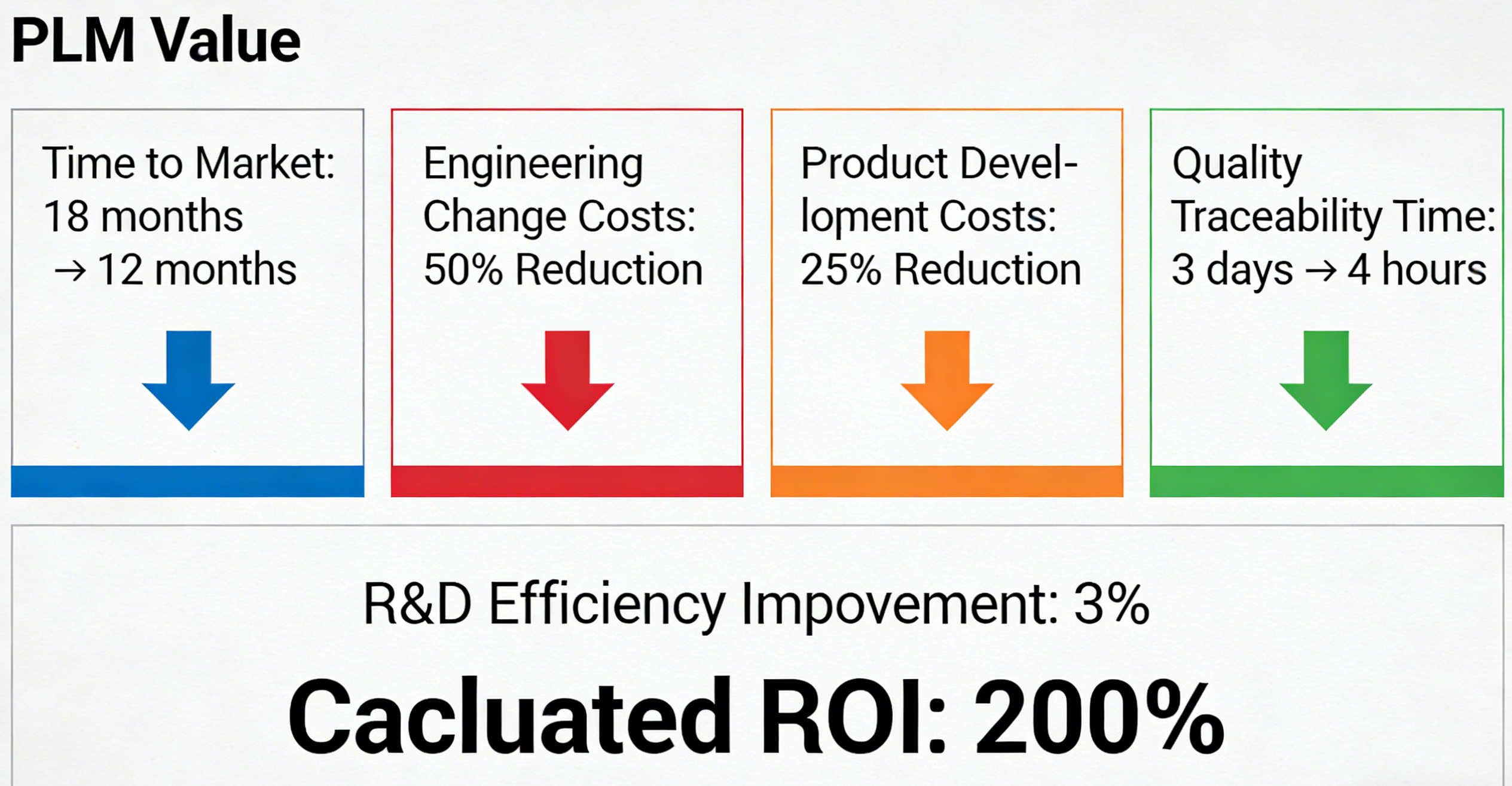
Enterprises that have deployed intelligent PLM report measurable improvements in product development performance.
Time to market decreases by 30% to 50%. Design closed loop reduces late stage modifications, change impact analysis accelerates decision making, and automated compliance verification shortens approval timelines.
Engineering change costs decrease by 40% to 60%. Change impact analysis precisely identifies impact scope, avoiding rework and delays caused by omissions.
Product development costs decrease by 20% to 30%. Design reuse rates increase, standardization improves, and redundant development work is substantially reduced.
Quality issue traceability time decreases by over 80%. The product knowledge graph enables rapid localization of quality issues to specific design features, material batches, and process parameters.
From Documents to Knowledge
The evolution direction of intelligent PLM is not about generating more product data but about making product data more useful. Document storage addresses information accessibility. Knowledge engines address information understandability, analyzability, and optimizability.
When product data is organized as knowledge graphs, when design decisions are supported by data, when change impacts are predictable and manageable, product development transforms from a trial and error process into an engineering activity.
Engineers no longer need to guess whether designs are reasonable; the system provides judgments based on historical data. Teams no longer need to repeatedly coordinate change impacts; the system automatically completes impact analysis. Organizations no longer depend on the experience of a few experts; knowledge is systematically captured and reused.