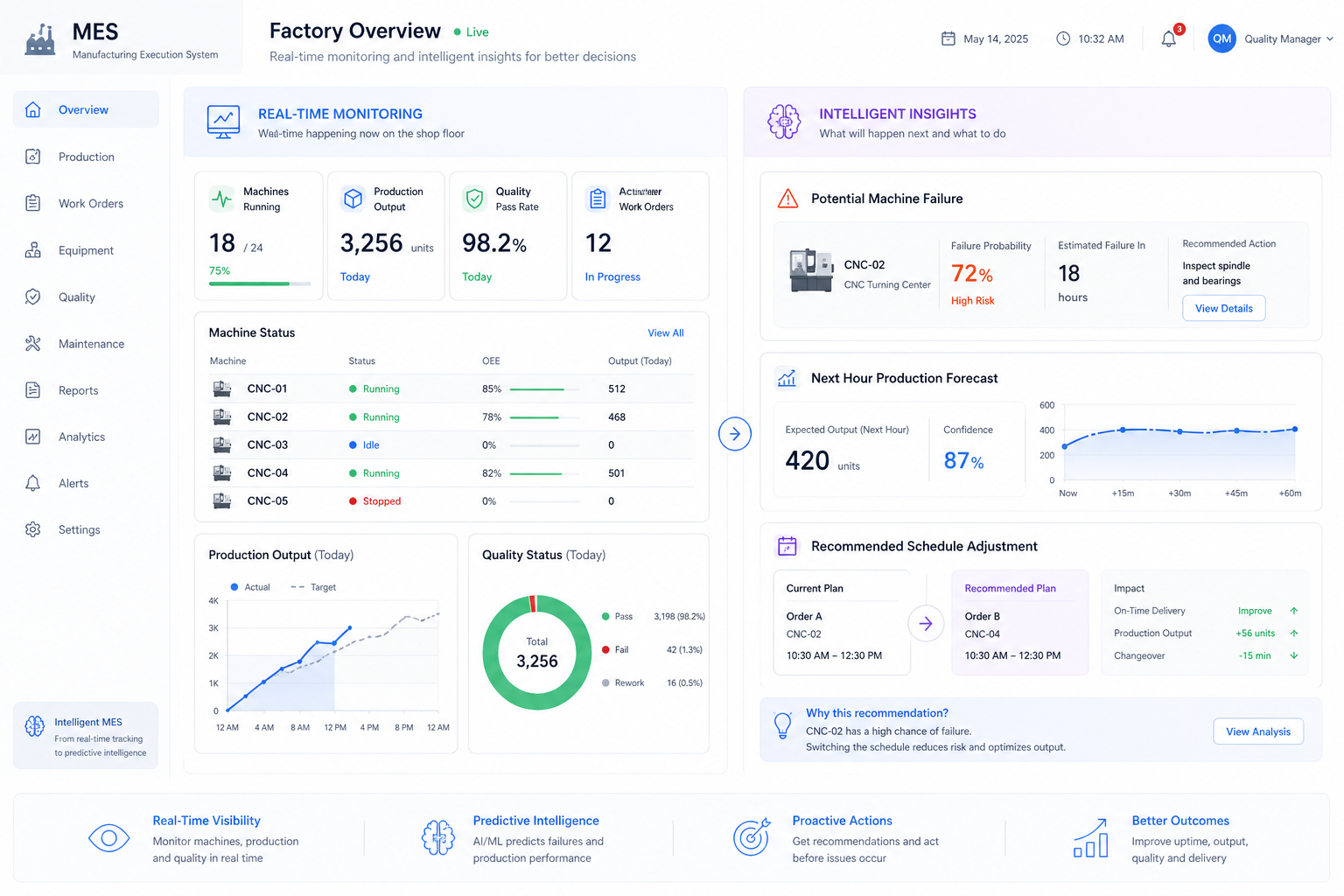
Manufacturing execution systems have long served as the bridge between enterprise planning and shop floor execution. They record production counts, monitor equipment status, and archive quality inspection data. Artificial intelligence is now driving a fundamental transformation of MES from a passive tracking system into an active factory intelligence platform.
Traditional MES answers what is happening on the shop floor at this moment. Intelligent MES answers what will happen in the next hour, which machine is about to fail, and how production should be rescheduled to minimize delivery impact. By deeply integrating real time machine data with predictive analytics, modern MES transforms the factory floor from an information black box into a transparent, self optimizing production environment.
The central proposition of MES intelligence is not to replace operators but to equip them with predictive judgment, enabling intervention before issues escalate into production disruptions.
The Invisible Efficiency Drain
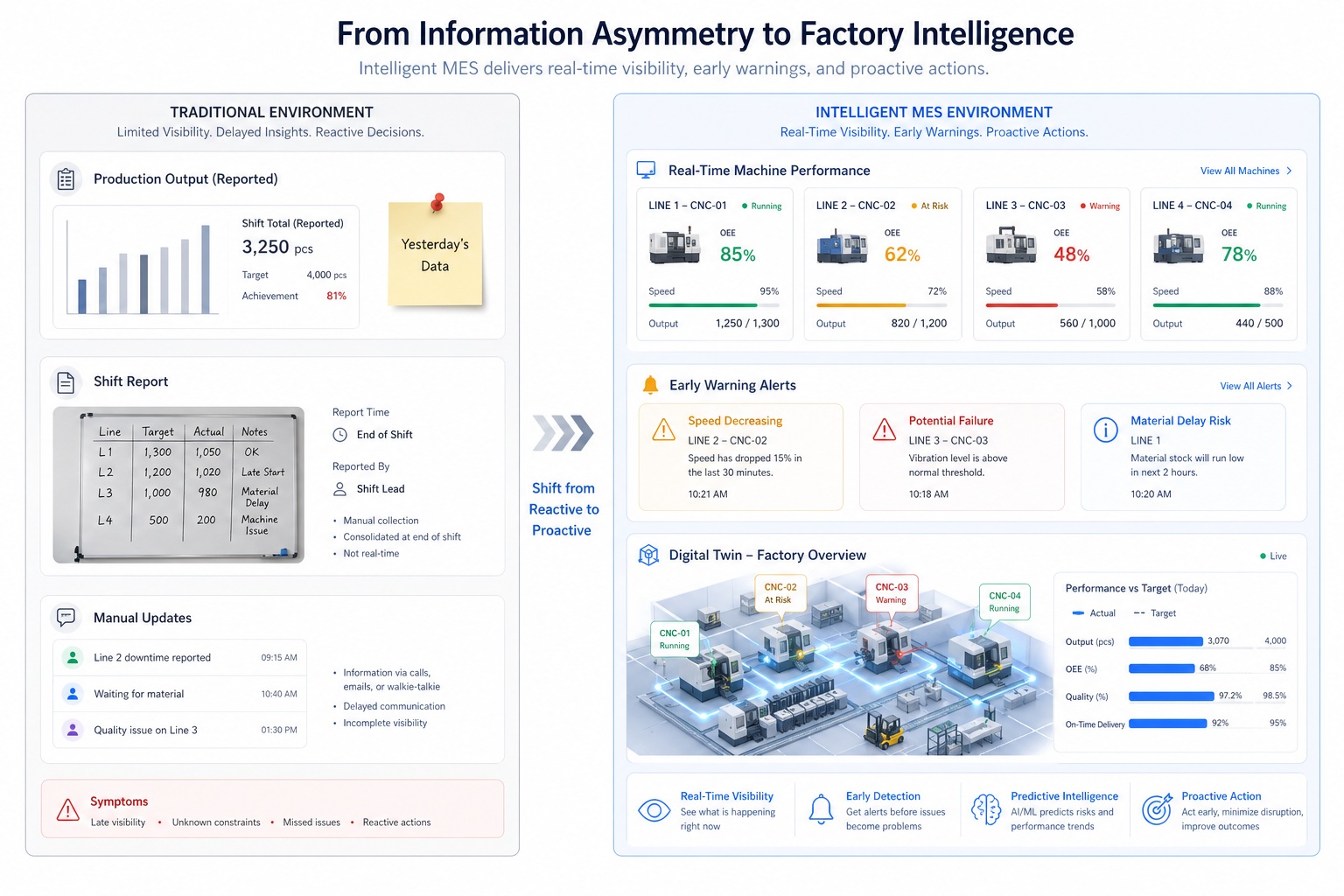
The factory floor has long suffered from information asymmetry. Production status is communicated through manual shift reports or static whiteboards. Managers learn about output after the fact, yet they lack visibility into real time constraints, emerging bottlenecks, or impending quality deviations.
Consider equipment performance degradation. When a critical machine begins operating at reduced speed due to mechanical issues, this information goes undetected in traditional environments. The performance decline remains unnoticed until output falls below shift targets or the machine fails completely. The resulting unplanned downtime triggers expediting costs, delivery delays, and cascading disruptions across downstream operations.
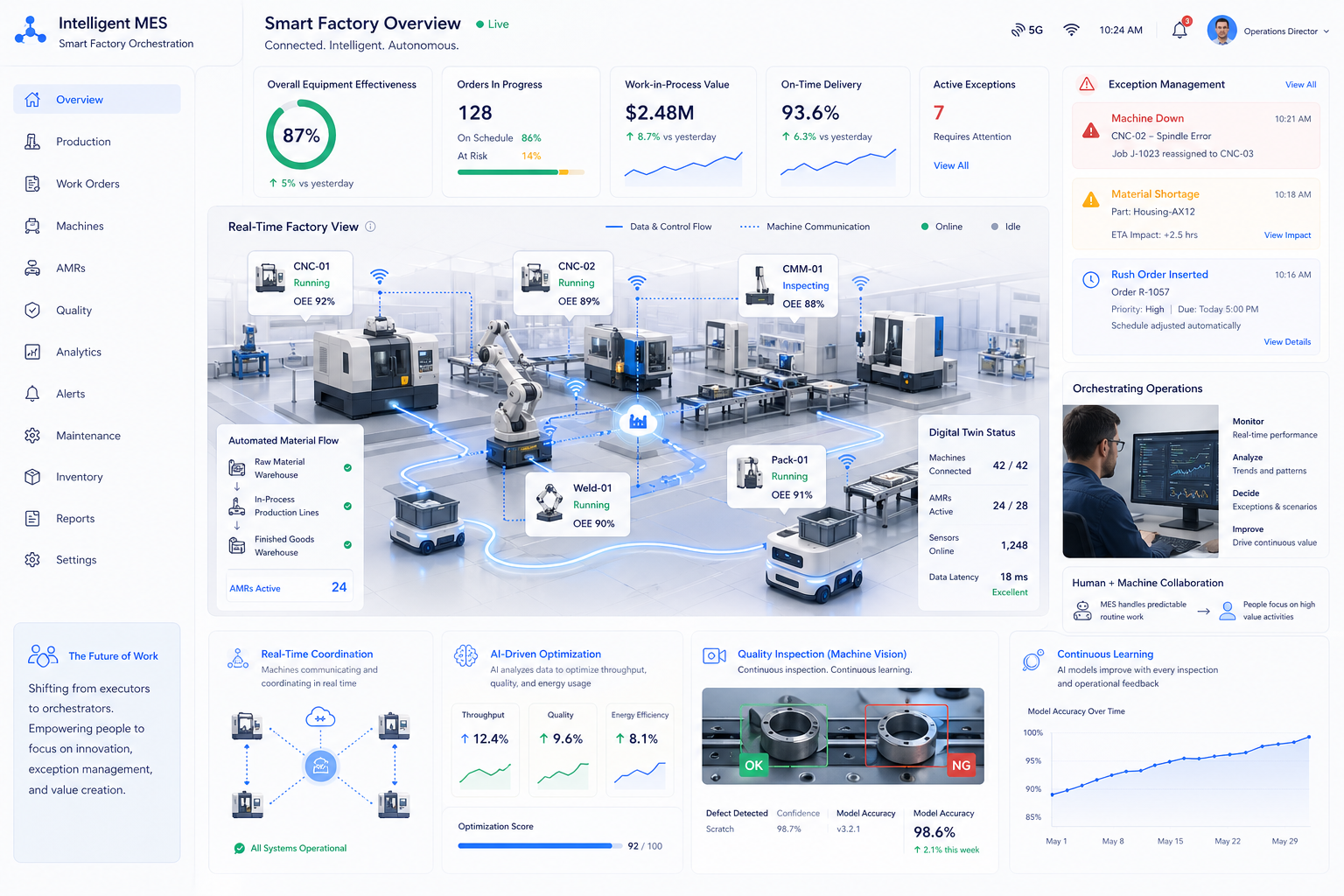
Intelligent MES addresses this information gap by constructing a digital twin of the physical factory. Every asset, every operator, and every material movement is tracked with millisecond precision. The system does not merely record events that have occurred but continuously compares actual performance against expected benchmarks, pushing alerts to relevant personnel before deviations evolve into production disruptions.
Data as Productivity
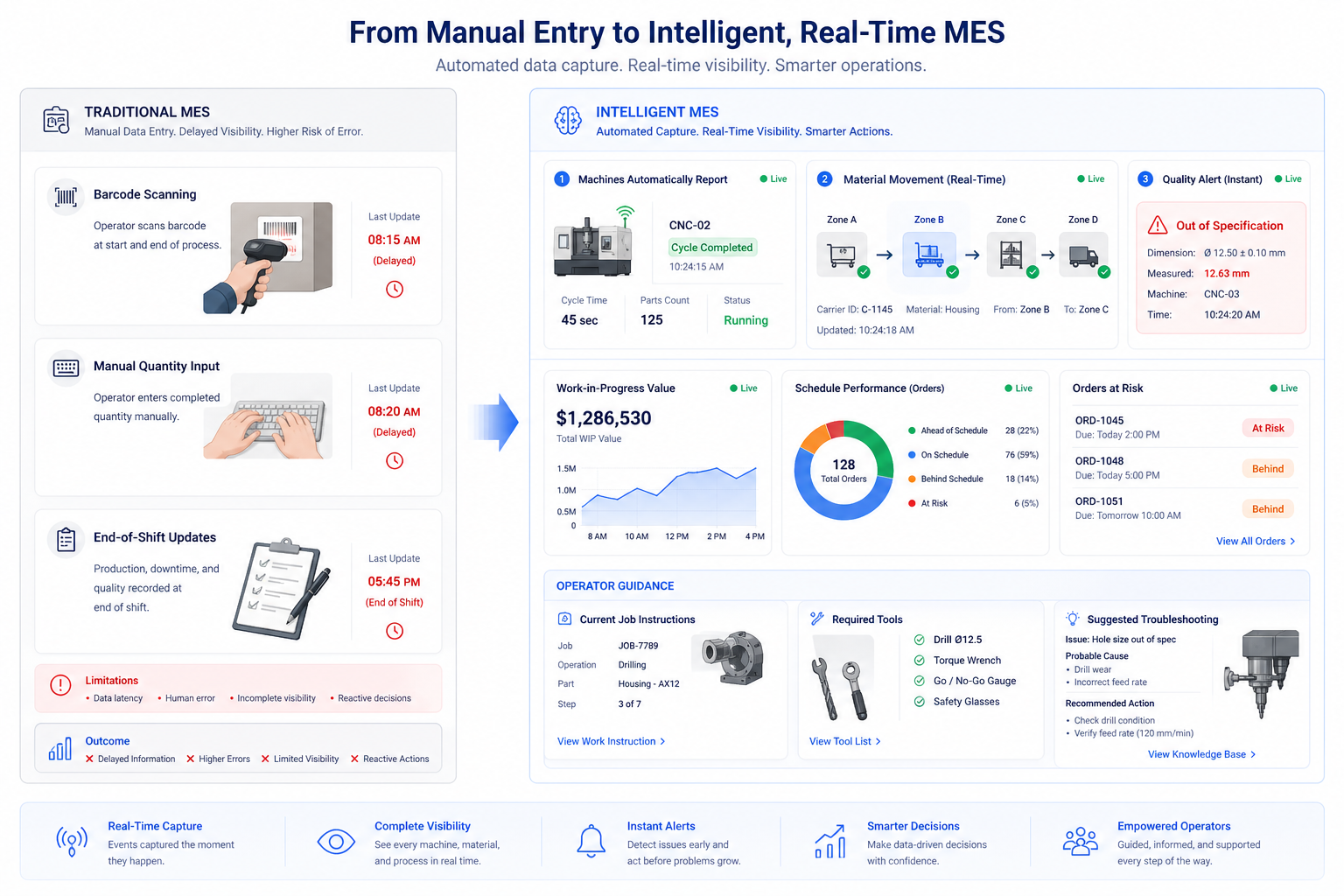
Traditional MES relies on manual data entry at workstations, with operators scanning barcodes or entering quantities at shift start and end. This approach introduces significant data latency and opportunities for human error.
Intelligent MES employs industrial internet of things sensors and automatic identification technologies to capture production events at the moment they occur. When a machine completes a processing cycle, the system records it instantly. When a material carrier moves across zones, its location updates automatically. When a quality measurement falls outside specification, the system flags it immediately.
Real time visibility fundamentally reshapes the dimensions of operational control. Production managers can view work in process value aggregated by work center, material cost, and labor cost at any moment, precisely identifying orders that are ahead of schedule, behind schedule, or at risk of missing delivery commitments.
The deeper transformation lies in the reshaping of the operator role. When operators approach a workstation, the system presents current job instructions, required tooling, and any special quality requirements. When facing anomalies, the system provides guided troubleshooting based on historical resolution patterns. Knowledge assets that previously resided only with experienced workers are systematically captured and shared across the organization.
Quality Shifted Left
Traditional quality control carries an inherent lag. Parts are inspected after production completion, and nonconforming materials are identified after value has already been added. Rework and scrap represent direct cost losses that could have been avoided.
Intelligent MES shifts quality management from after the fact detection to before the fact prediction. Machine learning models analyze historical quality data, integrating equipment parameters, material batch information, and process environment conditions to identify precursor patterns that precede defects. When equipment parameters begin drifting toward out of specification ranges, the system alerts operators before nonconforming parts are produced.
Process quality checks are embedded directly into production workflows. Rather than waiting for batch completion, quality inspections occur at each critical operation. When a key dimension falls outside tolerance, the system automatically isolates that job, preventing downstream operations from consuming resources on defective parts.
The direct effect of this transformation is evident in quality metrics. Scrap and rework are reduced by 25% to 35%. Quality costs decline significantly, and customer complaint rates decrease correspondingly.
Dynamic Dispatching
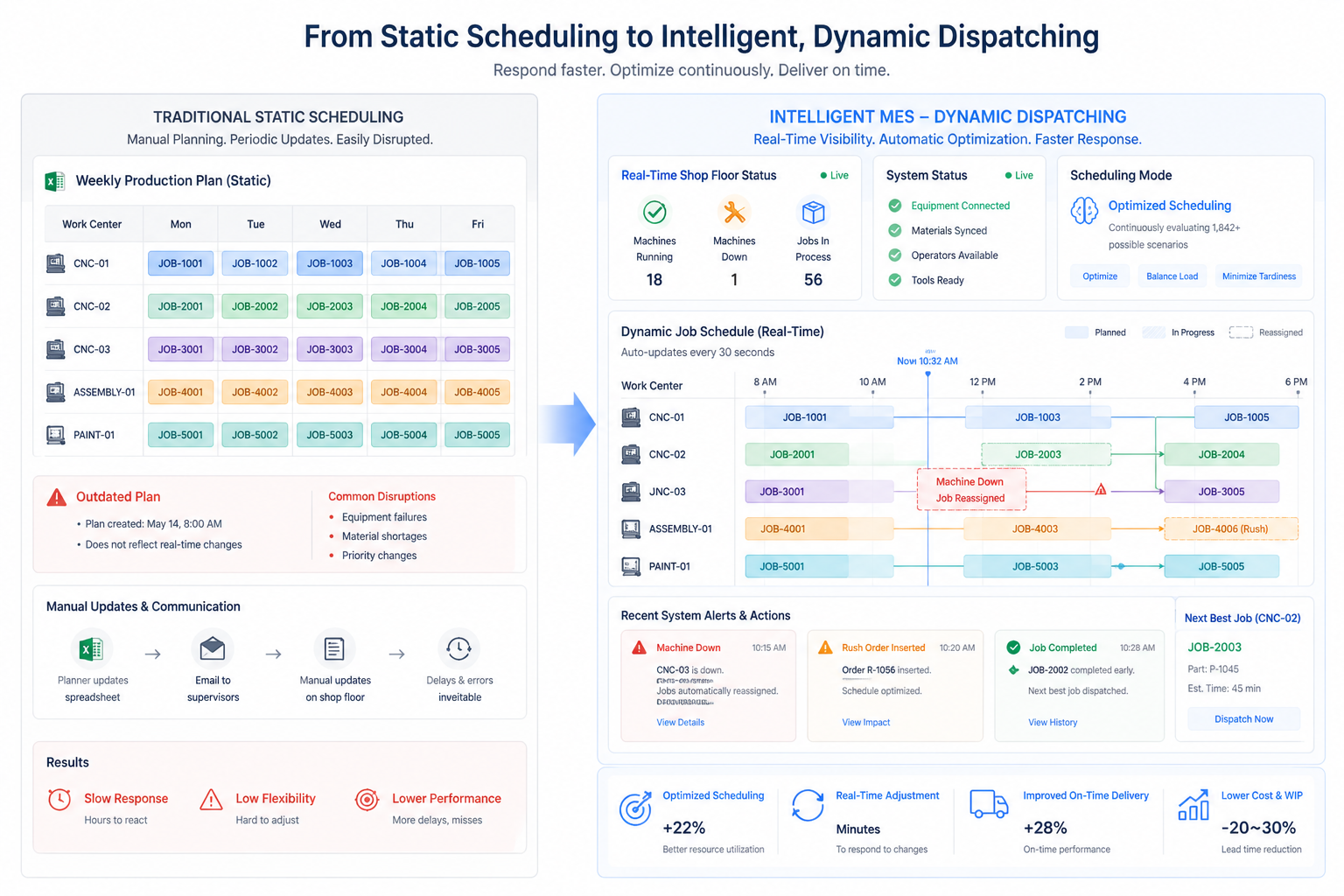
Traditional production scheduling is often performed using static spreadsheets on a weekly or daily cycle. Such plans quickly become obsolete under real world disruptions such as equipment failures, material shortages, and priority changes. Scheduling becomes a periodic gamble.
Intelligent MES replaces static scheduling with dynamic dispatching. The system continuously evaluates real time shop floor conditions, including equipment availability, operator skill matching, tooling status, and material locations. When an operation is completed, the system automatically determines the next optimal job for that work center based on current priorities, due dates, and equipment capabilities.
Dynamic dispatching enables manufacturers to respond to production disruptions in minutes rather than hours. When equipment goes down, the system automatically reassigns its jobs to alternative equipment. When an urgent order requires insertion, the system recalculates the impact on existing commitments and presents planners with options and their delivery consequences.
Manufacturing lead times are reduced by 20% to 30%, and on time delivery performance improves significantly.
Quantifiable Value
Manufacturers that have deployed intelligent MES report systematic improvements across key operational metrics.
Overall equipment effectiveness increases by 15% to 20%. Real time visibility into micro stoppages and performance degradation enables targeted improvement initiatives, eliminating the blindness previously caused by data scarcity.
Energy efficiency improves by 10% to 15%. Through AI driven load balancing, the system schedules energy intensive operations during off peak rate periods and prioritizes equipment with optimal energy efficiency profiles.
Behind these metric improvements lies a fundamental shift. The factory transforms from a cost center into a source of competitive advantage. Manufacturers that can respond more quickly to customer demand, deliver more reliably, and handle changes with greater flexibility are capturing clear market premiums.
Toward Autonomous Manufacturing
The convergence of 5G connectivity, artificial intelligence, and advanced robotics is reshaping the manufacturing landscape.
Manufacturing is evolving from linear processes into dynamic service networks, with intelligent MES serving as the orchestration layer for this transformation.
The industry is moving toward lights out manufacturing, where routine operations are handled by autonomous mobile robots coordinated by the MES. Machines communicate with each other to optimize material flow. Quality inspections are performed by machine vision systems that continuously learn and improve.
In this evolution, the role of human workers shifts from executors to orchestrators. Their time is directed toward high value activities such as process innovation, custom engineering, and exception management. The MES manages predictable routine work, enabling people to focus on exceptions that require judgment and creativity.
This is not a story of replacement. It is a story of value redefinition.
The Starting Point
For manufacturing enterprises evaluating this transformation, the starting point is often not technology selection but precise identification of core pain points.
Changeover times are excessive and unpredictable. A particular machine experiences recurring unplanned downtime with no clear root cause. Quality issue traceability takes days. The entire planning system collapses when an urgent order is inserted.
The pragmatic path begins with the most urgent pain point, applies intelligent MES capabilities to resolve it, and expands gradually after results are demonstrated. This approach is more effective than pursuing a large scale comprehensive implementation and is more likely to secure organizational consensus from management to the shop floor.
The value of intelligent MES lies not in the technology itself but in its capacity to help manufacturing enterprises answer a fundamental question. How can we deliver high quality products with greater reliability in an environment of increasing uncertainty.