Inventory management has long been considered the most fundamental and least glamorous function in enterprise operations. Warehouse staff record receipts and issues, conduct cycle counts, and reconcile ledgers. Finance departments focus on turnover rates and capital tie-up. Procurement teams issue replenishment orders based on inventory levels. Each function performs its role in a predictable routine.
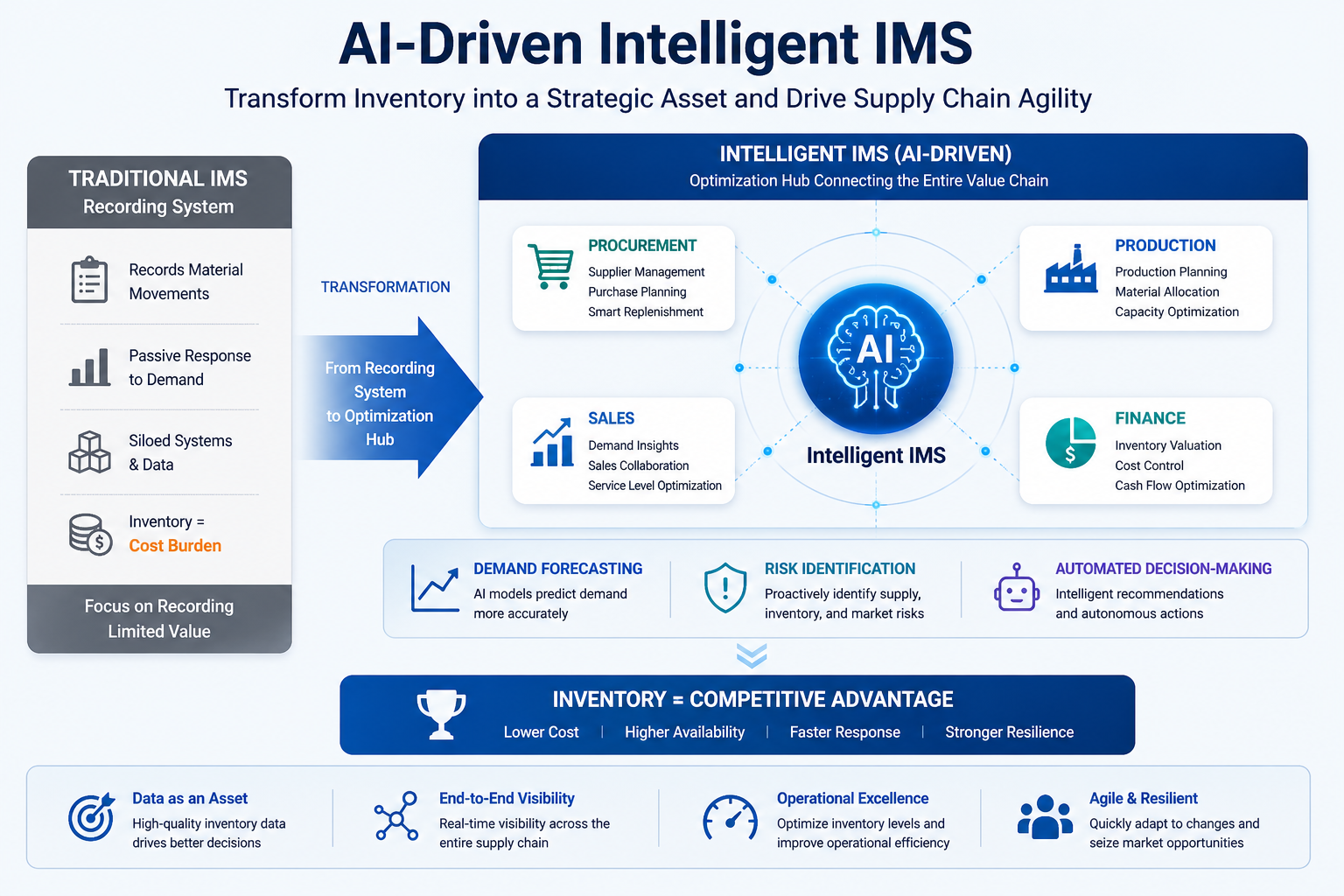
Artificial intelligence is now driving a fundamental transformation in inventory management. It is no longer merely a system for recording material movements but is evolving into a dynamic optimization hub that connects procurement, production, sales, and finance. An intelligent IMS can forecast demand, identify risks, and make autonomous decisions, converting inventory from a cost burden into a competitive advantage.
The core proposition of IMS intelligence is not to replace warehouse personnel but to transform inventory data into a critical asset that drives supply chain agility.
The Inventory Paradox
Inventory represents an enduring paradox in enterprise operations. Too little inventory creates stockout risk, potentially leading to production line stoppages, lost sales, and customer attrition. Too much inventory ties up substantial capital, increases storage costs, and may result in obsolescence losses as products are updated or expire.
Traditional inventory management attempts to navigate between stockout and overstock. Safety stock, reorder point, and economic order quantity models have been widely applied over the past decades. However, the common limitation of these models is their reliance on static calculations based on historical data, rendering them incapable of responding to real-world complexities such as demand fluctuations, supply disruptions, and market changes.
This paradox is amplified within traditional ERP systems. The inventory module experiences data latency with procurement, sales, and production modules. Inventory decisions are often based on demand forecasts from a week or even a month earlier. By the time market conditions change, the speed of inventory strategy adjustment lags far behind the changes themselves.
Smart Replenishment: From Rule-Driven to Forecast-Driven
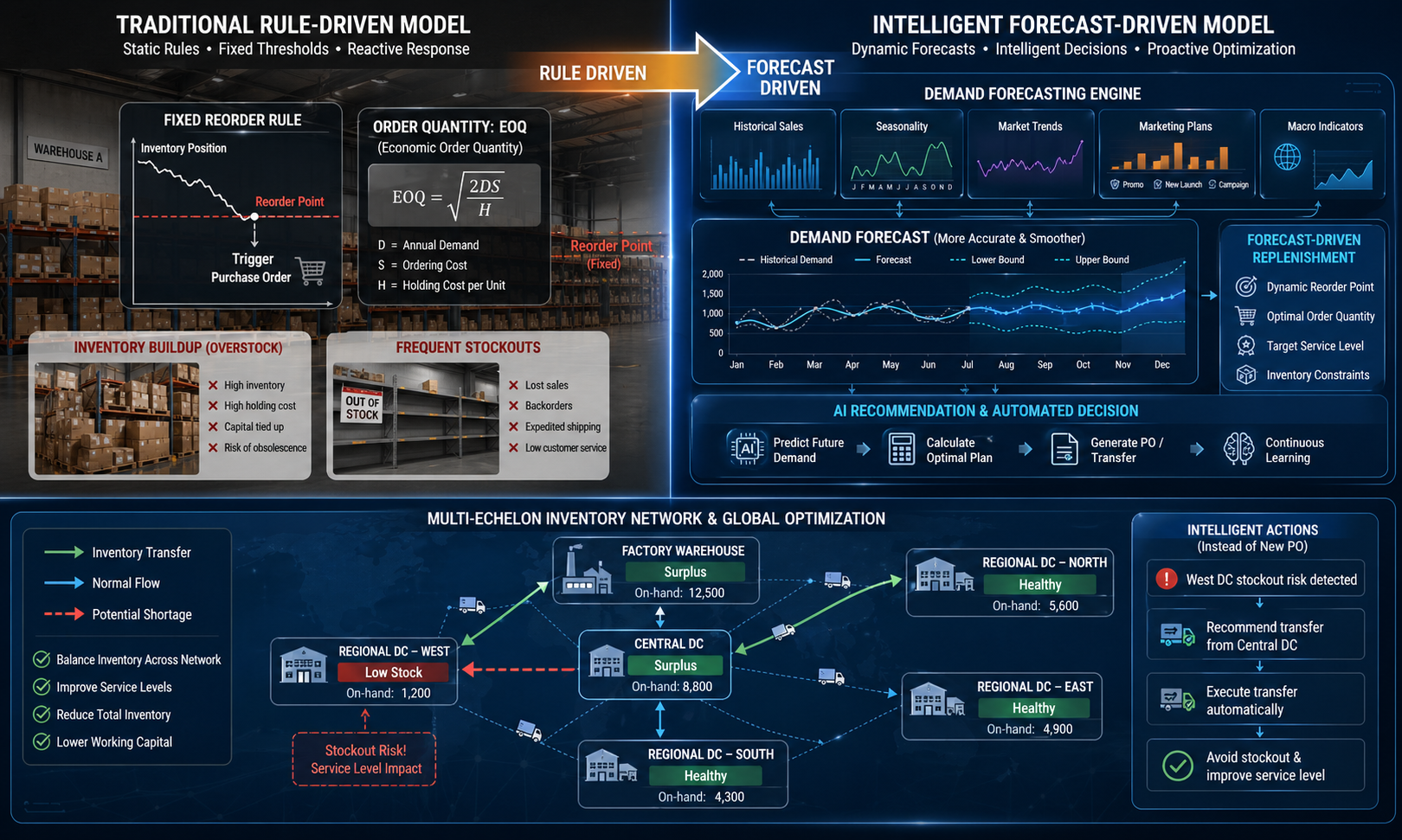
Traditional replenishment logic is based on fixed rules. When inventory drops to the reorder point, a purchase order is triggered. The order quantity is calculated based on economic order quantity. This approach functions adequately under stable demand, but once demand fluctuates, the result is either inventory buildup or frequent stockouts.
Intelligent IMS shifts replenishment logic from rule-driven to forecast-driven. The system integrates historical sales data, seasonal factors, market trends, marketing campaign plans, and even macroeconomic indicators to generate high-accuracy demand forecasts. Replenishment decisions are no longer triggered by simple threshold mechanisms but are based on dynamic predictions of future demand.
For multi-tier inventory networks, intelligent IMS enables global optimization. The system does not consider inventory levels at a single warehouse in isolation but coordinates inventory distribution across regional distribution centers, central warehouses, and plant warehouses. When a regional warehouse faces stockout risk while the central warehouse has surplus inventory, the system automatically generates transfer recommendations rather than triggering purchase orders. This global perspective improves service levels without increasing total inventory.
Obsolescence Early Warning: From After-the-Fact Disposal to Before-the-Fact Prevention
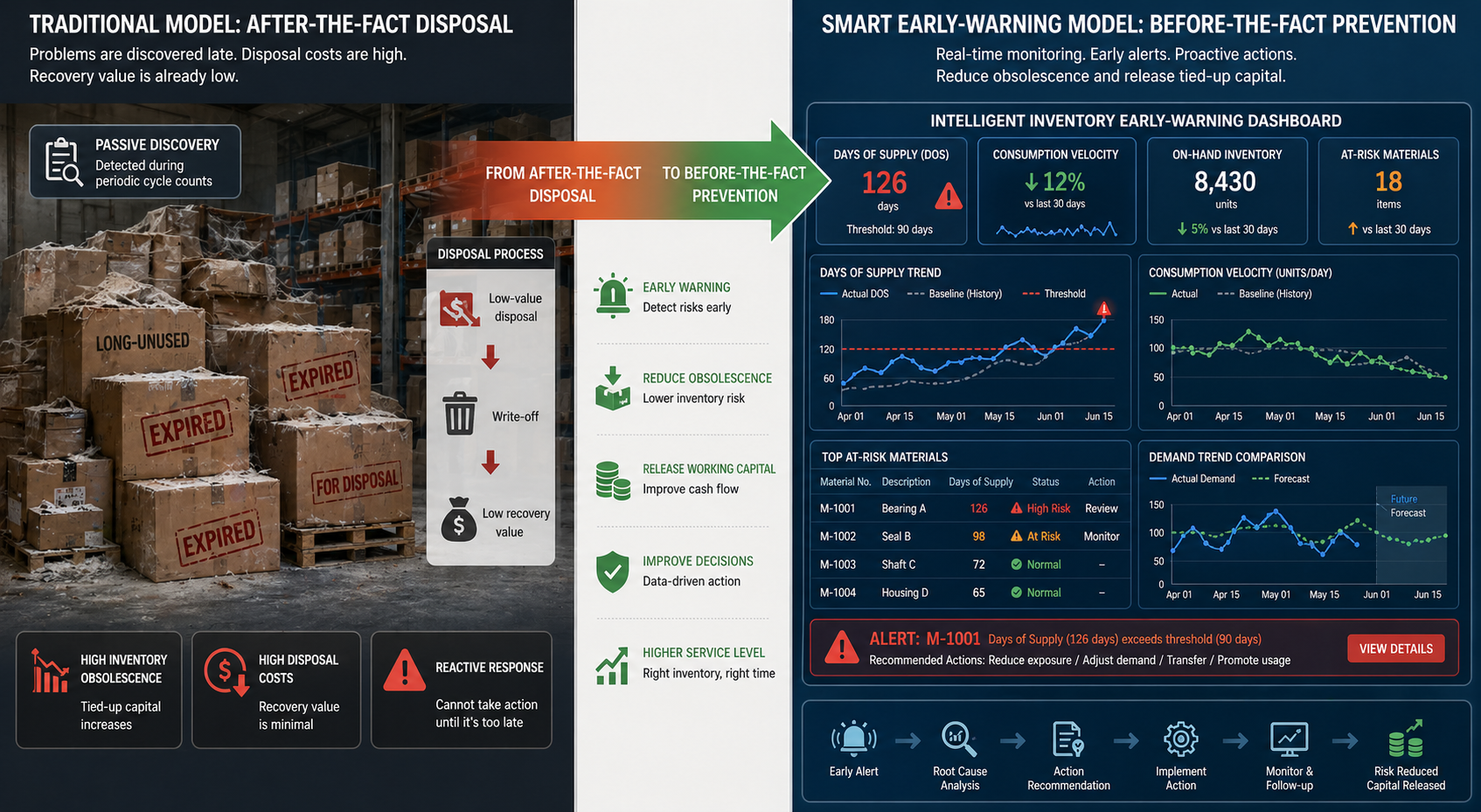
Obsolete inventory is a hidden killer in inventory management. Materials that remain unused for extended periods occupy warehouse space, tie up working capital, and may ultimately be disposed of at extremely low prices or written off entirely. Under traditional management, obsolete inventory is typically discovered during cycle counts, at which point disposal costs are already high and recovery value is already low.
Intelligent IMS shifts obsolescence management from after-the-fact disposal to before-the-fact prevention. The system continuously monitors material consumption velocity, comparing current consumption patterns against historical baselines. When the days of supply for a particular material exceeds a preset threshold, the system automatically issues an obsolescence alert rather than waiting for financial cycle counts to reveal the issue.
More importantly, intelligent IMS can trace the root causes of obsolescence. Was the purchase order quantity excessive, was the sales forecast inaccurate, or were the materials rendered unusable due to quality issues. The system attributes obsolescence to specific process steps, providing data-driven support for process improvement. When materials are deemed obsolete due to quality issues, the system automatically links to supplier records and quality inspection reports, providing evidence for supplier management.
Inventory Visibility: From System Record Discrepancy to Real-Time Consistency
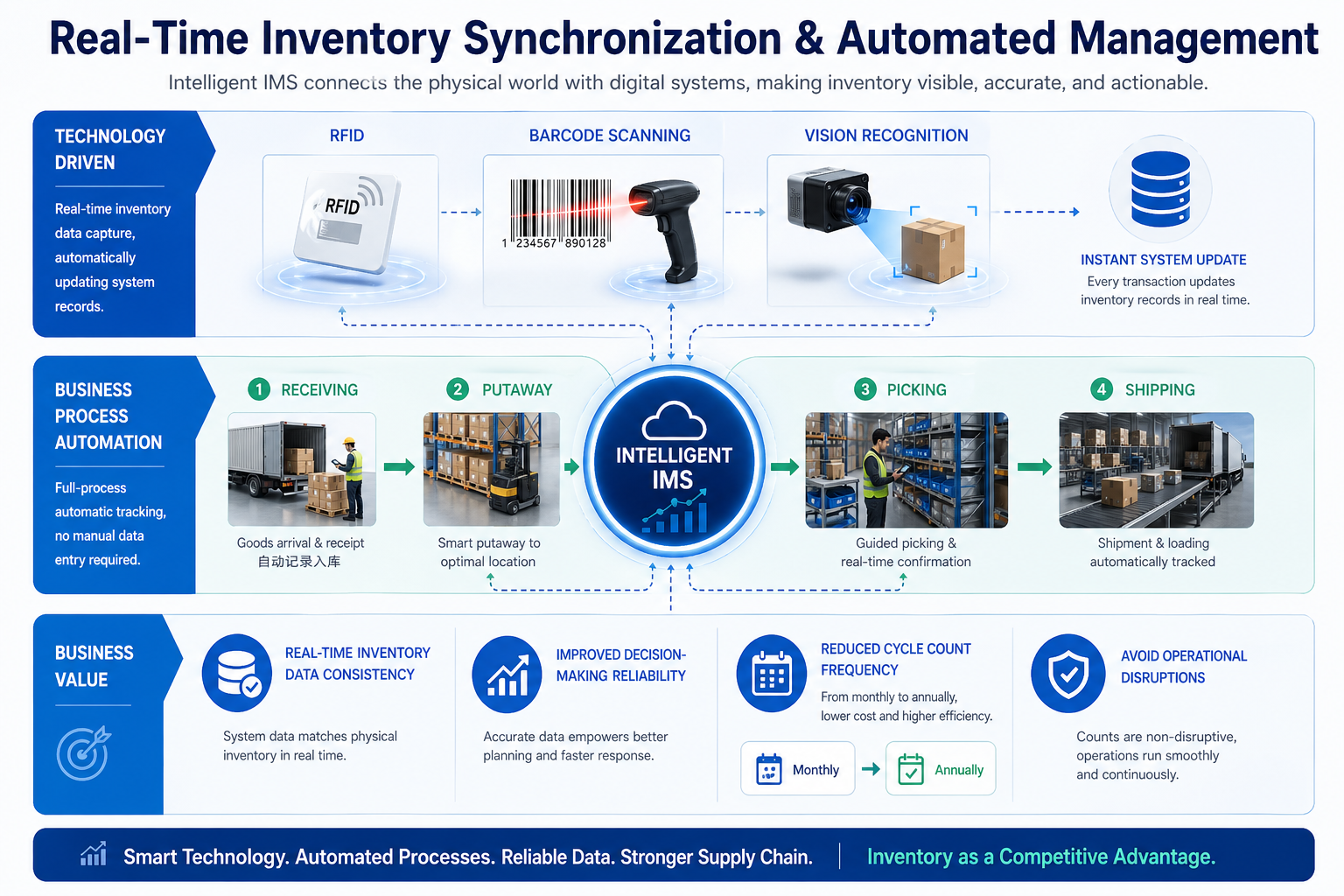
System record discrepancy is one of the most vexing challenges in inventory management. The quantity recorded in the system differs from the actual quantity in the warehouse, leading procurement, production, and sales decisions to be based on incorrect information. Traditional solutions rely on periodic physical counts, but operations must be paused during counts, and results are only reflected in the system after the count is completed.
Intelligent IMS achieves real-time synchronization of inventory status through industrial internet of things technologies. RFID tags, barcode scanning, and vision recognition technologies enable every receipt and issue transaction to update system records instantly. The entire process from material receipt and putaway to picking and shipment is automatically tracked, eliminating the need for manual data entry or scanning confirmation.
This capability delivers not only efficiency improvements but also reliability in decision-making foundations. When inventory data is consistent with physical inventory in real time, sales teams can accurately commit to delivery dates, procurement teams can place orders based on actual demand, and finance teams can accurately assess capital tie-up. Physical count frequency can be reduced from monthly to annually, and counts no longer require operational interruptions.
Inventory Cost Optimization
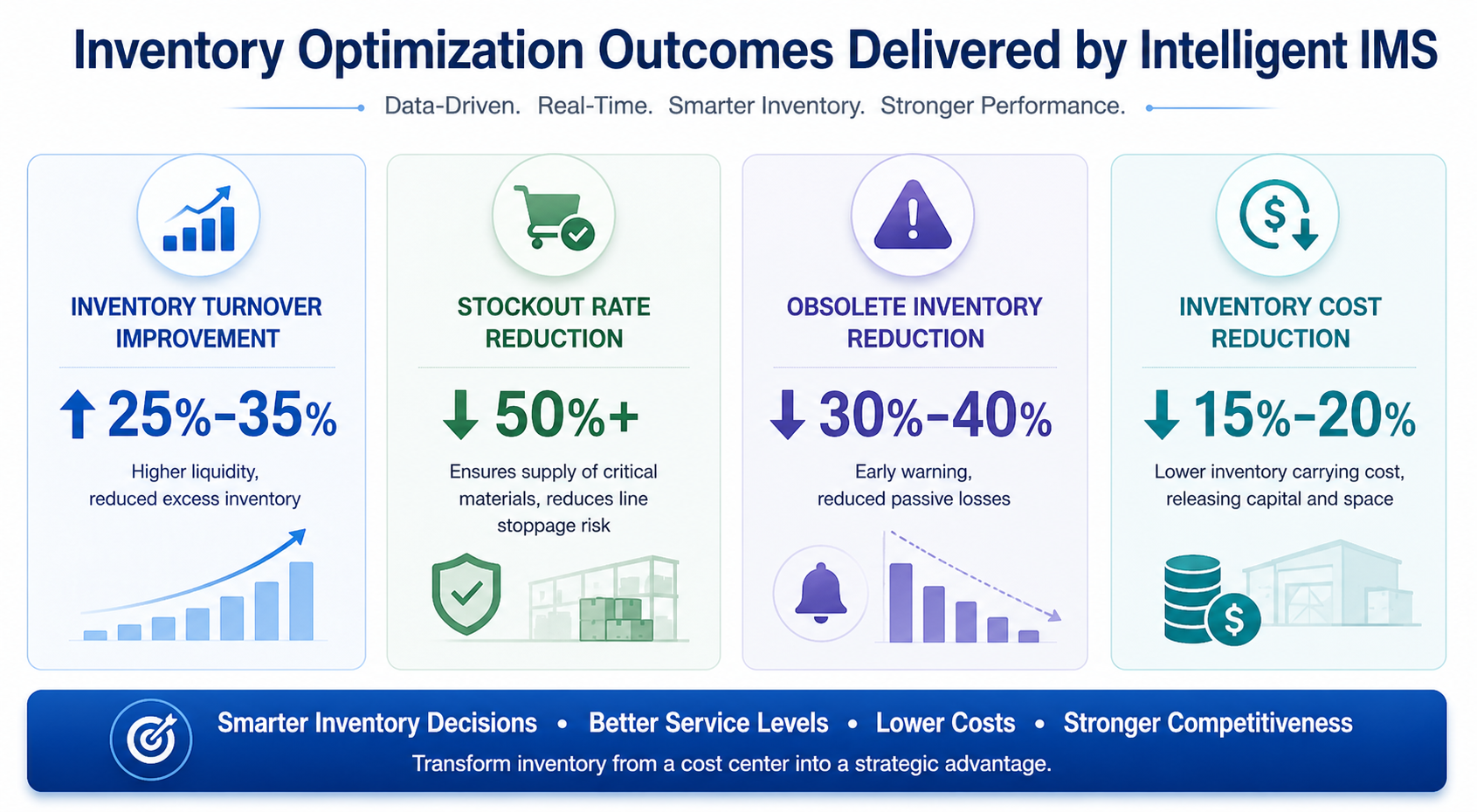
Enterprises that have deployed intelligent IMS report systematic improvements in inventory-related metrics.
Inventory turnover increases by 25% to 35%. Forecast-driven replenishment strategies reduce safety stock redundancy, while real-time visibility eliminates excess inventory caused by information asymmetry.
Stockout rates decrease by more than 50%. Dynamic inventory optimization models ensure critical materials remain available, significantly reducing production line stoppage risks and lost sales.
Obsolete inventory value declines by 30% to 40%. Obsolescence early-warning mechanisms enable enterprises to take action before materials lose value, rather than accepting losses passively.
Inventory carrying costs decrease by 15% to 20%. Overall inventory levels decline, warehouse space requirements diminish, and capital tie-up is substantially reduced.
The Path Forward
The convergence of 5G connectivity, artificial intelligence, and autonomous robotics is reshaping inventory management. Intelligent IMS serves as the orchestration layer for this transformation, evolving warehouses from storage facilities into dynamic distribution hubs.
Autonomous mobile robots perform receiving, putaway, picking, and shipping operations under the coordination of intelligent IMS. The system plans optimal routes in real time based on order priorities, inventory locations, and equipment status, enabling multiple robots to operate collaboratively without interference. Warehouses are no longer static storage spaces but dynamic networks of material flow.
In this evolution, the role of warehouse personnel shifts from material handlers to supervisors. Their time is directed toward high-value activities such as exception handling, process optimization, and data analysis. IMS manages predictable routine operations, enabling people to focus on exceptions that require judgment and experience.