Enterprise resource planning systems have long served as the recording system for organizations. They capture transactions, track inventory, and manage financial records. Artificial intelligence is now driving a fundamental transformation. ERP is evolving from a passive data repository into an active intelligent decision hub.
Traditional ERP answers the question of what happened. Intelligent ERP answers what is about to happen and how the organization should respond. By integrating predictive analytics with automated workflows, modern ERP converts transactional data into real-time business insights. This shift moves management from after-the-fact review to proactive foresight.
The goal of ERP intelligence is not to replace professional judgment. It is to transform vast amounts of data into actionable business insights.
The Core Challenge: Breaking Down Functional Silos
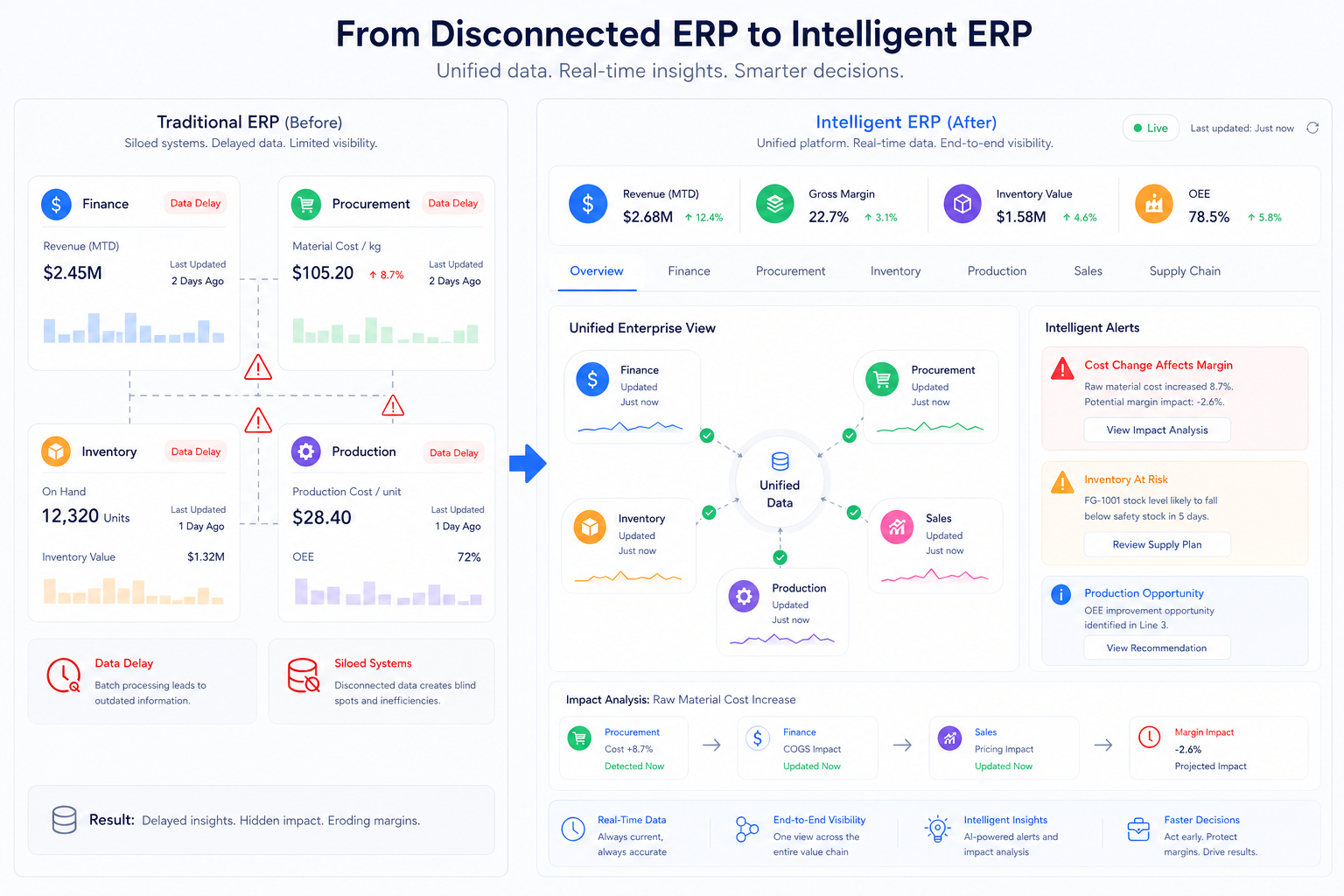
The greatest limitation of traditional ERP lies in module fragmentation. Finance, procurement, inventory, and production operate in isolation. Data synchronization relies on batch processing. Decision makers always see yesterday’s picture.
Consider an increase in raw material prices. The procurement module records the change, but cost accounting may take days to complete the revaluation. Sales quotations continue to run on outdated costs, and profit margins erode unnoticed. This information delay represents one of the most subtle yet damaging inefficiencies in enterprise management.
Intelligent ERP addresses this challenge by establishing a unified data foundation. Finance, supply chain, sales, and operations are placed within a single dynamic view. When an anomaly occurs in one area, the system automatically evaluates its impact across the entire value chain and recommends the optimal response.
1. Real-Time Data Pipeline
Traditional ERP depends on overnight batch processing. Intelligent ERP adopts an event-driven architecture. When a transaction occurs, all modules synchronize immediately.
When a sales order is entered, the system checks global inventory in real time. If inventory is insufficient, it automatically alerts the procurement module. When a supplier confirms a shipment delay, the system instantly evaluates the affected production orders and sales commitments, pushing risk notifications to account managers.
2. Financial and Operational Alignment
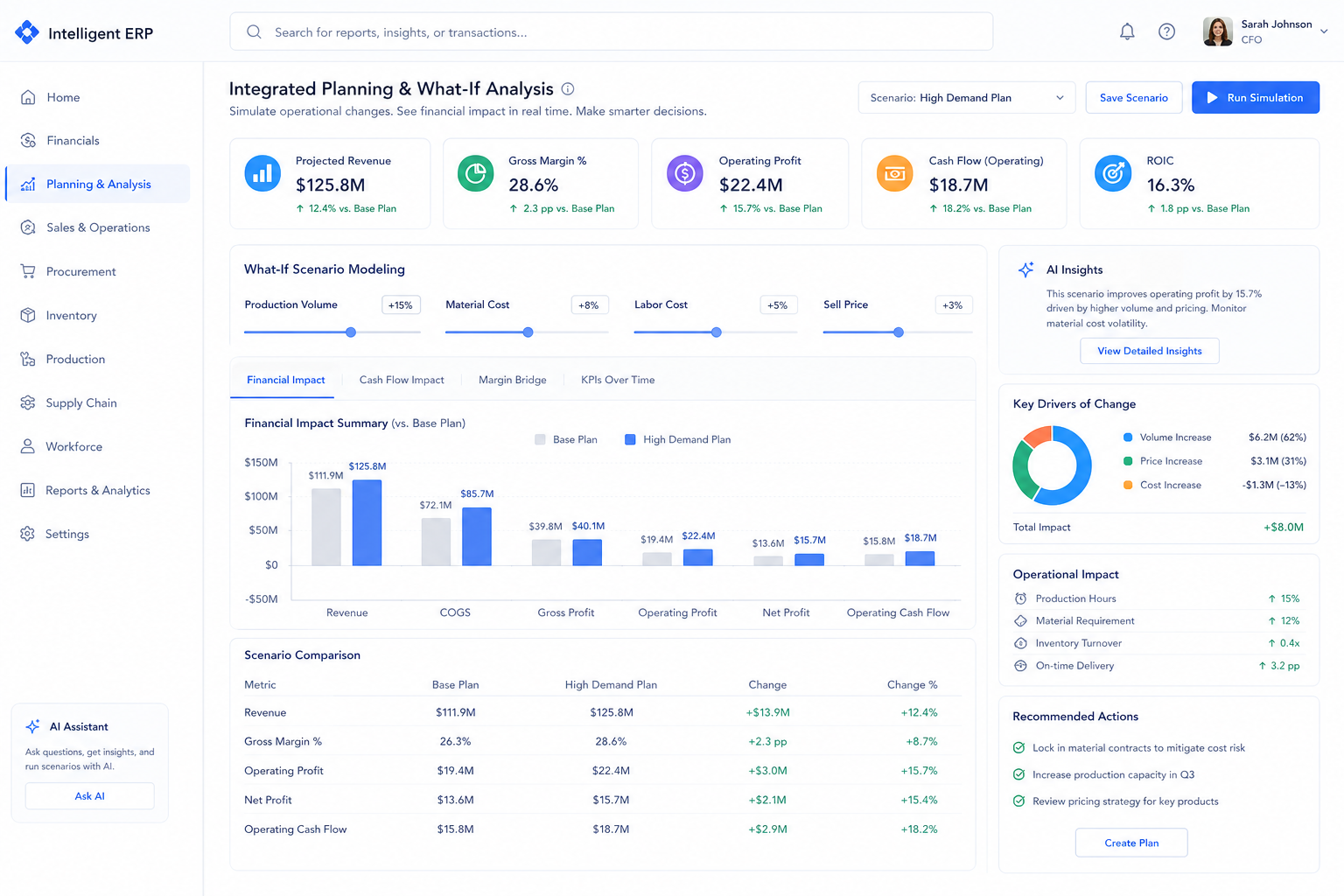
Intelligent ERP deeply integrates financial objectives with operational execution. AI models continuously simulate how different production plans affect financial outcomes. Planners can make trade-offs using what-if analysis rather than passively accepting results after the fact.
When production plans are adjusted, the system updates projected gross margin and cash flow impacts in real time. Decision makers can clearly see the financial implications behind every operational choice. Finance professionals transition from record keepers to embedded partners within business processes.
3. Intelligent Procurement and Risk Management
Supply chain disruption has become one of the greatest uncertainties facing enterprises. Intelligent ERP elevates procurement from order execution to proactive risk management.
Supplier risk profiles integrate external data with internal delivery records to generate comprehensive risk scores. Smart replenishment uses historical consumption patterns and in-transit inventory to automatically generate purchase suggestions, with buyers reviewing and confirming rather than calculating manually. Alternative material recommendations automatically retrieve approved substitute lists with cost differences when critical materials become scarce.
Measurable Impact
Organizations that have deployed intelligent ERP frameworks report significant improvements across key business metrics.
Inventory turnover increases by 15% to 25%. This is primarily driven by AI-optimized safety stock levels, which effectively reduce obsolete inventory.
The financial closing cycle shortens by 40% to 60%. Real-time data synchronization eliminates month end batch processing waits. Finance teams can dedicate their time to analysis rather than data reconciliation.
Procurement costs decrease by 8% to 12%. Intelligent price comparison and automated compliance procurement substantially reduce efficiency losses and compliance risks in the purchasing process.
Cash flow forecast accuracy exceeds 95%. Machine learning models integrate sales pipelines with accounts payable, providing reliable decision support for treasury management.

Advanced Analytics: From Predictive to Prescriptive
Intelligent ERP builds two advanced capabilities on top of traditional descriptive analytics.
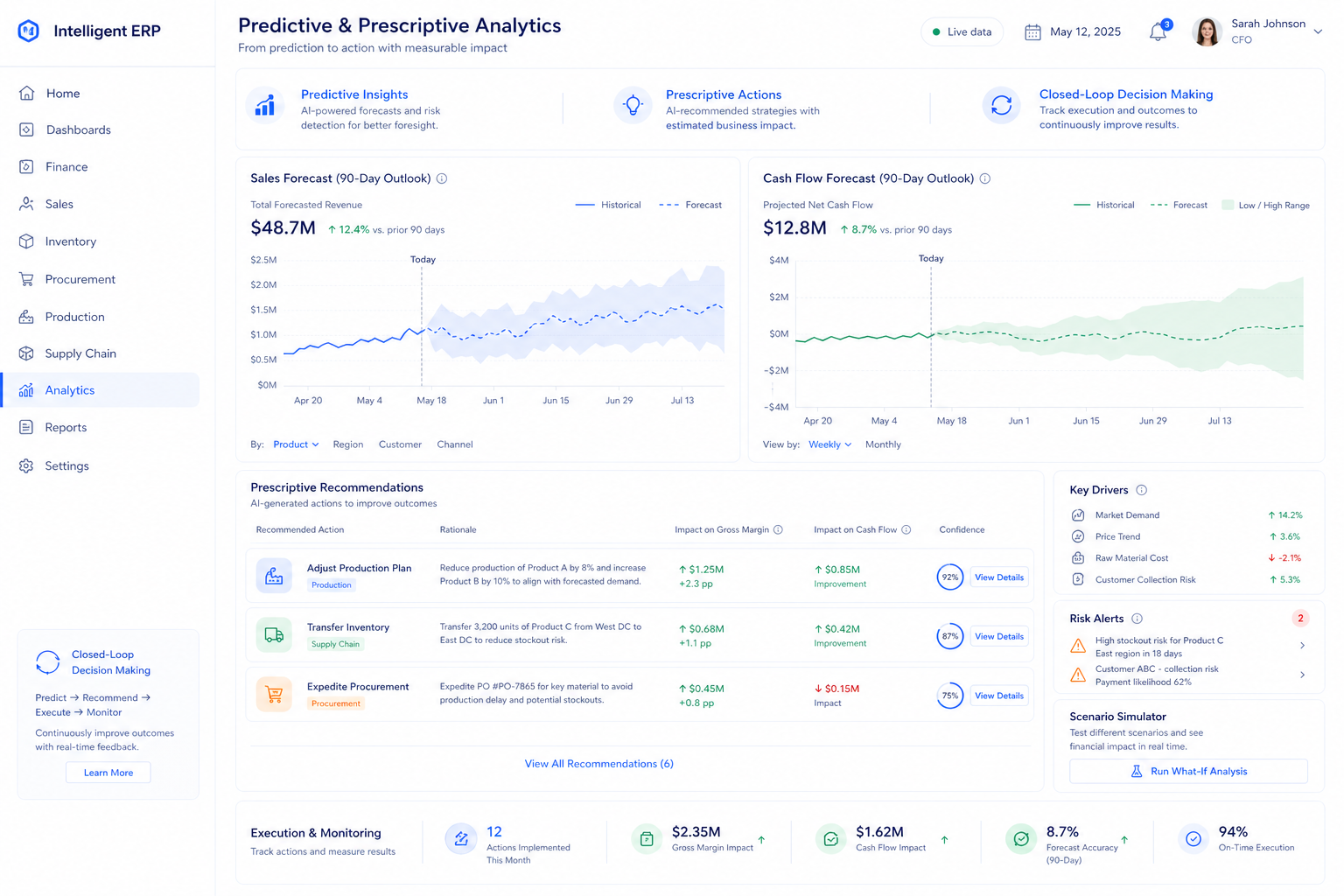
Predictive analytics enables foresight. The system generates high-accuracy sales forecasts by product, region, and customer dimension, incorporating historical sales data, market trends, and macroeconomic indicators. It also produces rolling 90-day cash flow forecasts by integrating collection probability with payment plans, supporting financing decisions.
Prescriptive analytics goes a step further. The value of prediction lies in guiding action. Intelligent ERP does not merely forecast stockout risks. It recommends specific strategies such as expediting procurement, transferring inventory, or advising the sales team to adjust delivery commitments. Each recommendation includes estimated impacts on gross margin and cash flow, creating a complete closed loop of prediction, recommendation, and execution.
The Future: The Autonomous Enterprise
As AI agent technology matures, ERP is moving from decision support to autonomous execution. The intelligent ERP of the future will automatically identify cash flow gaps and trigger financing processes. It will negotiate procurement terms autonomously with supplier systems. It will dynamically adjust inventory strategies in response to market fluctuations.
In this evolution, the role of human professionals shifts from process executors to strategy supervisors. Their focus moves to exception management, strategic planning, and cross-functional collaboration. ERP is no longer merely the enterprise recording system. It becomes the core engine that enables organizations to respond with agility to market changes.
Key Takeaways
The essence of intelligent ERP is a paradigm shift from recording to decision-making. Three core pillars, real-time data pipelines, financial and operational alignment, and intelligent procurement, collectively form the foundation for next-generation enterprise resource management. Measurable value is realized across four dimensions: inventory turnover, closing cycle, procurement cost, and forecast accuracy. The future points toward the autonomous enterprise, where humans focus on strategic oversight and systems assume greater execution responsibility.